
The Finitude of Life
MayaPersonal loss and evolutionary history make mortality both a universal biological fact and an intimate rupture that no scale of explanation can erase.
increasing Bearing strength in each event
 decreasing
Bearing strength in each eventdecreasingThe Child’s Discovery
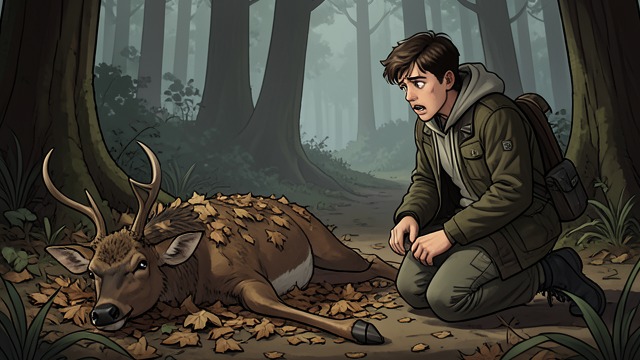
The Child’s Discovery
A body in the leaves
Frank finds a dead roe deer and realizes that death applies to animals like him. The discovery is physical and immediate, not a distant religious or philosophical idea.
Knowledge kept secret
His shame prevents him from seeking comfort, so the knowledge remains isolated in his mind. The episode shows how awareness of death can begin as a private shock long before it becomes a theory.
The Missing Branch
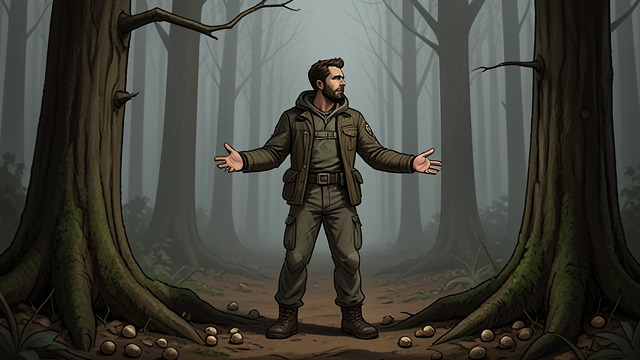
The Missing Branch
Ancestry without descendants
Frank imagines generations of organisms passing life forward and realizes that he has no children after Sonia’s death. His personal line appears to end where the evolutionary relay has continued for billions of years.
A particular loss
The idea that childlessness is disadvantageous in evolutionary terms does not explain the emotional force of his grief. Frank’s fear concerns not only the species’ continuation but the disappearance of his own relationships and future.
The Final Verse
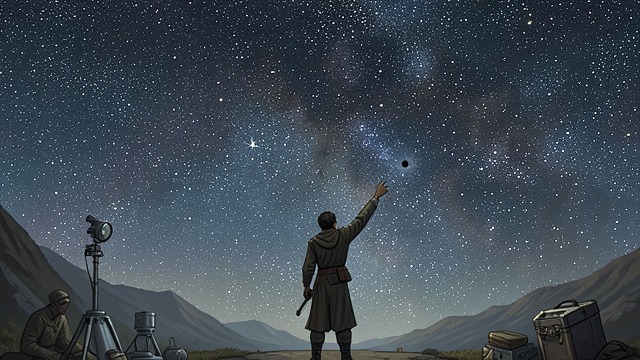
The Final Verse
A life measured in seconds
The final maxim compresses deep time and individual death into one contrast: a human being takes billions of years to create and seconds to die. It joins evolutionary wonder to personal vulnerability.
No easy consolation
The line does not claim that a long evolutionary past makes an individual loss small. It insists that the remarkable creation of a person and the suddenness of their death coexist without canceling one another.
A Funeral Reimagined
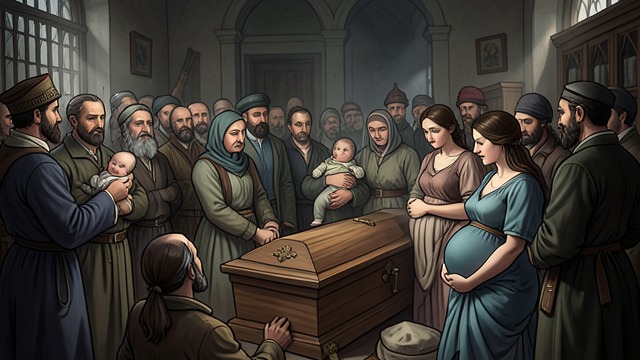
A Funeral Reimagined
Death anticipated
The earlier narrative leads Frank and the reader to approach a funeral as the completion of Ana’s life. The ceremony’s emotional force depends on the belief that an absence has become permanent.
Birth within the gathering
John’s later account places Ana alive at the Seville gathering, while Vera is visibly pregnant and a newborn is present. The contrast does not erase mortality; it exposes how easily a story about death can organize the reader’s expectations.
The Grief That Remains
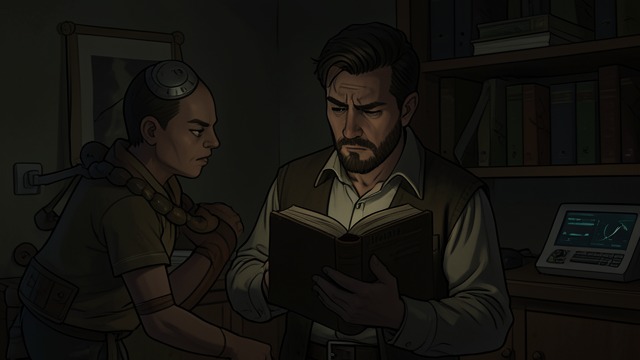
The Grief That Remains
No certainty beyond life
John admits that he cannot prove he will never meet Sheila again. The existence of the world already exceeds what he considers probable, leaving him open to possibilities he cannot establish.
Love as a continuing question
His uncertainty is not a settled doctrine of immortality. It is a form of hope shaped by bereavement: he wants to believe that a person’s disappearance from the visible world does not exhaust what that person means.
Before Frank moves to Madrid as a child
Frank’s first day on Taveuni
The closing card of the manifesto
At John’s account of the gathering in Seville
John’s final reflection in Croydon
