Animal Hierarchy and Alpha Leadership
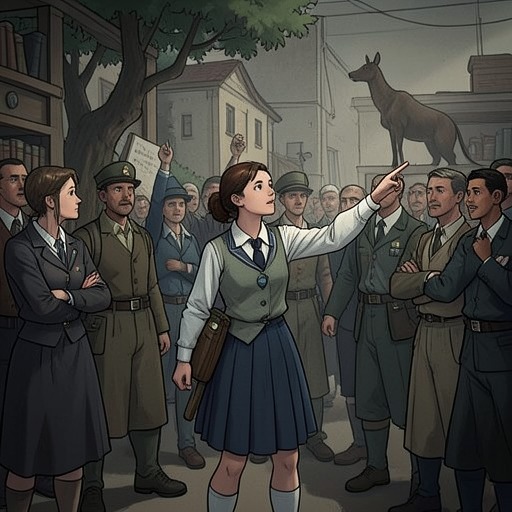
Mean GirlsAnimal Hierarchy and Alpha Leadership is the animal-behavior framework Cady Heron uses to make sense of social rank at North Shore High School. It explains the school’s cliques as territories governed by dominant figures, but its repeated use also exposes the limits of treating human social choices as instinct: Cady recognizes the pattern and still finds herself drawn into it.
Scientific Definition and School Setting
The concept first appears in an excerpt attributed to Cady’s mother, Betsy Heron, a PhD, from an article titled “Animal Hierarchies on the Savanna.” It defines hierarchy as an established group order shaped by survival factors: position in the food chain, access to resources, and the ability to thrive in unfavorable conditions. Dominant, or alpha, creatures maintain order, while a threat to their status can provoke aggression. The passage says such hierarchies have been observed among mammals, birds, and fish.
Cady’s first experience of the school cafeteria gives this framework a human setting. She sees the long tables as separate territories, each occupied by a particular group and apparently closed to newcomers. When a girl catches her eye and puts a bag on the empty seat beside her, Cady reads the gesture as a territorial boundary and moves on. The scene translates an abstract account of resource access into the concrete question of where a new student may sit.
Alpha Authority and Cady’s Choices
After Janis Ian asks Cady to join the Plastics, Cady admits that she is not entirely sure why she agrees. She does not want to disappoint Janis, who is her closest thing to a friend at North Shore, but she is also captivated by Regina’s authority. Cady compares Regina to an animal alpha whose presence makes others follow; she wonders whether Regina’s effect on people is like hardwired behavior and whether she herself might be susceptible to it. The metaphor therefore describes not only Regina’s position but Cady’s own vulnerability to its appeal.
At lunch, Regina stages a small contest for control by asking Cady to tell Aaron Samuels that his hair looks sexy pushed back. Cady imagines the animal-world answer as a predator’s attack on a rival, then distinguishes that imagined violence from the rules of “Girl World.” Instead of attacking Regina, she repeats the requested compliment flatly. The contrast shows how the animal analogy dramatizes an impulse that human social performance redirects into a controlled display.
Hierarchy as Rules and Performance
The hierarchy is not maintained by dominance alone; it is also reproduced through effort and norms. Gretchen Wieners insists that she has explained the high-school rules because that is what friends do, and describes maintaining the social structure as a job on which everything depends. Her account makes the system sound both deliberate and precarious: status requires continual performance, not simply an alpha’s presence.
Regina’s makeover of Cady gives that performance a visible form. She applies eye shadow and lip gloss, loads Cady’s hair with product, teaches her to brush her eyebrows, and selects a miniskirt, heels, a cashmere hoodie, and a rhinestone C necklace to echo Regina’s own R pendant. Walking the halls with the Plastics afterward, Cady feels famous, envied, and invincible. Other students imitate details of her style, while the attention around her makes belonging and visibility seem like rewards of adopting the group’s look. The animal model’s language of rank and access thus meets a distinctly human machinery of clothing, grooming, imitation, and spectatorship.
The Metaphor’s Limits and Reversal
When Cady’s position shifts, the alpha image becomes a warning as well as an explanation. She observes that the alpha lion is the first member of a pride whom a challenger targets. Although she did not expect to occupy Regina’s former role and is uncertain that she wants it, Cady decides she may as well enjoy being the group’s leader. The metaphor marks the danger inside her ascent: the position that offers power also makes its holder a target.
The book’s final school-year scene supplies a contrast to the fierce competition suggested by the hierarchy. After the Mathletes win the state championship, Kevin Gnapoor places a blue wool jacket with yellow sleeves over Cady’s shoulders. Wearing it and her championship medal, she feels like a normal high-school girl in a way she welcomes. The moment does not erase social groups, but it presents belonging through shared achievement rather than dominance over a rival. Across Cady’s movement from outsider to Plastic to Mathlete, animal hierarchy remains a sharp interpretive lens; the human story also shows that status can be performed, contested, and understood differently.