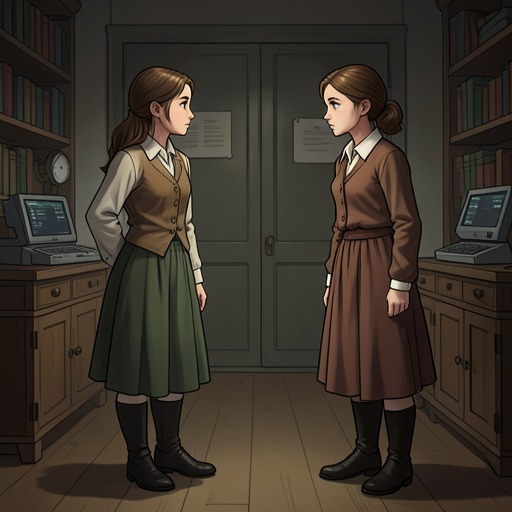
Cady’s house-party fallout
Mean GirlsCady Heron’s house party turns an attempt to perform her new social identity into a decisive break with Janis Ian and Damian. Cady invites Aaron Samuels while concealing the gathering from Janis, then admits that she pretended to be bad at math to get Aaron’s help. When Janis confronts her outside, Cady accuses her of having recruited her for revenge, and Janis rejects Cady’s claim that she is only pretending to be a Plastic. The party’s spectacle ends in a quieter, more intimate consequence: Janis gives Cady a prize-winning portrait of the earlier girl she remembers, leaving Cady alone with the possibility that her transformation has gone further than she admits.
Plans, Invitations, and a Hidden Audience
By this point, Cady is comfortable enough among the Plastics to consider taking over Regina George’s role as the group’s commanding figure. Her confidence carries beyond school: at dinner, she persuades her parents to let her stay home while they go to Madison. She gives them a different reason for staying, saying she has promised Janis she will attend Janis’s art show. The excuse is particularly revealing because the party she is planning will exclude Janis, even as Cady invokes their friendship to get permission.
Cady also invites Aaron in Calculus. She calls the gathering small, says Regina will not be there, and tells him he had better come. The invitation links the party to Cady’s interest in Aaron, while her assurance that Regina is excluded positions the gathering as separate from Regina’s influence. Yet Cady is already using the social habits she has acquired in the Plastics’ orbit: she manages what different people know and presents each of them with a version of the evening that serves her immediate purpose.
Janis does come, because she still believes that Cady is the unusual, recognizable girl she met early in the school year. That expectation sharpens the difference between Janis’s understanding of their relationship and Cady’s conduct. The party is not simply a private gathering that gets out of hand; it is a social scene in which Cady has chosen who may enter and who must remain outside.
The Party and Cady’s Performance
When Janis arrives, the house is already crowded and loud. Rap plays while guests drink from red Solo cups; tiny cups of Jell-O, understood as shots, sit on coffee tables and kitchen counters, and even on the back of a toilet tank downstairs. Janis looks for Cady through the hall and living room but initially cannot find her. The details establish a party on a scale Janis had not expected from Cady, with guests Cady herself did not know filling her parents’ home.
The party also carries the ordinary social complications of Cady’s new circle. Janis hears Gretchen Wieners calling out to Jason Mandrino, who is by the stereo looking through Cady’s parents’ music. He jokes about putting on “The Ramayala Monkey Chant!” His presence draws attention to Gretchen’s interest in him even as Janis searches for Cady, making the gathering a convergence of relationships rather than a celebration focused on one host.
When Cady finally appears, she has just come through a doorway after Janis hears a toilet flush, running water, and a clunk. Cady rubs her head, and her carefully styled hair is mussed. She wears a tight pink dress with black panels and a slim black necklace; Janis thinks the look is very Regina, while also acknowledging that Cady looks attractive. The description makes the change visible: Cady has not merely joined a group but adopted an appearance associated with its most powerful member.
In their conversation, Janis says she has spent too much time being angry at Regina and will not date anyone like her again. Cady answers that she would never lie to Janis. Then she admits that she did lie: she had pretended to be bad at math so Aaron would help her. Cady says she is actually bad at math’s opposite—she is good at it—and that she is now failing. She clarifies that she is not failing on purpose; she had wanted a reason to talk to Aaron. The confession exposes both the deception and its motive, while the claim that she is failing shows that the attempt to manufacture closeness has already had a consequence at school.
The exchange nearly turns into a kiss, but Aaron objects to the deception. As Cady, who has been drinking, tries to keep him there, Regina enters the bedroom in a shiny pink jacket and sees them together. Cady becomes visibly unwell and vomits on Aaron. This moment abruptly interrupts the flirtation and leaves the gathering’s private tensions exposed to Regina. The episode does not resolve into a romance between Cady and Aaron; instead, the admission and its immediate aftermath make clear how far Cady has gone in trying to reach him.
Janis’s Confrontation and the Rupture
The decisive confrontation takes place outside, when Janis and Damian arrive in Damian’s gray sedan. Janis rises through the open sunroof and calls Cady a liar. Cady starts to explain, then says she could not invite Janis because she had to pretend to be a Plastic. Janis rejects that distinction: she tells Cady that she is no longer pretending, describing her as cold, shiny, hard Plastic. Her accusation turns the party’s exclusion into a judgment about Cady’s identity.
Cady initially says all she wanted was real friends and for the boy she liked to like her back. Janis’s words trouble her because they give a name to the change she has been treating as a performance. Cady is not sure that Janis is wrong. That uncertainty matters: the confrontation is not only an argument between an accuser and someone who can dismiss the charge. It forces Cady to consider whether her new role has become real to her as well as to the people watching her.
Cady then strikes back. She accuses Janis of making her this way so she could use her for eighth-grade revenge, refusing to accept all the blame for what has happened. Janis answers that she and Regina at least know they are mean, and mocks Cady’s self-presentation as an innocent newcomer from Africa. The quarrel therefore reverses the alliance that once made Cady Janis’s trusted observer: each now presents the other as the person responsible for the harm between them.
Before leaving, Janis throws Cady a rolled-up canvas and tells her it won a prize. Damian revs the car, calls out for his pink shirt back, and the two drive away, leaving Cady alone. Once unrolled, the work is revealed as a colored-pencil-and-chalk sketch of Cady, Janis, and Damian. It depicts Cady as she looked earlier in the school year, in a plain T-shirt and ponytail, before her makeover and social transformation. The gift is both a final gesture of connection and a reminder of the person Janis believes Cady has abandoned.
Consequences and Significance
The party changes Cady’s relationships in different ways. With Janis, the break is explicit: Janis calls her a Plastic, answers Cady’s counteraccusation, and leaves with Damian rather than accepting Cady’s explanation. The portrait prevents the separation from becoming merely a dispute over who is mean. It preserves a specific image of their shared past and gives Cady a way to see how her appearance and conduct have changed.
With Aaron, the party brings Cady’s attraction into the open but also reveals that she engineered opportunities to speak with him. Her confession that she had feigned difficulty in math undermines her earlier assurance that she would not lie to him, and his response makes clear that the admission does not simply secure the closeness she wanted. Regina’s entrance and Cady’s illness further turn a planned romantic opportunity into an awkward public exposure.
The party also extends a pattern of social belonging built through invitation and exclusion. Earlier, Regina had invited Cady to sit at the Plastics’ table, making a place for her in a group whose rules could also be used to exclude someone. Now Cady exercises control over her own gathering, but her choice to keep Janis out helps destroy the friendship that had welcomed her before the Plastics did. The contrast shows how a role learned as a way into a group can shape the host’s actions even when she believes she is only pretending.
In the larger sequence of events, the party is a turning point rather than a contained mishap. Cady’s expanding influence and pleasure in performing as a Plastic coexist with the personal cost of that performance. The rupture with Janis and Damian makes that cost immediate; the sketch gives it a tangible form. Cady is left with the question of whether the girl in the portrait is merely an earlier version of herself or someone she still wants to be.