Jingle Bell Rock
Mean Girls“Jingle Bell Rock” is the song the Plastics perform at North Shore High School’s Christmas talent show. Its routine gives Cady Heron a conspicuous place at Regina George’s side: she is not merely watching the school’s social order but taking part in its choreography. When the performance falters, Cady begins singing, and the audience joins in; the recovery lets the group finish and gives Cady a brief, powerful sense that she belongs.
The song and the planned performance
Cady tells Janis Ian and Damian that she cannot meet that evening because she has to practice at Regina’s house for the talent show. Before she even identifies the number, Janis and Damian supply its name: “ ‘Jingle Bell Rock,’ ” a familiar annual performance that, as Janis remarks, is known throughout the English-speaking world. Their amused recognition contrasts with Cady’s surprise that they know it. To Cady, the routine is a particular commitment to Regina’s group; to them, it is a familiar school tradition.
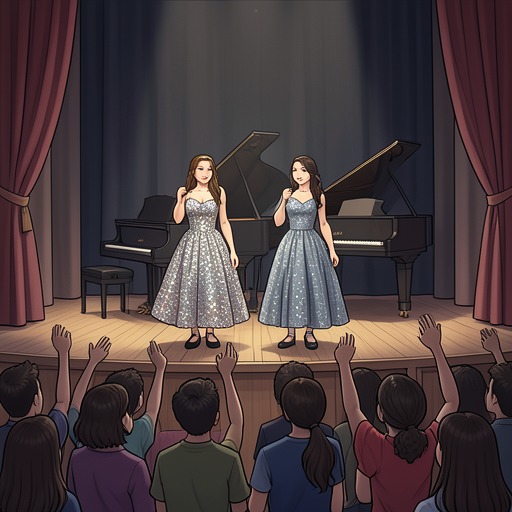
At the show, Mr. Duvall introduces the performers as Santa’s helpers doing the song. The curtains part to scattered applause. Cady tries to find her parents in the audience, but the stage lights make it difficult to see. Gretchen Wieners moves to the edge of the stage and starts the CD player, while Cady takes the practiced position with an elbow over Regina’s shoulder. The number has its cues, positions, and supporting equipment already in place: the CD player starts the music, and the dancers begin their steps together.
A role Cady both inhabits and questions
The performance makes Cady’s changing place in the Plastics visible. She is onstage beside Regina, copying the choreographed movements and participating in the group’s public image. But that alignment does not erase what she knows about Regina or what she intends to do. Cady hates Regina for being false, lying to her, and taking Aaron Samuels; she is also helping Janis and Damian with a plan against Regina. At the same time, Cady still wants Regina’s company and feels fortunate to have been chosen for her circle.
That contradiction becomes especially sharp during the dance. Cady knows she sent herself a candy gram, yet, while she stands at Regina’s side and imitates her steps, it becomes easy to believe that Regina sent it. The scene does not resolve Cady’s loyalty in favor of either friendship or opposition. Instead, the song gives her a moment in which the performed version of belonging feels persuasive, even as her knowledge of the deception and her plan remain intact.
The stage also marks how far Cady feels she has traveled from her previous life in Africa. She reflects that, a year earlier, she would have laughed at the idea that she would soon be dancing on this stage like someone in a music video. The contrast is not simply between two places: it measures the distance between the identity she once expected and the conspicuous school role she now occupies. She is dressed and positioned as part of the Plastics’ act, yet the experience registers for her as evidence that she has entered high school life rather than remaining outside it.
The faltering number and collective recovery
The performance nearly turns from spectacle into public failure. Cady feels fear from Regina, a response she had not thought Regina capable of showing. The danger is not only that Regina might go down: Cady recognizes that she is standing beside her and would fall with her. A moment that could have served as the revenge Janis, Damian, and Cady were waiting for instead places Cady’s own public standing at risk.
Cady responds by singing. Regina first looks at her in disbelief, and Cady is unsure whether she will have to finish alone. Then Aaron’s voice rises from the audience with the lyric, “To rock the night away!” Another girl joins him, and soon much of the audience is singing too. Ms. Norbury returns to her place at the piano; the room sways, claps, and sings along. With the audience’s participation and the piano’s return, the performers regain their footing and finish the dance together.
The recovery changes the scene’s social meaning without undoing its conflicts. The routine comes close to humiliating the performers before the student body and their families, but the audience’s response turns the exposed moment into a shared performance. Cady is exhilarated by having come so close to failure and then completing the number. The success belongs not just to the four dancers: the people watching help sustain the song, and Ms. Norbury’s return to the piano supports its continuation.
Belonging without reconciliation
The finish does not make Cady trust Regina or abandon her plans. She still compares trusting Regina to a gazelle trusting a lion to care for her calves. Yet the performance has made an emotional fact harder to dismiss: Cady wants to be near Regina and has begun to experience membership in her “little kingdom” as a kind of good fortune. The song holds these opposing responses together. Cady can understand the danger of Regina’s power and still feel drawn into its orbit.
When the lights dim enough for Cady to see the audience, she finds her parents at the front, to the left. They look surprised, happy, and somewhat relieved, having not seen the costumes or dance in advance. Their presence connects the unfamiliar public role Cady has taken on at school with the family life from which that role might seem distant. Her conclusion is larger than the completion of the dance: she has done it, and she feels that she is here, part of high school, like a regular person.
The number therefore functions as both performance and turning point in Cady’s experience of the Plastics. The steps let her publicly enact membership; the near-disaster exposes its risks; and the audience’s singing enables a successful ending without resolving the underlying rivalry. “Jingle Bell Rock” gives Cady a real sense of belonging, but the scene keeps that feeling in tension with the deception and opposition that continue after the music stops.