
Art as a Path to Recognition
Memoirs of a GeishaThis thread traces how Sayuri’s artistic training, her face as a subject for painting, and the discipline of performance help establish her public identity.
increasing Bearing strength in each event
 decreasing
Bearing strength in each eventdecreasingThe First Schoolroom
The First Schoolroom
Entering formal lessons
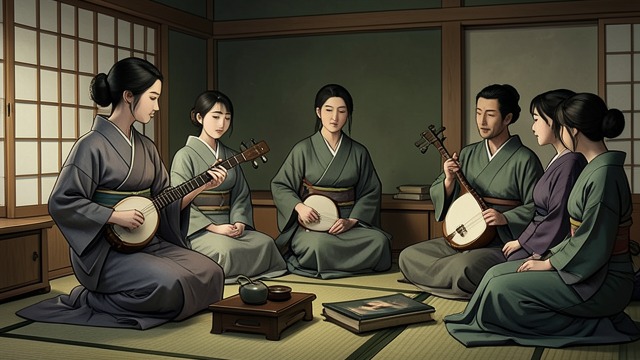
Chiyo begins attending lessons in music, dance, singing, and tea ceremony after a period of household labor. The school’s rules make artistic training inseparable from posture, speech, dress, and careful attention to rank.
Learning through observation
At first she watches Pumpkin struggle with shamisen and sees how demanding instruction can be. Chiyo also discovers that the school is a network of teachers and aspiring performers, where a girl’s prospects depend on consistency as much as on promise.
The lessons introduce a professional identity distinct from domestic service. Chiyo has not yet become a performer, but the school gives her the skills and vocabulary through which she can later build a place in Gion.
Dance as Emotional Language
Dance as Emotional Language
Technique and feeling
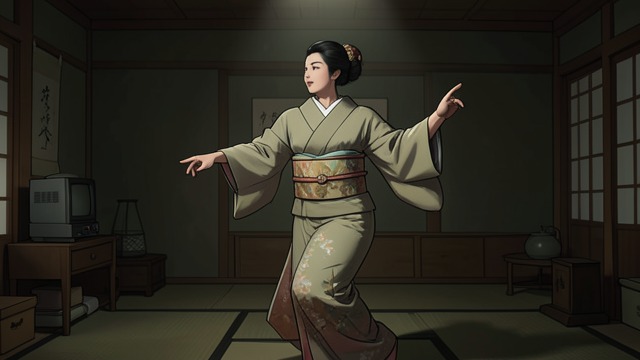
After returning to lessons, Chiyo must recover what she learned before her training was stopped. Mameha emphasizes dance as a central art and pushes her to understand how controlled movement can carry meaning even when the performer’s face remains composed.
A private method
Chiyo discovers that sadness gives her movements unusual weight and dignity. By imagining an audience and translating feeling into gestures, she begins to make technique expressive rather than mechanical.
This discovery turns difficulty into an artistic resource. Chiyo does not merely copy movements; she finds a way to use private longing as material for a public form, while still maintaining the discipline expected of a dancer.
Uchida Sees the Eyes
Uchida Sees the Eyes
A difficult introduction
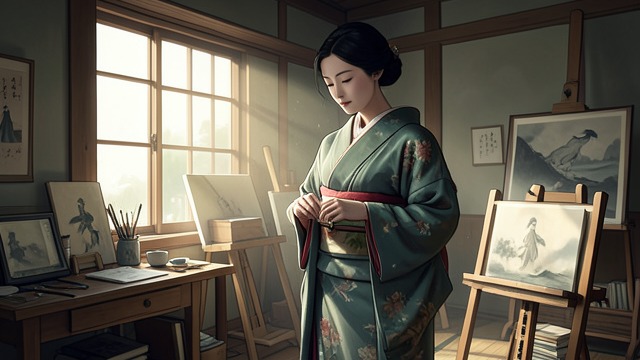
Mameha takes Sayuri to meet the painter Uchida Kosaburo, hoping that her unusual eyes will attract his artistic attention. Uchida is initially distracted by his disordered studio, his failed work, and a cat that has marked a drawing with paw prints.
An image takes form
As the visit ends, Sayuri looks at her hands in the sunset. Uchida, who had barely noticed her earlier, becomes absorbed in the sight of her face and eyes in the changing light.
The encounter later becomes connected to one of Uchida’s well-known images of a young woman. For Sayuri, the episode shows that artistic recognition may arrive unpredictably, through an unplanned moment rather than through deliberate performance.
The Poster and the Stage
The Poster and the Stage
A public image
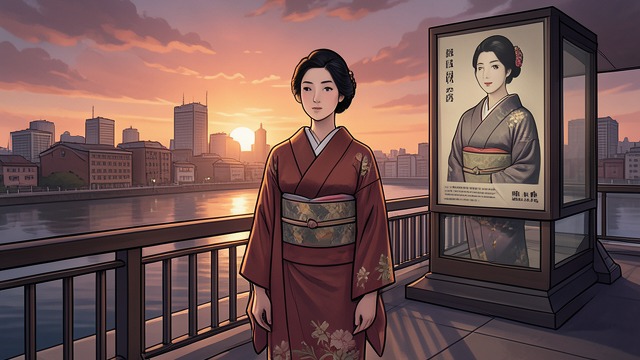
A poster for the seasonal dances depicts Sayuri in a kimono on a bridge, her blue-gray eyes prominent. Seeing her face reproduced across Kyoto unsettles her: she has become publicly recognizable, but that visibility also brings new scrutiny and envy.
Performance under pressure
Sayuri dances in the seasonal production after an injured apprentice leaves a role open. She draws on intense feeling, including the grief of Mameha’s dance, to perform with unusual concentration despite the demands of a first major stage appearance.
The poster and performance establish different forms of artistic recognition. One makes Sayuri an image for strangers; the other requires her to embody a story through disciplined movement before a live audience.
Art After Displacement
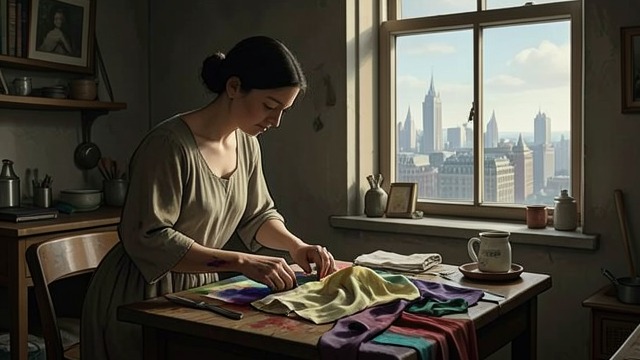
Art After Displacement
Work replaces performance
During the closure of the geisha districts, Sayuri leaves the stage and helps the Arashino family sew parachutes. After the war, she works with dyes and materials, and her hands become stained and damaged by the labor.
A former artist in ordinary life
The change is more than a new occupation: Sayuri no longer presents herself through elaborate kimono, makeup, and dance. Her work supports a household struggling with shortages, while her artistic training survives as memory rather than public practice.
Her return to Gion eventually restores some of that identity, but not the world in which it first flourished. The postwar years show that artistic accomplishment can endure inwardly even when the institutions that recognized it have been disrupted.
About a month after Chiyo arrives at the Nitta okiya
During Chiyo’s renewed training after Mameha takes her on
During Sayuri’s early apprenticeship, after her debut preparations begin
The spring dance season of 1935
During the postwar years at the Arashino residence and workshop
