1935 Dances of the Old Capital season
Memoirs of a GeishaThe 1935 Dances of the Old Capital season is a public turning point in Sayuri’s apprenticeship: she appears on the season’s poster, dances before an audience that includes the Chairman and Nobu, and discovers that the discipline of performance can carry her through even when private feeling overwhelms her. Its defining contrast is between the polished, collective spectacle of the stage and the inward grief that Sayuri absorbs from Mameha’s dance.
Poster and Public Recognition
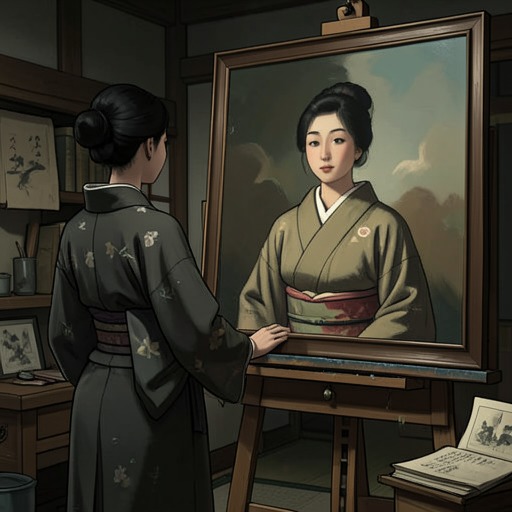
When Sayuri returns to Kyoto, she sees the new poster for that season’s Dances of the Old Capital in a glass case at Kyoto Station. The event is two weeks away; the poster had been distributed the previous day, while she was in Hakone. Each year’s production has a theme, and this year’s is “The Gleaming Light of the Morning Sun.” Uchida Kosaburo, who had created nearly every poster since 1919, depicts an apprentice in a green and orange kimono on an arched wooden bridge, gazing into the sunrise. Sayuri recognizes herself in the figure, especially in the startling blue-gray eyes.
The image quickly multiplies across Kyoto. Mr. Itchoda points out the posters along their route and asks the rickshaw driver to detour past a wall of them on the old Daimaru Department Store building. The citywide display makes Sayuri’s recognition difficult to separate from exposure: rather than feeling only the anticipated thrill of public honor, she thinks of the girl in the image as someone whose obi is being untied by an older man. The distinction matters because the poster celebrates her professional ascent while recalling the vulnerable body and intimate transactions implicated in her career.
The recognition also has a social cost. Sayuri expects congratulations, but learns that an honor does not arrive without consequences; after the posters appear, a young apprentice who had been friendly the previous week looks away instead of returning her bow. Public visibility marks her as successful, but it also sharpens rivalries and changes how peers receive her.
Opening Performance and Ensemble
On the first day of the season, the performances open at the Kaburenjo Theater. While putting on her makeup, Sayuri places the Chairman’s handkerchief beneath her dressing robe against her skin. Her hair is bound close to her head with a silk strip in preparation for wearing wigs. Seeing her face without its familiar frame of hair, she notices unfamiliar angles in her cheeks and around her eyes, and recognizes that even her own appearance is less fixed than she had imagined.
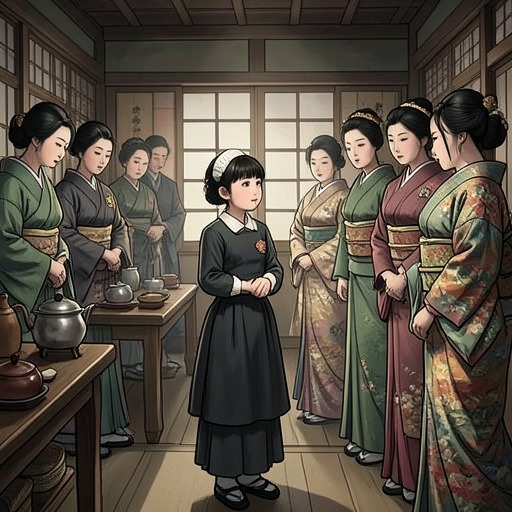
The opening dance puts the apprentices into a deliberately unified spectacle. Sayuri and the others wear identical yellow and red kimono with orange and gold obis, so that the group resembles shimmering images of sunlight. They enter together in a line, arms extended and folding fans open. The moment gives Sayuri a rare sense of belonging: she has not merely been placed beside a more established performer but feels herself part of a collective formation moving to the drums and shamisen.
Sayuri then changes for her solo, “The Morning Sun on the Waves.” The dance tells of a maiden who swims in the morning ocean and falls in love with an enchanted dolphin. Sayuri wears a pink kimono patterned with water and holds blue silk strips to suggest rippling water behind her. Umiyo plays the dolphin prince; other geisha embody wind, sunlight, and sprays of water, while apprentices in charcoal and blue kimono at the edges of the stage portray dolphins calling their prince back. The solo places Sayuri at the center of a carefully composed theatrical world, but the role depends on the coordinated presence of the surrounding cast.
Mameha’s Dance and Sayuri’s Response
Before her own entrance, Sayuri watches from a narrow, darkened corridor behind an orchestra booth, looking through slits in the sliding doors. She finds the Chairman and Nobu in the audience, then turns her attention to Mameha’s dance, “A Courtier Returns to His Wife.” Based on a Chinese poem, the story follows a courtier who conducts a long affair with a woman at the Imperial palace. His wife hides nearby to discover where he has been; by the time she sees him leave his mistress at dawn, she has fallen ill from the cold and dies soon afterward. For the spring production, the setting has been changed from China to Japan, while the central betrayal and death remain.
Mameha plays the wife and Kanako the courtier. Sayuri begins watching when the courtier bids farewell to his mistress. Against dawn light and the slow, heartbeat-like rhythm of the shamisen, he dances his thanks for the night and moves toward the rising sun to carry its warmth back to her. Mameha, hidden from the couple, begins the wife’s lament. The stage arrangement makes the betrayal visible to the audience while leaving the husband and mistress unaware of the grieving woman’s presence. Mameha’s dance, and the story it embodies, moves Sayuri so deeply that she feels the sorrow as though she herself had suffered the betrayal. When Mameha crosses toward a grove of trees for the death scene, Sayuri is too overcome to keep watching and must return backstage to prepare for her own entrance.
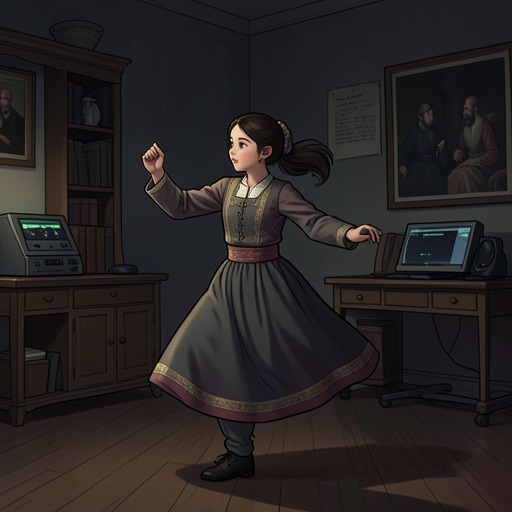
The feeling does not end when Sayuri leaves the viewing slit. Waiting in the wings, she experiences sadness as a physical weight pressing down on her. A dancer’s buttoned white socks may be worn small enough to reveal the seams in the wooden stage; in that moment, Sayuri feels the pressure so intensely that she imagines sensing even the fibers of the socks. She enters with folded fan, raised arms, and bent knees, but remembers little of the performance itself. What she does remember is the steadiness and evenness of her movements. Her mind seems to have shut down, yet the rehearsed dance proceeds without difficulty or nervousness.
Repetition, Technique, and Significance
For every performance during the rest of the month, Sayuri prepares in the same way: she concentrates on Mameha’s lament until she feels its sadness settle over her. Repetition turns a single overwhelming encounter into a practical part of her preparation. The grief does not become an abstract lesson or disappear; she deliberately summons it, using the emotional force of the earlier dance to enter her own role. In this way, Mameha’s performance continues within Sayuri’s, even though the two dances tell different stories.
The season’s movement from poster to ensemble, solo, and repeated performance charts the difference between being seen and learning to perform. Uchida’s image makes Sayuri recognizable across the city; the opening dance makes her one member of a disciplined group; the solo gives her a distinct role; and Mameha’s tragic dance reveals how performance can transmit feeling across the stage and into another performer. Sayuri’s reliable execution under emotional strain is not presented as freedom from feeling, but as technique capable of carrying her through it. The season therefore establishes her growing public stature while showing the intimate labor and emotional permeability on which that achievement depends.