Auntie
Memoirs of a GeishaAuntie is the limping, sharp-spoken caretaker of the Nitta okiya, and one of the few adults who combines a clear view of its harsh economics with personal concern for Chiyo and, later, Sayuri. She welcomes the child when her family leaves her behind, warns her about Hatsumomo’s capacity for harm, and returns to help restore the okiya after the war. Her place in the story is marked by practical acts of care: drying a child’s tears, refusing to beat her, carrying supplies, and steadying a drunken young woman who cannot explain herself.
Arrival at the Okiya
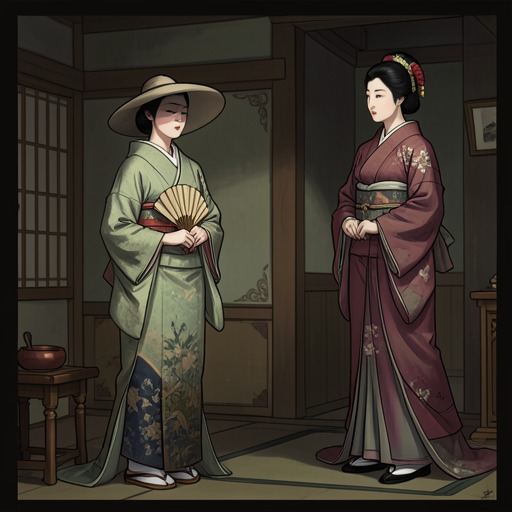
Auntie first appears behind Hatsumomo in the doorway as Chiyo is being brought to the Nitta okiya. Tall and knobby, she moves awkwardly because one hip juts out. After Hatsumomo’s ritual departure, Auntie takes charge of the sobbing child left in the entryway. She lets Chiyo cry for a long while, quiets a maid who comes to speak with her, then helps her stand and dries her face with a handkerchief from the sleeve of her plain gray kimono.
Her first reassurance is intentionally simple: she tells Chiyo that nobody is going to cook her and asks the girl to call her Auntie. When she notices Chiyo’s startling eyes, she says Mother will be thrilled. The exchange introduces a divided role: Auntie offers kindness to a frightened child, but the child is also being assessed for whether the household will keep her.
Auntie makes that uncertainty explicit after Chiyo has been washed in the courtyard and given a coarse, dark-blue cotton robe. She refuses to learn the child’s name yet, explaining that Mother and Granny had rejected the previous girl after only a month. The warning that it is better for Chiyo if they keep her shows that Auntie understands the okiya’s power over the girl’s immediate future. Her care is real, but it operates inside a household where acceptance is conditional.
Protecting Chiyo from the Okiya’s Conflicts
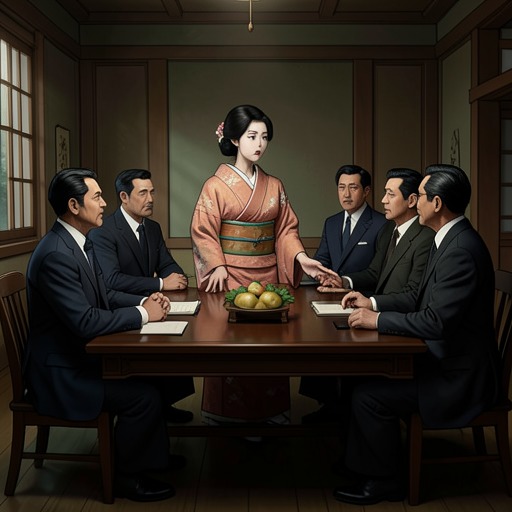
Auntie’s concern becomes clearest when Hatsumomo’s destruction of Mameha’s kimono leaves Chiyo threatened with punishment and the cost of the damage. Granny insists that Chiyo should be beaten and made to repay the kimono. Auntie volunteers to administer the beating herself, ostensibly to spare Granny’s joints, and leads Chiyo to the courtyard with a bamboo pole. Instead of striking her, she leans the pole against the storehouse and asks what Chiyo has done to make Hatsumomo determined to destroy her.
The feigned threat lets Auntie question Chiyo away from the immediate pressure of the household’s judgment. She does not accept Granny’s framing of the girl as simply deserving punishment; she wants to understand why Hatsumomo is targeting her. Her intervention does not remove the debt or the danger, but it gives Chiyo a rare adult who recognizes that the apparent offense is part of a wider conflict.
Auntie is equally direct about the material consequences. She tells Chiyo never to trust Hatsumomo, even if Hatsumomo seems to be helping, and explains that the kimono trick has burdened her with a debt so large she may never work it off. Her warning makes the okiya’s financial system legible to a child who does not yet understand what debt means. Auntie sees how Hatsumomo can turn a staged wrongdoing into an enduring economic burden, threatening not only Chiyo’s present safety but her ability to work toward a future in the profession.
Return and Restoration
Years later, after Chiyo has been living with the Arashinos during the war, Auntie comes to their door carrying coal in one hand and food in the other. Chiyo has written to Mother, though she cannot tell whether the letter prompted the okiya’s reopening or arrived when the decision was already forming. Auntie’s visit is the tangible sign that the household is preparing to resume life: she brings supplies to thank the Arashinos for caring for Chiyo, rather than arriving empty-handed to reclaim her.
The following day, Chiyo tearfully says farewell and returns to Gion. Auntie, Mother, and Sayuri begin putting the neglected okiya back in order. The work exposes how thoroughly war and absence have marked the house: dust lies over the woodwork, dead rodents remain in the well, and birds have torn apart the tatami in Mother’s room to make a nest in the alcove. The household can afford only a cook and one adult maid, so Mother works alongside the others. Auntie’s return places her among the people rebuilding the domestic setting that had first received Chiyo as a frightened nine-year-old.
Care in Sayuri’s Later Life
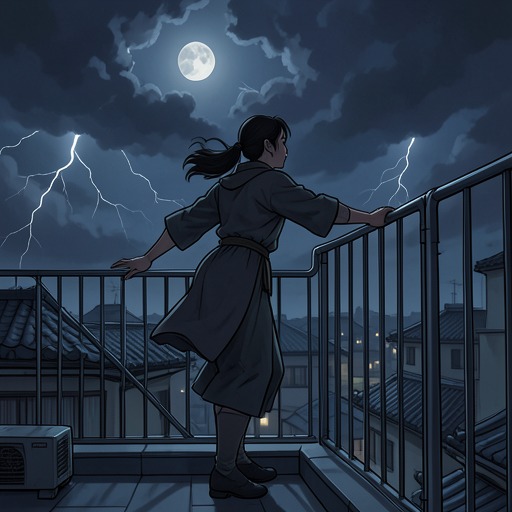
Auntie’s presence continues after the household has been restored. In a later episode, Sayuri, drunk and carrying a piece of concrete wrapped in silk, makes her way through Gion toward the okiya because she intends to take it to Nobu. Auntie has heard her stumbling and meets her in the upstairs hallway, asking why she is carrying a rock. When Sayuri cannot explain, Auntie does not demand an account before helping her.
Instead, she leads Sayuri into her room, dries her face, and touches up her makeup by the light of an electric lantern. Sayuri is so limp that Auntie has to support her chin; when her head keeps rolling, Auntie grips it with both hands to hold it still. She tells Sayuri she hopes never to see her act this way again, but accompanies that rebuke with close, practical attention. The scene echoes her first care for Chiyo: once again, the young woman is distressed and unable to manage alone, and Auntie responds by tending to what is immediately in front of her.
Across these episodes, Auntie’s authority is neither grand nor protective in any absolute sense. She cannot erase Chiyo’s debts, undo Hatsumomo’s hostility, or prevent the hardships that divide Sayuri’s life. Her importance lies instead in the moments when she recognizes vulnerability beneath a household’s judgment and answers it with concrete help. The bamboo pole she does not use, the food and coal she carries, and the hands that keep Sayuri’s head still define a steady, unsentimental form of loyalty.