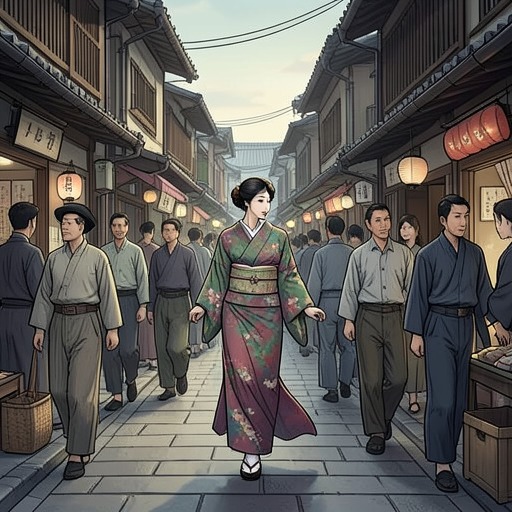
Baron Matsunaga Tsuneyoshi
Memoirs of a GeishaBaron Matsunaga Tsuneyoshi is Mameha’s wealthy danna and a man of formidable social and financial standing. His power appears both in the grandeur of his estate and in his casual expectation that women’s beauty is best appreciated without their clothing. Through him, Sayuri encounters the privileges and sexual assumptions surrounding elite patronage—and sees how easily a geisha may be treated as a replacement within it.
Identity and Background
Mameha identifies Baron Matsunaga as her danna when she tells Sayuri that he has returned to town and will come to lunch. The retrospective account places his wealth in a family history of political influence and financial power: his family controlled one of Japan’s large banks, and his older brother had inherited the title before being assassinated while serving as finance minister in Prime Minister Inukai’s cabinet.
The Baron, already in his thirties at the time of his brother’s death, inherited both the title and his brother’s holdings. Those holdings included a grand estate in Kyoto, not far from Gion. His business interests kept him in Tokyo much of the time; the account later reveals that he also maintained a mistress in Tokyo’s Akasaka geisha district. He could afford not one but two geisha mistresses, a detail that makes the reach of his money—and the transactional structure of his intimacy—plain.
Patronage and Private Life
The Baron’s relationship with Mameha is introduced through the preparations for his visit. At Mameha’s apartment, Sayuri sees a freshly made futon and a complete kimono ensemble laid out for her. The smooth, newly changed sheets puzzle her until she learns the Baron is coming for lunch; she then understands that the preparations are connected to Mameha’s afternoon with her danna. The scene conveys the practical arrangements surrounding patronage without making the Baron’s private conduct more explicit than Sayuri can infer.
His presence is also intermittent. Although he has an estate near Gion, business keeps him in Tokyo for much of his time, where he has another mistress. The contrast between the grandeur of his Kyoto household and his divided attention across two geisha districts underscores the scale of his resources. For the women connected to him, he is not simply a private companion: his wealth and invitations can shape access to influential company and prestigious occasions.
The Estate and the Party
On the afternoon of the gathering, Mameha and Sayuri arrive after the party is already under way, traveling by rickshaw to the Baron’s estate at the base of the hills in the northeast of the city. Sayuri has never visited a place so luxurious. The main house dates to the Baron’s grandfather, while the gardens were designed and built by his father. The estate’s carefully composed landscape gives visible form to the family’s inherited status: the Baron’s older brother had moved the pond and created a moss garden with stepping-stones leading from the moon-viewing pavilion. Black swans glide across the water as Sayuri takes in a setting whose cultivated detail seems almost overwhelming.
The tea ceremony begins not in an ordinary pavilion but aboard a boat at the pond’s edge. The narrow craft contains wooden seats and a miniature roofed pavilion with a tatami platform; a square cavity filled with sand serves as the brazier. Mameha lights charcoal and heats water in an iron kettle while Sayuri arranges the implements. The ceremony’s formal precision unfolds within a display of wealth and leisure, joining the disciplined artistry of geisha culture to the Baron’s private domain.
Conduct and Attitudes
At the gathering, the conversation turns to kimono after a man jokes that Sayuri should take off the robes because they are awkward. The Baron agrees, saying that he never understands why women wear kimono and that nothing is as beautiful as a woman without clothing. Nobu counters that this is not true when the kimono was made by his friend Arashino. The Baron insists that even Arashino’s robes cannot surpass what they cover, then spills his sake while trying to set down the cup.
The exchange makes his view of women explicit: clothing and craft may be admired, but in his judgment they remain secondary to the naked female body. His remarks are framed as party talk, with laughter and drinking around them, yet they expose the entitlement beneath his ease. The elaborate kimono and the tea ceremony represent trained skill and aesthetic form; his words reduce that form to something valued chiefly for what it conceals. His wealth gives such talk the weight of a social power, not merely a private preference.
Sayuri and the Invitation
Later, when the Baron discusses the annual gathering for viewing blossoms, he says that the blossoms are only an excuse for a party and expects the Chairman to attend, as he does every year. Sayuri is unsettled by the mention of the Chairman, whose presence has occupied her thoughts throughout the afternoon; she feels, briefly, as if her secret has been exposed.
The Baron then complains that no one will come and blames Mameha for speaking about matters she should have kept private. He announces a punishment: Mameha will no longer be invited to his party that year, and Sayuri must go in her place. Sayuri initially takes the decision as a joke, but immediately imagines how lovely it would be to walk through the estate with the Chairman without Nobu, Dr. Crab, or Mameha nearby. Mameha replies that Sayuri is busy with rehearsals. The invitation thus joins the Baron’s authority over his social circle to Sayuri’s private longing: he can remove one woman and name another, while the prospect awakens a hope that the gathering might bring Sayuri closer to the Chairman.