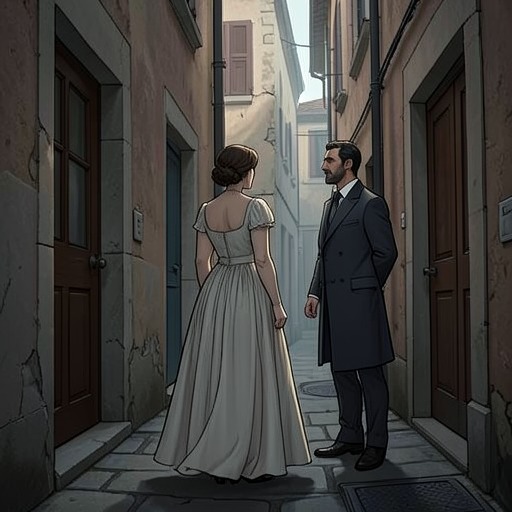
Chiyo and Mr. Tanaka
Memoirs of a GeishaChiyo and Mr. Tanaka are bound by a painful, consequential relationship: his decision to send her away from Yoroido causes the rupture she longs to undo, yet ultimately changes the direction of her life. A package and letter from him bring the news that destroys her hope of returning to her family, while her later reflection gives that same separation a more complicated meaning—as both loss and the beginning of a different future.
The package and the hope of release
More than six months after arriving in Gion, Chiyo receives a package whose return address identifies Mr. Tanaka. She has no idea what it contains, but seeing his name rekindles the hope that he has recognized his mistake in sending her to the okiya and has found some way to free her. She knows even as a child that she cannot imagine how a package could release her from what she calls slavery; nevertheless, she believes its opening may change her life forever.
Auntie, rather than Chiyo, takes charge of opening it. She cuts the twine, unwraps coarse paper and canvas sacking sewn with heavy thread, and frees an envelope bearing Chiyo’s name. Inside the dark wooden box, nestled in white linen, are the small mortuary tablets that once stood before the altar in Chiyo’s childhood home. Two are unfamiliar and newer than the others. The contents do not offer a way home: they carry the material traces of the family and place from which Chiyo has been separated, and make the package’s promise of rescue collapse into foreboding.
The letter and the family’s loss
The accompanying letter begins with an address to Chiyo and places its news in the span of time since her departure: two seasons have passed, and a new spring is near. Mr. Tanaka writes that he, too, was once an orphaned child, and offers an apology for the burden he must impose on her. He reports that Chiyo’s mother died six weeks after Chiyo left for Kyoto and that her father died a few weeks later. Their remains are enshrined in the village cemetery; services were held at Hoko-ji Temple in Senzuru, and women in Yoroido chanted sutras for them.
His letter also reports what became of Satsu. She passed through Yoroido late in the fall, then ran away again with the son of Mr. Sugi. Mr. Sugi hopes to see his son again and asks that Chiyo notify him if she hears from her sister. The request gives the news a further consequence: Satsu is not simply absent from Chiyo’s life but has disappeared into a separate, uncertain course, while Mr. Tanaka’s account offers no reunion or reassurance.
For Chiyo, the losses arrive together. Before Auntie has finished reading, she is weeping; learning of her mother’s death would already be terrible, as would learning of her father’s, but learning both at once and believing her sister lost to her leaves her mind like a broken vase that cannot stand. The package and letter thus turn her imagined rescue into confirmation that the family she has been waiting to return to is gone or beyond her reach.
The letter’s account of Chiyo’s future
Mr. Tanaka does not write only to report deaths and departures. He describes an apprentice geisha’s training as arduous, but says he admires those who can recast suffering and become great artists. He recalls visiting Gion, seeing the spring dances, and attending a party at a teahouse. From that experience, he takes satisfaction in the possibility that Chiyo has found a safe place in the world and will not have to endure years of uncertainty.
His image of the swan expresses the separation as a burden placed on those who are beautiful and talented: an exceptional child cannot remain in her parents’ tree without dying there, and must find her own way. The image offers Mr. Tanaka’s rationale for Chiyo’s departure, not an undoing of its cost. His sympathy and confidence in her potential sit beside the fact that his earlier decision has carried her away from her family before she could know what would happen to them.
Retrospective meaning and lasting contradiction
At sixty-five, Chiyo remembers Mr. Tanaka’s first appearance in her life as both its best and worst afternoon. The worstness is legible in the suffering that follows his decision and in the letter that closes off her hope of going home. The good, as she later explains it, lies not in the losses themselves but in the change of horizon his action set in motion. Without him, she imagines her life as a simple stream from her childhood home to the ocean; by sending her out into the world, he forced it to find another course.
That later judgment does not erase the younger Chiyo’s attachment to home. When the letter arrives, she has spent over half a year in Gion while still believing she might find a better life elsewhere with at least part of her family. She describes herself as living only half in Gion, the other half in dreams of going home. After the news, spring and summer blur into misery and fear; on a winter evening she watches snow fall into the okiya courtyard and imagines her sick father at their lonely table and her frail mother on her futon. Her attempt to flee into the courtyard cannot free her from grief.
The relationship’s significance therefore rests in a lasting contradiction rather than reconciliation. Mr. Tanaka is the person whose decision takes Chiyo from the world she knows, and the person whose letter makes the finality of that departure unmistakable. Yet Chiyo’s older account also credits that displacement with changing her possibilities. The life he set in motion brings suffering and separation, but it cannot be reduced to them: the route away from home becomes the route into a world she would otherwise never have entered.