Chiyo and Satsu’s escape plan and Chiyo’s failed rooftop escape
Memoirs of a GeishaChiyo and Satsu’s escape plan and Chiyo’s failed rooftop escape mark the point at which a shared hope of flight becomes a solitary, disastrous attempt. After Hatsumomo discovers that Chiyo has sought out her sister and planned to run away, the okiya tightens its control: its door is locked, Chiyo is watched, and the escape route she imagines leads across the roof. The fall breaks her arm and, in Auntie’s judgment, ends her prospects as a geisha. At the same time, Chiyo learns that Satsu has escaped without her, turning a failed reunion into a separation that shapes what follows.
The Plan Exposed and the Okiya Locked
The plan begins to unravel when Hatsumomo confronts Chiyo about her absence. Chiyo had been sent out to deliver Hatsumomo’s shamisen, but more than an hour has passed; Hatsumomo knows that Chiyo went to find her sister and made plans to escape. She accuses Chiyo of returning to spy on her, while Chiyo tries to placate her, insisting she will do whatever Hatsumomo wants because she does not want trouble with Mother. The exchange makes clear that Chiyo’s errand has placed her under suspicion, and that Hatsumomo can turn knowledge of the attempted escape into leverage.
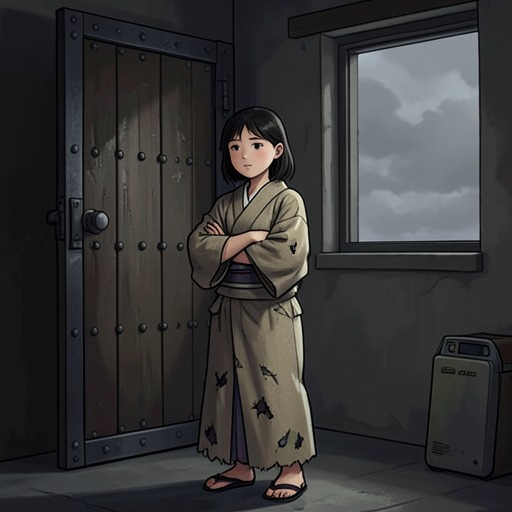
The next day, Mother punishes the maids by denying them dried fish for six weeks because they had tolerated Hatsumomo’s boyfriend in the okiya. Pumpkin cries when she hears the order, while Chiyo becomes an easy target for the household’s anger. Mother is willing to add the cost of an emerald obi brooch Chiyo never saw or touched to her debt, though Chiyo doubts Mother truly believes she stole it. The more consequential accusation is that Chiyo left the okiya without permission: Yoko confirms it, and Mother orders the front door locked. Auntie keeps the only key around her neck even while sleeping, and Pumpkin takes over Chiyo’s former evening post by the entrance, where she must wake Auntie to let Hatsumomo in. The household turns the ordinary routines of access and supervision into barriers to escape.
Chiyo spends each night searching for a way out, but by the Monday before the sisters’ planned flight she has found none. Her despair drains energy from her chores. While she is supposed to be washing the maids’ floor, water squeezed from her rag runs toward a back corner rather than toward the doorway. The apparent reversal of its course suggests a route in her imagination: up the stairs, to the second-floor landing, up a ladder, through a trapdoor, and onto the roof beside the gravity-feed tank. She does not know how she would descend from the roof or reach the street, but the idea offers a chance to get out of the locked house.
A Nighttime Route Across the Roofs
On the evening of the planned escape, Chiyo pretends to fall asleep while waiting for the okiya to settle. Her thoughts turn to her parents and to the prospect of seeing them again; she also watches Granny prepare for bed and imagines the suffering that might have made Granny cruel. That moment of recognition sharpens Chiyo’s fear of the life ahead of her in Gion. She still expects Satsu to know what to do, and the thought that her sister will be waiting sustains her when she is unsure whether she can survive outside.
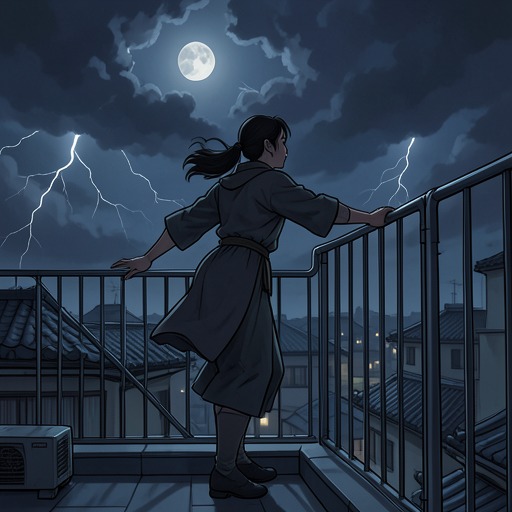
Chiyo waits until the maids are snoring and Pumpkin appears drowsy at her post. She listens outside Mother’s room, then peeks in and sees Mother asleep with her dog, Taku, between her feet. Changing clothes in the upstairs hallway, she takes the shoes used in the toilet because the better wooden shoes are inaccessible while Pumpkin guards the entrance. They are poor shoes, much too large for her, but she will not attempt the escape barefoot. After silently closing the trapdoor behind her, she hides her sleeping robe under the gravity-feed tank and climbs onto the roof ridge with the shoes in her hands.
The journey over the roof is slow and precarious. Thick tiles overlap like small steps and clank if she shifts her weight too quickly; each sound seems to echo across the nearby roofs. Chiyo crosses to the lower roof of the neighboring building and searches for a way down. She eventually finds an open courtyard near the end of the block and thinks she can reach a bath shed by following the gutter, then descend into the courtyard. She recognizes the risk of entering another household: the building may be an okiya, someone may seize her, and its front door may be locked too. But with no safer route in sight, she chooses the descent, unaware that the decision will damage the future she is trying to escape.
When Chiyo swings herself over the ridge, the slope proves too steep to climb back up. Her wrists can hook over the roof, but the oversized toilet shoes keep her from gripping it properly. She begins sliding, briefly hoping she can stop at the outward curve of the eaves. A loose tile clatters into the courtyard and shatters; then one of her shoes slips away, landing below with a soft plop. Footsteps approach along a wooden walkway. Thinking of flies clinging to walls, Chiyo tries to hold herself against the roof with her toes, elbows, knees, and finally her palms. Her hands do not slow her; she accelerates, hears herself skid, and suddenly loses the roof beneath her.
The Fall and Its Immediate Cost
As she falls, Chiyo imagines a woman in the courtyard noticing the broken tile and looking up just in time to see her drop. She lands on her side rather than on anyone, raising an arm to protect her head, but the impact leaves her dazed. Two women kneel over her on the moss and lift her onto the wooden walkway. One calls out, in astonishment, that it is raining little girls. Chiyo is too stunned and hurt to get up, and her thoughts are fixed on Satsu waiting opposite the Minamiza Theater—on the promise she will now be unable to keep.
A maid is sent up the street to identify where Chiyo came from. While Chiyo curls up in shock and clutches her painful arm, Auntie finds her, pulls her to her feet, and slaps her. Auntie drags her back to the okiya and strikes her again at its wooden door. In the courtyard she throws Chiyo onto the walkway, pours water over her robe so the rod will sting more, and beats her. Auntie declares that Chiyo will never be a geisha and that neither she nor anyone else can help her now. The attempted escape has become not merely a failed journey but an occasion for the household to enforce its authority through violence. Granny’s beating of Pumpkin for failing to watch Chiyo adds a further consequence: the punishment spreads to the girl left behind at the door.
Chiyo has broken her arm in the fall. The next morning a doctor takes her to a nearby clinic; she returns to the okiya late in the afternoon with her arm in a plaster cast and still in severe pain. Mother calls her into her room and asks how much she thinks Mother paid for her. Chiyo does not care whether Mother strikes her for her answer. Mother says she paid seventy-five yen, then itemizes the debts she will charge to Chiyo: the ruined kimono, the stolen brooch she has been accused of taking, the medical expenses for her broken arm, and the cost of her meals and lessons. She adds a debt associated with Satsu’s escape: the mistress of the Tatsuyo in Miyagawa-cho has not paid what she owes Mother for Chiyo’s older sister and now says she will not pay. Mother concludes that Chiyo already owes more than she can ever repay, even though a successful geisha might have paid the debt over ten or fifteen years. In the wake of the fall, injury is not treated as a reason to relieve Chiyo’s obligations; it becomes another charge against her.
Separation and Lasting Reversal
The escape’s outcome is divided sharply between the sisters. Mother’s news confirms that Satsu has run away. Chiyo has spent the day wondering whether her sister got free, and now knows that she did; she wants to feel happy for Satsu but cannot, because her own failed attempt has left her injured, indebted, and confined. Their arrangement to meet opposite the Minamiza Theater has collapsed: Satsu will wait in vain, while Chiyo is returned to the okiya and learns that the way out has closed behind her.
Auntie’s declaration that Chiyo will never be a geisha gives the accident an apparent finality, but Mother’s calculation reveals a different trap. Chiyo’s future is discussed in the language of investment and repayment: she might have repaid her debts through years of successful work, but the escape attempt now makes her seem unworthy of further investment. The sequence therefore binds bodily harm to economic control. The cast records an injury caused by the roof, while the added medical expense and accumulating obligations make that injury part of the okiya’s account against her.
The roof crossing also reverses the promise that first animated Chiyo’s plan. She has mistaken a narrow possibility of movement for a real passage to freedom: water running toward a corner leads her to imagine a route upward, but the route across the roofs ends in a fall into another household’s courtyard. The episode’s suspense comes from the gap between a child’s limited knowledge and the stakes she cannot yet see. Chiyo thinks she is undertaking an adventure and does not understand what the escape will cost her; afterward, the broken arm, the locked okiya, and Satsu’s absence make that cost concrete. What she gains is not reunion, but the knowledge that Satsu got away—and that Chiyo remains behind to face the debt and punishment alone.