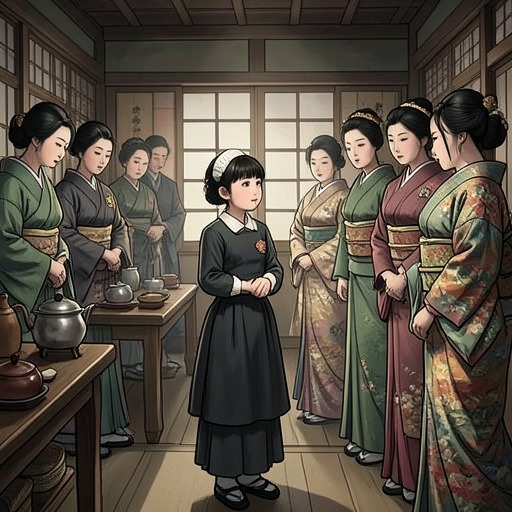
Chiyo becomes Mameha’s younger sister and debuts as Sayuri
Memoirs of a GeishaChiyo becomes Mameha’s younger sister and debuts as Sayuri in a ceremony that converts private ambition into a recognized place within Gion’s geisha world. The change is marked by formal dress, a visit to the Gion Shrine, shared sake at the Ichiriki Teahouse, and a new name; its emotional cost appears just as clearly in Chiyo’s fear that Sayuri has displaced the girl she used to be.
Preparation and Transformation
The day of the ceremony begins with Chiyo bathing and spending the morning dressing. Auntie helps finish her makeup and hair. The layers of wax and makeup leave Chiyo with so little sensation in her face that touching her cheek produces only a vague sense of pressure; she repeatedly checks it, and Auntie has to redo her makeup. In the mirror, Chiyo recognizes both the person kneeling at the makeup stand and the unfamiliar geisha looking back. Her white face, red lips, softly tinted cheeks, silk flowers, and sprigs of unhusked rice make the transformation visible, but the mirror does not make it feel simple.
Her formal black kimono bears the crest of the Nitta okiya. An embroidered dragon rises from its hem to the middle of her thigh, its mane rendered in reddish lacquered threads, its claws and teeth in silver, and its eyes in real gold. The elaborate garment gives the occasion a public and institutional character: Chiyo is not merely putting on a costume, but appearing in the house’s formal colors and crest as she enters a new role. Before leaving the okiya, she tucks into her obi the handkerchief the Chairman gave her, carrying a personal token into the rite as a good-luck charm.
The Sister-Binding Ceremony
Auntie accompanies Chiyo to Mameha’s apartment, where Chiyo expresses her gratitude and pledges to honor and respect her. The two, with Auntie, then go to the Gion Shrine. There Chiyo and Mameha clap their hands and announce to the gods that they will soon be bound as sisters. Chiyo prays for favor in the years ahead and gives thanks for having received the wish she had pleaded for three and a half years earlier: to become a geisha. The ceremony therefore joins a new personal bond to the fulfillment of a long-held aim.
The binding itself takes place at the Ichiriki Teahouse, a prominent establishment on Shijo Avenue. Its entrance and apricot-colored wall make it conspicuous among Gion’s first-class teahouses, and its history includes the leader of the Forty-seven Ronin hiding there while plotting revenge. Inside, the participants pass through a meandering corridor to a small tatami room. The space retains the dusty fragrance of kuroyaki, the traditional charcoal-based scent worn by generations of geisha. That smell becomes a lasting link for Chiyo: even later, she keeps some in a wooden vial, and its scent recalls her return to the room.
The mistress of the Ichiriki attends the brief rite. A maid brings several sake cups; Chiyo drinks three sips from a cup, passes it to Mameha, and Mameha drinks three sips in turn. They repeat the exchange with three cups. The ceremony lasts about ten minutes, but its result is decisive: from then on, Chiyo is no longer known by her childhood name. She becomes the novice geisha Sayuri, Mameha’s younger sister and apprentice.
A Name and Its Cost
Mameha has worked with her fortune-teller for a long time to select the new name. Its choice depends not only on sound but also on the meaning of its characters and the number of strokes, which can be considered lucky or unlucky. Sayuri combines “sa,” meaning together, “yu,” taken from the zodiac sign for the Hen to balance other elements in Chiyo’s personality, and “ri,” meaning understanding. Combinations that incorporated an element from Mameha’s own name had been judged inauspicious. The name is thus deliberately chosen, but it does not simply absorb the older sister’s identity: it marks Chiyo’s own place in the relationship.
The name feels lovely to Chiyo and strange at the same time. After the ceremony, the group moves to another room for red rice, made with rice and red beans, but Chiyo picks at the meal and feels unsettled rather than celebratory. When the mistress addresses her as Sayuri, Chiyo understands what troubles her: it feels as though the barefoot girl named Chiyo, running from the pond to her tipsy house, no longer exists. The emotional turn complicates the ceremony’s apparent success. The old wish has come true, yet becoming Sayuri means imagining that the child who wished for it has been destroyed.
Learning to Appear as Sayuri
The rite makes Chiyo Mameha’s younger sister, but it does not instantly make her a practiced geisha. During the first month of apprenticeship, Sayuri is a novice who cannot dance or entertain by herself; she must be accompanied by Mameha and is expected mainly to watch and learn. The new status therefore combines recognition with restriction: Sayuri has crossed a threshold, but her public work remains under her older sister’s guidance.
Mameha intends to spend the early afternoon introducing Sayuri to mistresses of teahouses and okiya with whom she has relationships. Before those introductions, she tests her apprentice’s manners. She asks Sayuri to kneel, then makes her repeat the movement because the robes are awkward. Mameha gives her a small gourd ornament to hang from her obi; because it is hollow and light, it is thought to counterbalance the heaviness of the body and help clumsy apprentices avoid falling. She also asks Sayuri to pretend to pour tea from an empty pot so she can assess how Sayuri holds her sleeve. Sayuri’s first attempt exposes the underside of her arm too conspicuously. After several more tries, Mameha teaches her a more demure method, and they are ready to go out.
The introductions turn the sisterhood into a public network. In tall wooden okobo, which Sayuri finds difficult to walk in, the pair make around twenty visits to teahouses and okiya, usually staying only a few minutes. At each door, Mameha asks to speak with the mistress and introduces her new younger sister; Sayuri bows low and asks for the mistress’s favor. They visit the fifteen or sixteen teahouses where Mameha regularly entertains, as well as selected okiya connected to her. Sayuri is exhausted within an hour, but the rounds establish her name and face among the people who will shape her working life. By shortly after three, the introductions are finished; there is no long rest, because Mameha has arranged Sayuri’s first engagement that evening.
Material Signs and Lasting Consequences
The ceremony’s transformation depends on costly objects and practiced labor as well as ritual. The kimono Sayuri wears is part of a world in which garments are carefully handled and preserved. Elsewhere, a storehouse of red lacquered cases holds kimono wrapped in linen paper, some cases containing about fifteen robes; the collection is described as worth roughly twice the combined value of Yoroido and Senzuru. This material scale helps explain why formal dress signifies more than beauty: garments embody wealth, labor, and the resources through which a geisha’s standing is made visible.
The care required to dress also illuminates the work hidden beneath the finished appearance. An obi can be nearly as wide as a woman’s shoulders and twice as long as a man is tall. Its support requires several cords and clasps, padding to shape the knot, and minutes of careful tying; the dresser Mr. Bekku finishes with scarcely a wrinkle in the heavy fabric. In Sayuri’s ceremonial outfit, the polished result similarly depends on assistance from Auntie and on the discipline Mameha begins teaching her. The new identity is publicly hers, but it is constructed through other people’s knowledge and continued instruction.
The later life of objects associated with the ceremony underscores the contrast between abundance and scarcity. Years afterward, wartime bans on cosmetics and permanents, and the near absence of lavish gifts, leave Sayuri with only a modest set of possessions: scrolls, inkstones, bowls, stereoscopic photographs, and a sterling-silver viewer given by the Kabuki actor Onoe Yoegoro XVII. During the war she lives with the Arashino family, works sewing parachutes, and sees Mr. Arashino sell kimono when the household needs money for food. The elaborate clothing and treasured objects that once made professional identity visible now belong to a world of dwindling resources. Against that later disruption, the short sister-binding ceremony stands as the moment when Chiyo is formally named and equipped to begin her life as Sayuri, even as she remains conscious of what the new name seems to leave behind.