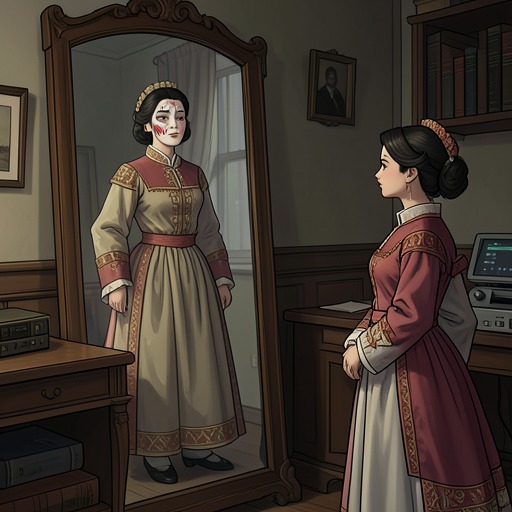
Geisha older-sister system
Memoirs of a GeishaThe Geisha older-sister system is the formal and practical bond through which an established geisha guides an apprentice toward a place in Gion. Sealed by a ceremony compared to a wedding, it turns professional instruction into a family-like relationship: the younger woman learns her trade, enters the senior woman’s social network, and becomes answerable to her. The arrangement can help an apprentice attract patrons and repay her debts, but it also distributes the benefits of her success across the commercial world that sustains Gion.
Eligibility and Kinship
A girl preparing to debut as an apprentice needs an older sister: a more experienced geisha who can stand beside her as she enters professional life. The required seniority is surprisingly slight. The older sister need have been a geisha only one day longer than the girl she trains, so the title does not necessarily imply a great age difference or a long-established teacher. The example of Hatsumomo’s older sister, the celebrated Tomi-hatsu, who was already an old woman when she trained her, represents one possible arrangement rather than a rule.
The bond is established in a ceremony that resembles a wedding. Afterward, the women address one another as older sister and younger sister, in the language of a family relationship, and are expected to regard each other as nearly family. The ceremonial form gives professional apprenticeship a durable personal structure: the connection is not merely a series of lessons but a relationship that organizes the younger woman’s entry into the community.
The novel presents the ideal of the bond in demanding terms. Some geisha may not take the role as seriously as they should, but a conscientious older sister becomes the most important figure in a young geisha’s life. Her duties extend well beyond correcting technique. She teaches the social poise required to meet customers, including how to combine embarrassment and laughter when a man tells a naughty joke, and helps her younger sister choose the appropriate grade of wax for her makeup. Practical knowledge and public conduct are taught together, because success depends on performing the profession as well as learning its crafts.
Training and Introduction to Gion
An older sister must make her apprentice visible to the people and businesses on which a working geisha depends. During the day, she takes the younger woman around Gion and presents her to the mistresses of appropriate teahouses, the wigmaker who serves stage performers, chefs at important restaurants, and other professional contacts. These introductions establish more than acquaintance: they give the apprentice access to the network through which she can be recognized, invited, and eventually employed.
The work continues after sunset, when Gion comes into its fullest life. The older sister takes her apprentice along to entertain and introduces her to customers and patrons she has known for years. She asks them to remember the newcomer’s name and invites them to summon her on a future visit. A fourteen-year-old apprentice may not yet be the person a customer is willing to pay to spend an evening with; nevertheless, her sister and the teahouse mistress continue to present her. If the customer likes her, he may in time become her patron and grow fond of her as he is of the older sister. Thus the relationship creates a gradual passage from being introduced to being chosen.
This work helps produce the public identity on which the apprentice’s career depends. The older sister’s introductions connect lessons in deportment and appearance to actual rooms, customers, and professional gatekeepers. Her responsibility is therefore both educational and representative: the younger woman does not enter Gion alone but is shown to the community under the standing of someone already known there.
Shared Risks and Economic Interests
The older sister’s obligation can be burdensome. The younger girl is described as dependent on her as a passenger is on the train she rides, and misbehavior by the apprentice reflects on the woman training her. The senior geisha must therefore invest labor and reputation without complete control over how the younger woman will act. The bond offers influence and opportunity, but it also makes the older sister answerable for the conduct of someone still learning her place.
At the same time, the arrangement is sustained by shared material interests. The apprentice benefits if she can pay off her accumulated debts over time and, if fortunate, become the mistress of a wealthy man. The older sister receives a portion of the apprentice’s fees, as do the mistresses of the teahouses where she entertains. Other businesses may not take a direct share, but successful apprentices bring customers into Gion, benefiting the wigmaker, the hair-ornament shop, and the sweets shop from which the young geisha buys gifts for patrons. The system makes mentorship one part of a broader circuit of work, patronage, and spending.
The older sister’s investment is therefore not reducible to affection, nor is the familial language merely ornamental. Personal closeness and economic exchange operate together: the apprentice is taught and promoted by a woman whose own reputation and income can benefit from her success. Gion as a whole also has a stake in making newcomers successful, because an apprentice who attracts patrons brings business to the interconnected establishments around her.
Choosing an Older Sister
The importance of the bond does not mean that the apprentice freely chooses its terms. A girl has little say in who becomes her older sister. An established geisha must protect her reputation and will not readily take on a younger woman she considers dull or one she doubts her patrons will like. Yet the mistress of an okiya that has invested heavily in an apprentice’s training cannot simply wait and hope that a suitable geisha volunteers. Successful older sisters consequently receive more requests than they can accept: some girls can be turned away, while other requests are harder to refuse.
That imbalance is crucial to the case of Chiyo. Mother may have expected Hatsumomo to train her, and Hatsumomo had already acted as older sister to at least two well-known young geisha. With those girls, she had behaved properly because she chose the relationships and expected to earn money from them. Chiyo’s situation was different. Although Mother could have compelled Hatsumomo to take her—Hatsumomo lived in the same okiya and depended on its collection of kimono—such compulsion could not guarantee real instruction or support. Chiyo understood that the role required sustained goodwill that authority alone could not produce.
The contrast between Hatsumomo’s successful earlier mentorships and her hostility toward Chiyo exposes the gap between the system’s formal structure and its actual quality. The same woman could fulfill the role when it suited her and become a threat when assigned a girl she resented. The account pointedly imagines that, if ordered to take Chiyo to the Mizuki Teahouse to meet its mistress, Hatsumomo might instead have taken her to the Kamo River and pushed her in. The exaggerated counterexample makes the stakes plain: the older-sister bond is meant to usher an apprentice into Gion, but a hostile or unwilling senior woman could turn that essential introduction into abandonment or harm.
Ceremony, Name, and Professional Transition
Chiyo’s eventual bond with Mameha shows the system at work in the formal transition to apprenticeship. Their ceremony takes place at the Ichiriki Teahouse and lasts about ten minutes. A maid brings several sake cups; Chiyo and Mameha each drink three sips from each of three cups, completing the ritual that makes them sisters. The concise ceremony produces a lasting change in status: from that moment, Chiyo is no longer known by her childhood name but as the novice geisha Sayuri.
The new status carries immediate limits. During the first month of apprenticeship, Sayuri is a novice who cannot perform dances or entertain independently of Mameha; she spends much of the period watching and learning. Mameha has also worked with a fortune-teller to choose her name, weighing not only its sound but the meanings of its characters and the number of strokes, considered lucky or unlucky. The chosen elements of the name are explained as “sa,” meaning “together,” “yu,” taken from the zodiac sign for the Hen to balance other elements in her personality, and “ri,” meaning “understanding.” Combinations that incorporated an element from Mameha’s name were rejected by the fortune-teller as inauspicious.
The ceremony’s success is not emotionally simple for the younger woman. After the ritual and a lunch of red rice mixed with red beans, Sayuri feels unsettled rather than celebratory. Hearing the teahouse mistress call her by her new name makes her feel that the barefoot child Chiyo has ceased to exist, replaced by the apprentice whose face is whitened and lips reddened for her new role. The older-sister system thus marks both an entry into professional life and a rupture in self-understanding: Mameha’s sponsorship enables the new identity, while the ritual makes its cost visible to Chiyo.
Limits and Significance
The Geisha older-sister system is neither simply a private friendship nor just a technical apprenticeship. It joins family-like obligation to instruction, public introduction, reputational responsibility, and economic participation. The younger woman’s chances depend on access to a senior woman’s knowledge and contacts; the senior woman and the surrounding businesses have reasons to promote the apprentice’s success. Yet the same dependence leaves the apprentice exposed when an assignment is imposed or the older sister withholds genuine support.
Its importance in Sayuri’s story lies in how it converts a girl’s precarious position into an organized path toward professional recognition, without making that path secure or self-directed. The sake ceremony can confer a new name and a place in Gion, but it cannot by itself supply the trust and labor the relationship requires. The contrast between Hatsumomo’s formal suitability and her unwillingness to help Chiyo, and Mameha’s actual role in Sayuri’s debut, shows that the institution’s promise depends on the person who inhabits it. In this system, a sister is at once teacher, social sponsor, economic partner, and guardian of a novice’s standing; the apprentice’s future is shaped by all four functions together.