General Tottori
Memoirs of a GeishaGeneral Tottori is a low-ranking military officer whose relationship with Sayuri develops into a danna arrangement with the Nitta okiya. His position in military procurement gives the household more than a source of patronage: it supplies practical help and a measure of protection during wartime scarcity. When he is taken into custody in December 1942, that protection collapses, exposing the okiya’s dependence on a powerful ally and marking a decisive turn in its wartime fortunes.
Identity and Introduction
Sayuri first knows General Tottori as a regular presence at Gion parties, usually attending as someone else’s guest. She recalls him as short, brisk in his movements, and seldom without a cigarette; smoke seemed to trail around him. One evening, slightly drunk, he entertained himself by explaining army ranks while she confused them. He described his own rank, sho-jo, as meaning “little general,” and she mistakenly took this to mean that he held little authority. Her later account makes the irony plain: modest language and low rank did not prevent him from wielding consequential power.
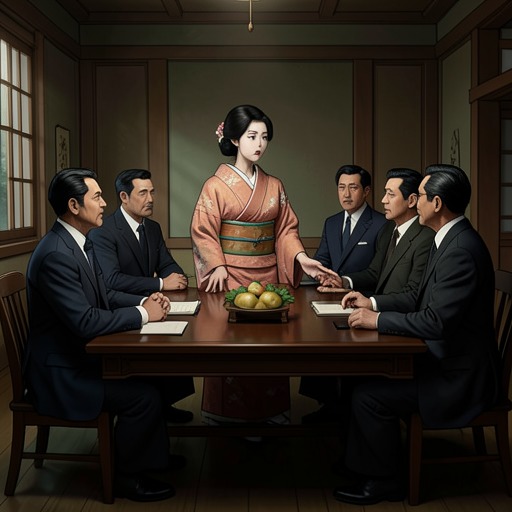
Mameha identifies him to Mother as a potential patron for Sayuri. The General has just received a new appointment in military procurement, a position Mameha explains through the mundane example of securing ink pads for the army at a favorable price. The post, she argues, now places him in a position to take a mistress for the first time, and he has expressed interest in Sayuri. This proposal offers the okiya a possible alternative to Nobu’s patronage, even as Sayuri herself is uncertain whether Mameha is acting to help her or pursuing another purpose.
Patronage and the Okiya
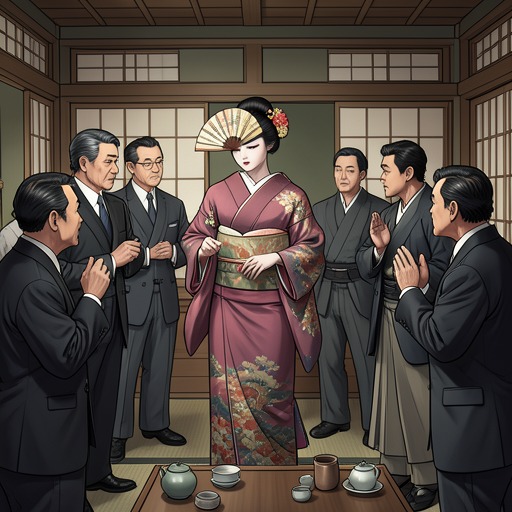
In September, when Sayuri is eighteen, she and the General drink sake together in a formal ceremony at the Ichiriki Teahouse. The ritual is the same kind of binding ceremony Sayuri had performed with Mameha on becoming her younger sister and with Dr. Crab before her mizuage. The weeks afterward bring congratulations to Mother for securing what others regard as a favorable alliance. The arrangement makes the General Sayuri’s danna and connects his resources to the household that manages her work and expenses.
The personal benefits prove more limited than the title might suggest. Sayuri continues making her nightly rounds in Gion; she does not receive the lavish gifts, sponsored dance recitals, or leisure time she had expected. Military patrons, she observes, did not maintain a geisha as businessmen or aristocrats did. The General does, however, cover ordinary expenses, including Sayuri’s lessons, annual registration fee, and medical bills. The contrast is central to the arrangement: there is little display of luxury, but substantial practical value to the okiya.
His office makes that value unusually concrete. When Auntie falls ill in March 1939 and the doctors cannot help, a telephone call to the General brings an important doctor from the military hospital in Kamigyo Ward, carrying medicine that cures her. The household also receives regular deliveries of tea, sugar, and chocolates, commodities increasingly scarce even in Gion. These benefits are not merely private gifts to Sayuri; they help sustain the okiya and reinforce Mother’s assessment of the alliance as profitable.
Protection During Wartime
The General’s influence extends beyond supplies and medical assistance. In fall 1941, military police discover a maid carrying roughly ten times the ration coupons her okiya was permitted. Her mistress sends her to the Nitta household for safekeeping before arrangements can be made to take her to the countryside. The household is chosen because General Tottori has instructed the military police to leave it alone. In a district where okiya hoard coupons to survive, his intervention places Sayuri’s household among those with the greatest protection and access to scarce resources.
That privilege is relative, not permanent. As the war darkens, the okiya’s good fortune ends abruptly. In December 1942, a military policeman arrives and reads out accusations including hoarding cotton, withholding metal and rubber from the war effort, and misusing ration tickets. Sayuri recognizes that the household has committed these offenses, as have other okiya in Gion, but its exceptional survival and resources have made it conspicuous. Mother then tells her that General Tottori has been taken into custody that morning and urges her to hide the household’s best possessions before they are seized.
The consequences follow quickly. Within a week, the okiya is stripped of necessities that other households had lost earlier, including food stores and undergarments. Its supply of tea, once a means of obtaining favors for Mameha, is gone, and Mameha becomes the household’s source instead. Later in the month, the neighborhood association confiscates ceramics and scrolls for sale on the gray market, both to raise money and to punish the family. The association’s leader regrets carrying out the removals, but military orders leave no room to refuse. The General’s arrest thus changes the household’s position from protected supplier to target of enforcement.
Consequences and Narrative Significance
The General’s patronage also alters Sayuri’s relationships. After he becomes her danna, Nobu stops inviting her to parties and eventually stops coming to the Ichiriki. Sayuri suspects that he is avoiding her; when she sends him a New Year card, he does not respond. She experiences the silence as a painful loss of a friend who had treated her kindly, and without Nobu’s patronage she is no longer invited to Iwamura Electric parties, making it much harder to see the Chairman. The alliance therefore brings security to the okiya while narrowing Sayuri’s access to another important personal and professional connection.
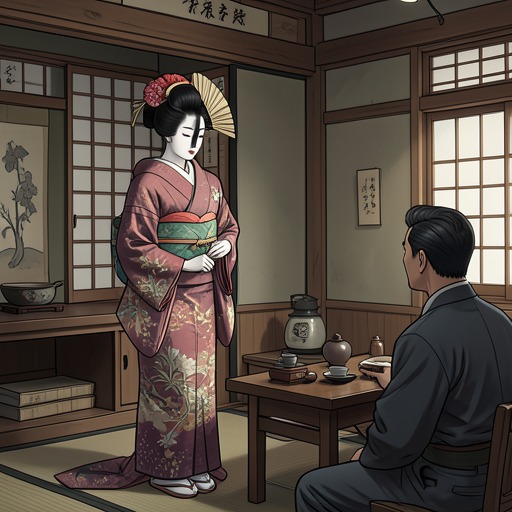
After the General’s arrest, the government announces the closure of the geisha districts and orders geisha to report to a registry office. Sayuri is still acquainted with him and sets out to find him at the Suruya Inn, where they had met for years, but the protection his position once afforded the household is already gone. His arc is defined less by personal transformation than by the changing reach of his office: first a prospective patron, then the source of practical aid and wartime shelter, and finally an absent protector whose detention leaves the household exposed. Through him, the novel shows how a geisha household’s apparent security can rest on a fragile bargain with power, vulnerable to the same political machinery that had sustained it.