General Tottori is detained and the Nitta okiya loses wartime protection
Memoirs of a GeishaGeneral Tottori’s detention in December 1942 removes the protection that had kept the Nitta okiya unusually secure amid wartime shortages. The ensuing investigation turns its accumulated advantages into liabilities: food and supplies are taken, valuables are sold, and the household loses the privileged position that had allowed it to help others in Gion.
Wartime protection and unequal security
General Tottori’s influence had made the Nitta okiya one of the places where supplies continued to arrive even after rationing began. For years, the household received food, tea, linens, cosmetics, and chocolate. It did not keep everything behind closed doors: Mother passed some provisions to people who came seeking help, reasoning that Gion’s households were connected and that one household’s security depended on the others. In the fall of 1941, a maid carrying far more ration coupons than her okiya was allowed to possess was sent to the Nitta okiya for safekeeping. General Tottori had instructed the military police to leave the household alone, making it a refuge for the maid as well as a beneficiary of the wartime supply network.
That protection did not mean the household’s practices were legal or unique. The narrator acknowledges that every okiya in Gion hoarded coupons and violated wartime restrictions, while the better-established households generally held more. The difference was that the Nitta okiya had enjoyed unusually good fortune and had remained prosperous longer than most. Its comparative security rested not simply on its own resources but on General Tottori’s power to shield it from enforcement.
The investigation begins
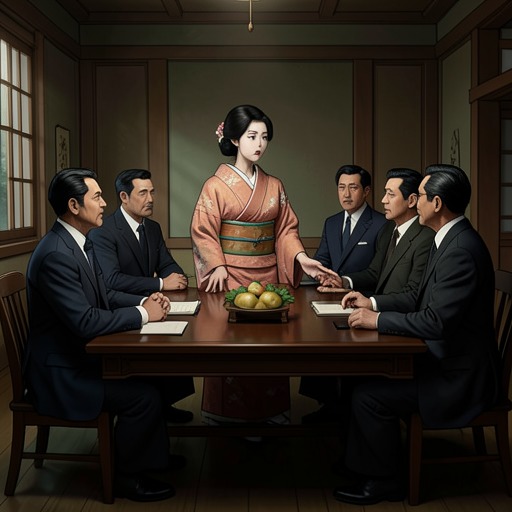
In December 1942, a few weeks before New Year’s Day, a military policeman came to the household while the narrator was eating her first meal after helping clean for the holiday. She initially assumed the visitor had come to make a delivery. The maid interrupted her to report that a military policeman had asked for Mother; when told Mother was out, he said he would speak with the narrator instead.
The officer removed his boots in the entrance hall, a gesture that made clear he intended to enter whether invited or not. The narrator noticed that his pistol remained secured in its holster, but the visit still broke with the household’s previous experience of police. Ordinarily, officers treated them with unusual deference because of the protection General Tottori provided. Now the policeman stood inside their home and asked what vegetables they had planted, putting the household’s conduct under scrutiny.
The narrator tried to deflect the question with a remark about the snow resembling ocean foam. The officer did not respond to it. Instead, he read from a list of alleged offenses: hoarding cotton materials, failing to surrender metal and rubber needed for the war effort, and misusing ration tickets. The accusations described actions the household had in fact taken, though the narrator notes that other Gion okiya had done the same. The investigation therefore exposed both a broad pattern of wartime evasion and the particular vulnerability of a household whose exceptional advantage had attracted official attention.
Tottori’s detention and the loss of supplies
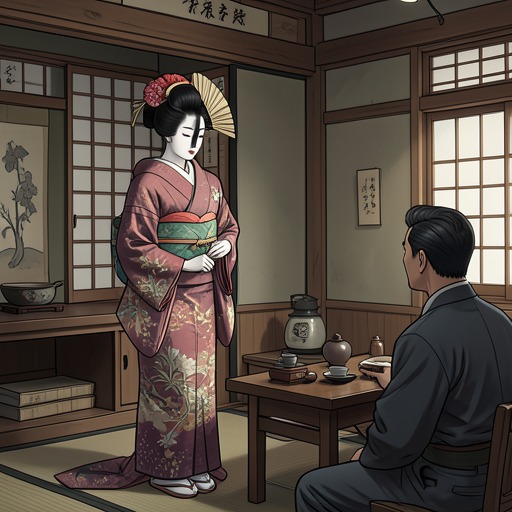
Mother returned while the policeman was there. Rather than appearing surprised, she treated him with marked politeness, led him to the reception room, and served him some of the household’s ill-gotten tea. Their conversation continued behind a closed door. When Mother stepped out, she told the narrator that General Tottori had been taken into custody that morning and warned her to hide the household’s best things before they were gone.
The news explains the abrupt change in the police’s behavior: the authority that had protected the Nitta okiya was no longer available. Within a week, the household was stripped of stores of food, undergarments, and other goods that many families had already lost. Its relationship with Mameha changed materially as well. The Nitta okiya had once supplied her with packets of tea, which the narrator believes she used to obtain favors; after the confiscations, Mameha’s supplies were better than theirs, and she became the household’s source instead.
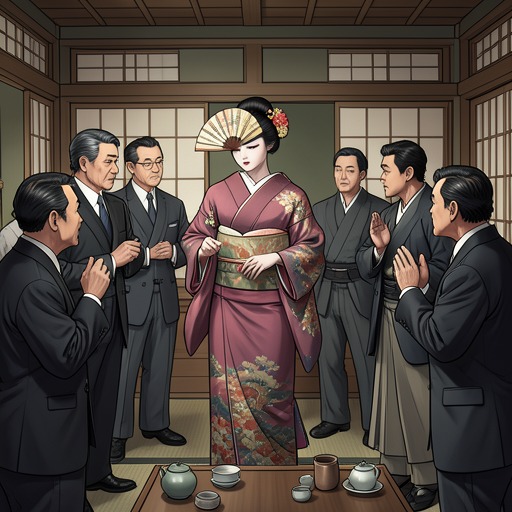
Toward the end of the month, the neighborhood association began taking ceramics and scrolls from the household and selling them on the gray market. The narrator distinguishes this from the black market, which dealt in rationed or illegal goods such as fuel, food, and metals. The gray market primarily involved households selling treasured possessions to raise money. In this case, the sales also served as punishment, and the proceeds benefited others. The association’s head, herself the mistress of a nearby okiya, was sorry to take the objects, but the military police had ordered it; no one could refuse.
From privilege to exposure
The episode reverses the household’s wartime position. Before the detention, the Nitta okiya’s supplies made it a rare pocket of security within Gion, and that relative abundance enabled it to assist neighbors. Afterward, its stored goods and household objects became targets for confiscation and punishment. The same visibility that had testified to its good fortune now marked it as a household to be disciplined.
The loss also belongs to a larger deterioration rather than an isolated visit. By the middle of 1943, people in Gion had begun to fear that the war might end badly and that the government would close the geisha districts. When a shopkeeper later announced that the government had ordered those districts closed and instructed the geisha to report to a registry office, the immediate question was which men might save them from factory work. The narrator then set out to find General Tottori, her former danna, at the Suruya Inn, hoping to reach him before anyone else. His detention had thus done more than remove a source of supplies: it had weakened the household’s protection before the wider wartime closure narrowed the geisha’s choices.
Continuing consequences
The loss of wartime protection forms part of the longer chain of political and economic reversals in the story. After the war, two of Iwamura Electric’s four factories were destroyed, and Nobu gave the narrator a piece of concrete from the company’s factory in Osaka to represent the company’s uncertain future. Later, the Occupation authorities nearly decided against the company, a judgment that would have led to its seizure and barred the Chairman and Nobu from working in business. The Minister intervened and persuaded the authorities to reopen the case.
These later crises are distinct from the 1942 detention, but they echo its underlying vulnerability: political authority can abruptly withdraw the conditions on which a household or business has relied. For the Nitta okiya, protection had been concentrated in General Tottori’s influence; when he was taken into custody, material security vanished quickly. The episode makes wartime privilege look less like stable wealth than like a temporary shelter, one that could disappear with a single change in power.