Hatsumomo bribes teahouse maids to track Sayuri
Memoirs of a GeishaHatsumomo bribes teahouse maids to track Sayuri, transforming a personal rivalry into a practical campaign to control where her younger rival can appear. By paying workers to report Sayuri and Mameha’s engagements, Hatsumomo repeatedly reaches their parties before Sayuri can establish herself. The surveillance disrupts Mameha’s plan for Sayuri’s debut, forces her out of Gion’s ordinary circuit of engagements, and makes the district itself feel closed to her.
The pursuit across Gion
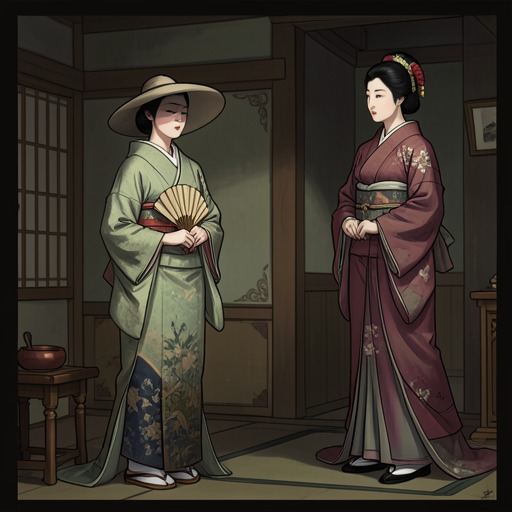
At a party hosted by the chancellor of Kyoto University, Mameha leaves Sayuri at the table while she talks with an acquaintance. Sayuri is about to introduce herself to an older man when the door slides open and Hatsumomo enters with Pumpkin. Mameha immediately claims that she and Sayuri were expected elsewhere half an hour earlier. They rise and leave just as Hatsumomo arrives, avoiding a direct confrontation but making clear that she has found them once again.
Mameha takes Sayuri into an empty tatami room after they leave. In the darkness, Sayuri lets her jaw sag with frustration: she cannot understand how Hatsumomo keeps discovering their whereabouts. Mameha asks what Sayuri said to Hatsumomo earlier that day, but Sayuri insists she could not have disclosed their destination because she herself had not known it. The uncertainty points beyond an accidental encounter: someone with access to their plans must be passing information along.
Mameha tries to evade the pattern by choosing a gathering she would rather not attend. The new conductor of the Tokyo Philharmonic, Naga Teruomi, has just arrived in town, and Mameha expects that Hatsumomo will not be there. The party is held across Shijō Avenue, in a teahouse down a narrow alley. Mameha speaks with the conductor, who asks her to dance, and a maid is bringing over a shamisen when the door slides open again. The recurrence makes the apparent coincidence impossible to ignore: even at an engagement Mameha has selected precisely because she thinks it safe, Hatsumomo has found them.
The bribery exposed
As Mameha and Sayuri leave, Mameha stops at the foot of the stairs to question the maid who had shown them upstairs. She observes that a maid is likely to want many things while having little money, then asks what the girl plans to do with the funds she has just earned. The maid denies having earned anything, but her nervous swallowing gives away her answer. When Mameha asks how much Hatsumomo promised, the maid looks down.
The exchange reveals the mechanism behind Hatsumomo’s pursuit. Mameha had suspected that the maid sent a message, and later learns that Hatsumomo bribed at least one maid in every first-class teahouse in Gion. The maids were instructed to call Yoko, the girl who answered the telephone at the okiya, whenever Mameha and Sayuri arrived at a party. At the time, Sayuri and Mameha do not know that Yoko is involved; the bribed maid’s reaction nevertheless confirms that information is moving through the teahouses to Hatsumomo.
The scheme is effective because it uses the ordinary workings of the district against Sayuri. Mameha and Sayuri cannot rely on choosing a different party when the staff at the venues themselves can report their arrival. As they leave the alley, Hatsumomo’s voice carries down from a window above. The narrow passage makes the pursuer audible even after she has driven them out, underscoring how little privacy or room to maneuver Sayuri has within Gion.
Sayuri’s exclusion and its limits
After hearing Hatsumomo ridicule Mameha, the two leave the alley. Mameha looks up and down the street, unable to think of another place they can go, and tells Sayuri to return to her okiya until she has devised a new plan. For Sayuri, the abrupt end to the evening is more than a missed party: her first attempts to make a place for herself among Gion’s engagements are being stopped before they can gather momentum.
Mameha subsequently calls Sayuri an exile for the moment. She hopes that the experience will make Sayuri more determined to defeat Hatsumomo, but warns that following her around Gion will accomplish nothing until she has a plan. Hatsumomo’s power is social as well as logistical: Sayuri believes that the ridicule Hatsumomo can spread would damage her standing in the eyes of men and women in Gion. Staying at home is a way to limit that harm, but it also keeps Sayuri from the parties where a novice would ordinarily gain experience and recognition.
The exclusion is serious but not absolute. Mameha finds occasional engagements that are safe and takes Sayuri along when she leaves Gion. Sayuri travels by train to Kobe for the opening of a factory and accompanies a former president of Nippon Telephone & Telegraph on a limousine tour of Kyoto. These trips do not undo Hatsumomo’s control of the local party circuit, but they give Sayuri experience and a view of a world beyond the district. The contrast establishes both the reach and the limit of the bribery: Hatsumomo can make Gion inaccessible for a time, but she cannot close off every opportunity beyond it.
A stalled debut
The campaign’s consequence is felt in Sayuri’s interrupted professional progress. She had expected to be attending banquets and numerous parties, learning through the public work that follows years of training. Instead, while Hatsumomo continues to move through Gion in full regalia, Sayuri remains in the okiya practicing dance and shamisen as if nothing in her life had changed. The image of Hatsumomo’s white makeup glowing above her dark robe once might have inspired envy; now Sayuri sees the beauty without admiration and feels only hatred.
Mameha’s term for Sayuri’s condition, exile, names the reversal. Sayuri is not formally expelled from her home or training, but the bribery makes the venues where her career should develop unsafe. The tactic therefore attacks her visibility: if Sayuri cannot appear at parties without Hatsumomo learning where she is, she cannot simply follow the expected route into public life. Mameha’s later efforts to find engagements beyond Gion preserve a path forward, but the interruption delays the debut she had been preparing to make.
The episode also clarifies the difference between Mameha and Hatsumomo as operators within the same social world. Mameha responds to each discovery by reading the situation, testing the maid’s account, and changing the plan; Hatsumomo turns the network of teahouse workers into an instrument for pursuit. Her bribery makes ordinary hospitality and communication serve as surveillance. Its immediate victory is limited—Sayuri still travels with Mameha beyond Gion—but it succeeds in making her rival’s anticipated debut stall and in converting a neighborhood of possible engagements into a place Sayuri must approach with caution.