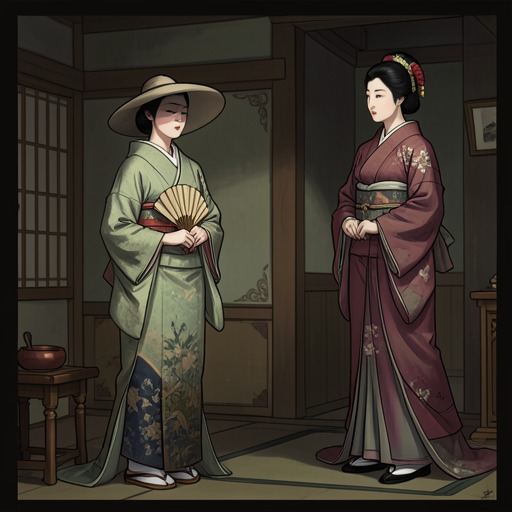
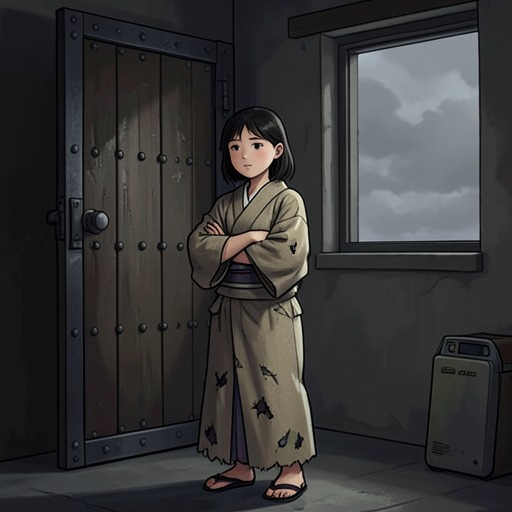
Hatsumomo designs the destruction of Mameha’s kimono and frames Chiyo
Memoirs of a GeishaHatsumomo’s destruction of Mameha’s kimono is the first clear demonstration of how she uses Chiyo as an instrument in her rivalry with Mameha. She makes the young girl mark an exquisite garment with ink, then denies responsibility when the damage is discovered and leaves Chiyo to bear the debt and punishment. The incident converts a beautiful, costly object into evidence of Hatsumomo’s power: she can damage a rival’s property, manipulate the household’s judgment, and make a vulnerable child pay for the consequences.
The kimono and the rivalry
Mameha’s garment is a pale green silk gauze kimono with a vine bearing red leaves. Its delicacy makes the planned damage particularly pointed: the vine is not merely printed on the fabric but formed from heavily lacquered threads, bunched together and sewn into place. The garment’s artistry gives Hatsumomo’s prank material stakes, while its ownership makes the act a direct attack on Mameha, whom Hatsumomo resents as more successful than herself.
Hatsumomo tells her friend Korin that she found the kimono after returning to the Kaburenjo Theater to retrieve something left during a rehearsal. She says she heard moaning from the basement stairs, went to investigate, and discovered Mameha with a man. That account explains how Hatsumomo obtained access to the garment; it does not make the kimono hers. When Korin recognizes it as Mameha’s, Hatsumomo treats the discovery as an opportunity for mischief and draws Chiyo into the plan.
Chiyo is made the instrument
Hatsumomo orders Chiyo to bring the kimono to its storage place, then has her grind ink and put a brush to the silk. She holds Chiyo’s hand over the fabric and instructs her to practice calligraphy. When Chiyo protests that she cannot do it, Korin warns that disobedience could cost her the chance to find her sister, Satsu. Hatsumomo reinforces the threat, insisting that Chiyo must do what she is told. The coercion makes Chiyo’s apparent act of defacement the visible fact, while Hatsumomo’s manipulation remains hidden from those who will judge the damage.
The marks have no intended meaning: Hatsumomo directs where Chiyo should write and what sorts of marks to make simply because she wants to be artistic. Korin’s excitement at the brush touching the powdery green silk even wakes an elderly maid, but Hatsumomo frightens the woman back to her futon with a stamping, lunging gesture. The women then refold the kimono in its linen wrapping and return it to storage, leaving Chiyo to carry the object and the risk into the next day.
Discovery, denial, and punishment
The following morning, Mother, Granny, and Auntie meet in the formal reception room. Mameha and her maid have visited, and when Hatsumomo arrives, Mother stops her on the stairs to tell her so. Hatsumomo immediately performs regret and claims she tried to stop Chiyo from marking the kimono. She says Chiyo must have mistaken it for Hatsumomo’s and acted out of hatred, presenting the damage as an attack on Hatsumomo rather than a scheme directed against Mameha.
Auntie identifies the story’s weakness: everyone knows Hatsumomo hates Mameha and resents anyone more successful than herself. Mother also refuses to accept the excuse, saying she respects Mameha and will not tolerate such behavior in the household. Yet her decision turns on what can be proved: the maid saw Chiyo holding the brush. Mother therefore orders Chiyo to pay for the kimono, despite acknowledging uncertainty about what happened. Granny adds a beating to the repayment, and Auntie takes Chiyo to the courtyard with the bamboo pole. The household recognizes Hatsumomo’s hostility but still imposes the material cost on the child whose hand left the marks.
Debt as a weapon
Auntie does not beat Chiyo as Granny demands. Instead, she explains that Hatsumomo’s trick has burdened the girl with a debt that may be too large ever to work off. The kimono’s value thus reaches beyond the damaged silk: because Chiyo is dependent on the okiya for her lessons and future training, a debt can threaten her prospects as a geisha. Auntie warns that Hatsumomo is dangerous precisely because she can make apparent assistance or obedience serve a destructive purpose.
Auntie nevertheless carries out a beating, leading Chiyo to the walkway and making her lie on her stomach. Chiyo cries out with each blow and imagines Hatsumomo smiling down at her. When the beating ends, Hatsumomo appears above her and asks her to move out of the way. Chiyo recalls that Hatsumomo had promised to tell her where she could find Satsu; the original threat has therefore worked on more than one level, using Chiyo’s hope of finding her sister to secure obedience.
The incident’s lasting material contrast
The episode establishes a pattern that recurs in Chiyo’s life: expensive possessions carry obligations, and those obligations can be used to control people with little power. The okiya’s kimono collection is stored in lacquered cases, with some cases holding about fifteen garments; the collection is valuable enough to make Granny fear fire. Against that wealth, Chiyo’s imposed liability is not an abstract reprimand but a financial burden attached to the household’s most precious goods.
Later, the contrast between abundance and scarcity becomes sharper. During the war, Chiyo’s possessions amount to a few scrolls, inkstones, bowls, photographs, and a silver viewer; lavish gifts have become rare, and cosmetics and permanents are banned as luxuries. Mother, by contrast, grows richer through the wartime trade in other people’s heirlooms, including kimono sold by the Arashino family. These later circumstances do not erase the earlier incident, but they echo its central imbalance: the value and circulation of beautiful objects are governed by people who can impose costs on others. In the first kimono episode, Hatsumomo makes that system personal, turning Mameha’s garment into a trap for Chiyo.