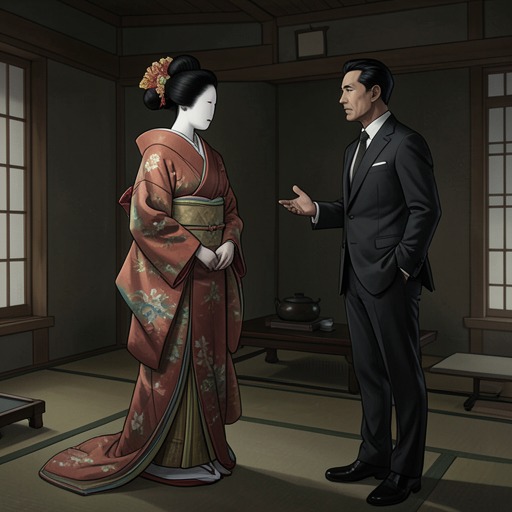
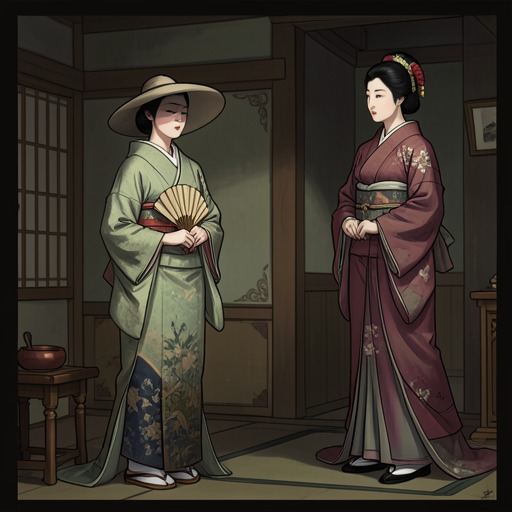
Hatsumomo discovers Sayuri’s journal and the stolen brooch
Memoirs of a GeishaHatsumomo discovers Sayuri’s journal and the stolen brooch in a confrontation that turns private exposure into a reversal of power inside the okiya. As Hatsumomo threatens to reveal Sayuri’s writing to Mother, Sayuri finds the emerald obi brooch that Hatsumomo had once used to frame her for theft. The journal gives Hatsumomo leverage, but the recovered brooch makes her old accusation answerable at last—and exposes how far the balance between the two women has shifted.
Background and the move between rooms
The confrontation begins amid a delayed exchange of rooms and belongings. Auntie assigns Sayuri a corner in Hatsumomo’s room and a similar space for Hatsumomo and Pumpkin in the smaller room, expecting the move to be completed as their possessions are transferred. Sayuri moves her things first, carrying across makeup, undergarments, books, magazines, scrolls, inkstones, bowls, and a sterling-silver stereoscopic viewer. The modest collection reflects a changed period: the military government has banned cosmetics and permanents as luxuries, and lavish gifts have become rare, even though women in Gion still enjoy some latitude.
By the evening after Sayuri has moved, Hatsumomo and Pumpkin have not yet begun shifting their belongings. On the third day, Sayuri returns from lessons intending to ask Auntie for help if Hatsumomo’s bottles and ointments still occupy the makeup stand. Instead, she finds both room doors open, a broken jar of white ointment on the hallway floor, and Hatsumomo sitting at Sayuri’s table with a notebook in her hands. The unfinished move has placed Sayuri’s private writing within Hatsumomo’s reach.
The journal becomes leverage
The notebook is a diary Sayuri began keeping while still an apprentice. Conscious of the expectation that a geisha keep discreet about the men she knows, she records thoughts and feelings rather than indiscreet particulars, and uses code names for men. Nobu appears as Mr. Tsu, after a scornful sound he sometimes makes; the Chairman is Mr. Haa, after the breath Sayuri once imagined him letting out beside her. She has marked the cover private, but never expected anyone to read it.
Hatsumomo greets Sayuri as if she has been waiting to praise the diary, then makes clear that she has read it. When Sayuri denies writing about Nobu, Hatsumomo turns to a passage describing his anger when a geisha stares at him, his missing arm, and Sayuri’s belief that he appreciates her lack of fear or revulsion. The coded name does not protect the subject: Hatsumomo identifies Nobu from the details and uses the entry to press Sayuri. What Sayuri had treated as private reflection has become evidence Hatsumomo can use against her.
Hatsumomo is drunk, though Sayuri first mistakes the glass in her hand for water and only recognizes the smell of sake when she approaches. She clutches the journal and says she will return it, but threatens instead to take it to Mother, adding that Mother will be pleased to read what Sayuri has written about her. The threat reaches beyond Sayuri’s feelings about Nobu: it makes the diary a potential instrument of exposure inside the household. Sayuri tries to reclaim it, but Hatsumomo holds on and heads for the door.
The brooch reverses the accusation
Hatsumomo’s hurried exit takes her over the broken glass from the ointment jar. She shrieks, cuts her foot, and continues to her room, leaving a trail of ointment and blood. Sayuri follows, determined not to leave without her journal. The room is in disorder from Hatsumomo’s efforts to move: underclothing and perfume bottles are scattered, and the tiny safe where she keeps jewelry stands open, with pieces spilling onto the mats.
Among them Sayuri recognizes the emerald obi brooch Hatsumomo had accused her of stealing years earlier, after Sayuri found Hatsumomo and her boyfriend in the maids’ room. The object’s return is more than a chance discovery: the brooch is the physical proof missing from an old accusation that had been added to Sayuri’s debts. Sayuri picks it up while Hatsumomo, seeing the movement, tells her to go ahead and steal a piece of jewelry, adding that she would rather have the cash Sayuri would owe her.
Sayuri asks how much she will have to pay and holds the brooch up before Hatsumomo. Hatsumomo’s smile fades. While Hatsumomo sits stunned, Sayuri takes the journal from the table with her other hand and leaves. She hides the diary on a shelf between tissue-wrapped, in-season kimono in a closet, then tries to misdirect Hatsumomo by opening and closing drawers at her makeup stand as if she had stashed it there. The concealment protects the journal while Sayuri carries the brooch to Mother’s room.
Mother’s judgment and the changed balance
Mother first examines the jewel as an object of value, noting that it will not fetch much on the black market. Sayuri explains that it is the brooch Hatsumomo had accused her of stealing and that its cost was added to Sayuri’s debts; she has just found it beside Hatsumomo’s jewelry box. Hatsumomo arrives behind Sayuri and claims to recognize it as the brooch she lost, but Sayuri points to how difficult it is to find things while drunk.
Hatsumomo shifts tactics, telling Mother that she had been searching Sayuri’s makeup stand to hide something for Sayuri: the journal. She claims Sayuri showed it to her the previous year and says it contains incriminating passages about men and Mother. Sayuri considers denying the journal’s existence, but recognizes that the truth of Hatsumomo’s claim no longer determines the outcome. Ten years earlier, when Hatsumomo was the okiya’s principal earner, Mother might have accepted almost any accusation against Sayuri and charged her for its consequences. Now Sayuri is the okiya’s daughter and its prime geisha, while Hatsumomo’s career is dying. Mother does not need to establish where the truth lies to act against Hatsumomo.
Mother orders Hatsumomo to repay Sayuri for the brooch and to pay for replacing the tatami stained with blood. She warns that it has been a costly day, though it is not yet noon. The journal has enabled Hatsumomo to threaten Sayuri, but the brooch and the disorder of Hatsumomo’s own making turn that threat into an occasion for punishment. Sayuri denies that the journal exists; Hatsumomo searches the dressing table drawers, but Sayuri has already hidden it among the kimono. The confrontation ends with Hatsumomo glaring at her, unable to restore the authority she once held over Sayuri.
A turning point in their rivalry
Looking back, Sayuri distinguishes this encounter from her mizuage, which she had once thought was the turning point between herself and Hatsumomo. The mizuage had lifted her beyond Hatsumomo’s reach, but might not have ended their uneasy coexistence. The day Hatsumomo read the journal and Sayuri found the brooch changed the relationship more decisively: an old false charge could finally be answered with evidence, and Hatsumomo’s attempt to exploit Sayuri’s private feelings met a reversal in the okiya’s judgment.
The episode’s two objects carry opposing kinds of power. The journal is intimate writing made vulnerable by its physical presence in the room; the brooch, once the basis of a debt imposed on Sayuri, is recovered from the very place where Hatsumomo keeps her possessions. Their exchange converts exposure into counter-evidence. The result is not simply a clever recovery: it makes visible a change already under way, as Sayuri’s position strengthens and Hatsumomo’s former dominance ebbs. Sayuri later names this day, rather than her mizuage, as the true turning point in their relationship.