Hatsumomo obstructs Sayuri’s efforts to establish herself in Gion
Memoirs of a GeishaHatsumomo obstructs Sayuri’s efforts to establish herself in Gion by tracking her early outings with Mameha and closing off the district’s banquet and party circuit. What begins as Sayuri’s hoped-for entry into public life becomes an enforced retreat: Mameha discovers that Hatsumomo’s surveillance extends through bribed teahouse staff, and Sayuri is left practicing at the okiya while her debut stalls. The episode makes visibility itself a battleground: Hatsumomo can follow Sayuri into rooms where she has barely begun to speak, while Mameha must keep withdrawing her pupil to protect her from ridicule and damage to her standing.
A debut shadowed from the start
At Sayuri’s first banquet, she is introduced as a novice and instructed to remain close to Mameha, following her like a shadow. Her brief formal introduction is the extent of her participation; no one speaks to her afterward. The contrast between this constrained first appearance and the years she has spent watching Hatsumomo and Pumpkin leave the okiya for engagements gives the evening its importance: Sayuri has entered the public world she longed to join, but she has not yet acquired the freedom or standing to move through it independently.
The initial hope that she might succeed is tested on an evening when Mameha takes her to successive parties. At a gathering for a young film actor, Hatsumomo does not appear, and Sayuri begins to imagine that her prospects may come true. The next stop is a party given by the chancellor of Kyoto University. Mameha is speaking with an acquaintance, leaving Sayuri to find a place beside an old man in a stained white shirt who drinks beer and burps. Before Sayuri can introduce herself, Hatsumomo and Pumpkin arrive. Mameha immediately excuses herself and Sayuri, saying they had been expected elsewhere half an hour earlier; they leave just after Hatsumomo enters. Their exit preserves Sayuri from a direct confrontation, but it also shows that Hatsumomo’s arrival can dictate the terms of her evening.
Pursuit and discovery of the bribery
Mameha tries to evade Hatsumomo by choosing a gathering she believes is little known: a party for Naga Teruomi, newly appointed conductor of the Tokyo Philharmonic. The party is held in a teahouse reached by crossing Shijō Avenue and turning into a narrow alley. There, just as Mameha is about to dance, Hatsumomo and Pumpkin appear again. Sayuri compares them to dogs that will not stop following. Mameha and Hatsumomo exchange smiles that appear companionable, but Sayuri reads Mameha’s anger in her tightened jaw and flared nostrils. Mameha cuts the visit short, thanking the conductor for allowing them to drop in and leaving before the dance begins.
At the entrance, Mameha questions the young maid who had escorted them upstairs. She asks what the maid will do with the funds she has just earned; the maid denies receiving money, but her nervous swallowing betrays her. Mameha asks how much Hatsumomo promised her. The exchange reveals the mechanism behind the repeated discoveries. Sayuri later learns that Hatsumomo had bribed at least one maid in every first-class teahouse in Gion to call Yoko, the girl who answered the telephone at their okiya, whenever Mameha and Sayuri arrived. Yoko’s involvement was not known to them at the time, but Mameha correctly recognizes that the maid had passed a message to Hatsumomo. The pursuit is therefore not simply a matter of Hatsumomo guessing their plans: it depends on an organized information network reaching from teahouses back to the okiya.
Exile from Gion
After another failed attempt to find a safe place, Mameha and Sayuri hear Hatsumomo speaking from a window above the alley. Mameha pushes Sayuri onward rather than letting her remain to listen. She concludes that if Hatsumomo can find them there, she can find them anywhere in Gion, and tells Sayuri to return to the okiya until she has devised a new plan.
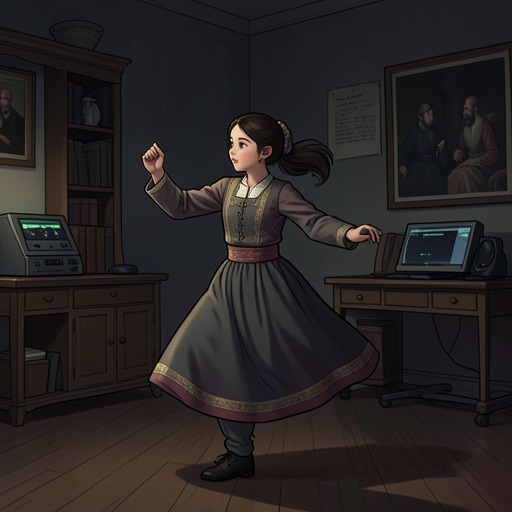
The disruption changes how Sayuri sees her rival. She compares Hatsumomo’s effect on her to the change in an object’s appearance when its real purpose becomes known: beauty can no longer be separated from harm. Hatsumomo had once seemed beautiful enough to provoke envy; after bringing Sayuri’s debut to a standstill, she becomes monstrous in Sayuri’s eyes. While Sayuri should have been attending banquets and numerous parties, she is instead kept at the okiya practicing dance and shamisen as though nothing had changed since the previous year. Hatsumomo still passes through the corridor in full regalia, white makeup glowing above her dark robe, but Sayuri now feels hatred rather than admiration.
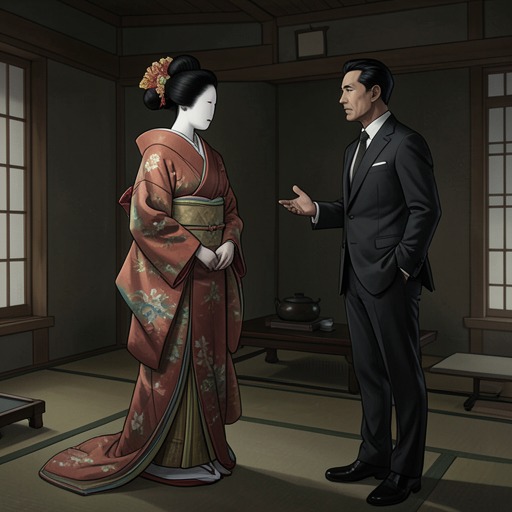
Mameha names Sayuri’s position plainly: for the moment, she is an exile. She warns that following her around Gion will not solve the problem and that Hatsumomo’s ridicule could harm Sayuri’s reputation in the eyes of both men and women. The danger is reputational as well as practical. A novice whose public introduction depends on others’ reception cannot easily answer an established rival’s mockery without risking further damage, so staying home becomes a defensive measure rather than a choice.
Workarounds and lasting significance
The exclusion is not complete. Mameha remains resourceful and occasionally finds engagements outside Gion that Sayuri can safely attend. Sayuri travels by train to Kobe when Mameha cuts the ribbon at a new factory; on another occasion, she accompanies the former president of Nippon Telephone & Telegraph on a limousine tour of Kyoto. These invitations offer limited routes beyond Hatsumomo’s reach, but they do not restore Sayuri’s place in Gion or resume the debut she had anticipated. Instead, they show Mameha trying to preserve her pupil’s experience and prospects while the local party network remains compromised.
The episode establishes a sharp asymmetry between the women. Sayuri is newly visible but has little control over where she may go or how others will interpret her. Hatsumomo can exploit her established position and access to information to make that visibility dangerous. Mameha responds through tactical withdrawals, investigation, and engagements beyond the district, but for the time being she cannot simply undo the damage. The result is an early reversal in Sayuri’s understanding of beauty and power: the regalia that once represented the future she wanted now belongs to the woman preventing her from reaching it.