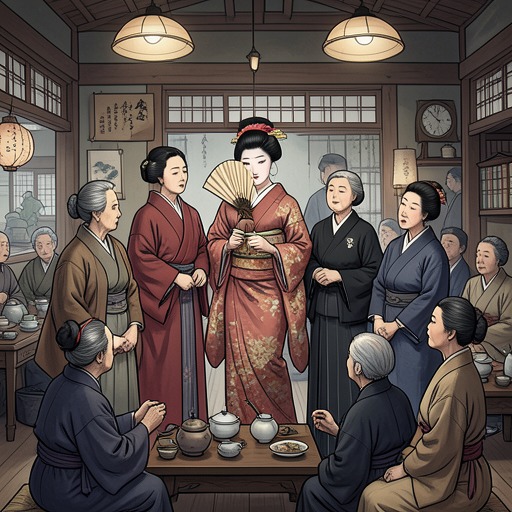
Hatsumomo sabotages Sayuri’s mizuage plans
Memoirs of a GeishaHatsumomo sabotages Sayuri’s mizuage plans by turning a passing exchange into a calculated rumor: she leads Dr. Crab to believe Sayuri has already been secretly involved with a young man. The lie attacks the very condition Mameha is trying to present as Sayuri’s value to a prospective mizuage patron, and Dr. Crab’s withdrawal shows how quickly reputation can become a practical obstacle in Gion. What begins as Hatsumomo’s baiting of Sayuri ends with Mameha forced to defend both her apprentice’s honesty and the plan’s dwindling timetable.
The opening for sabotage
Dr. Crab’s connection to the Shirae Teahouse made him a promising but not entirely free agent for Mameha’s plans. Though he had become wealthy enough to patronize the Ichiriki, he continued to visit the Shirae, the modest establishment where he had once been able to afford a place. When Mameha and Sayuri first entertained him there, his reserved manner gave little indication of whether he had enjoyed their company: he looked down through small round glasses, ate sashimi awkwardly, and kept largely quiet. Yet he contacted them the following week and returned nearly every week for months. That steady attention gave Mameha grounds to hope that he might become Sayuri’s mizuage patron.
The vulnerability in that arrangement surfaced one cold day in mid-March. Sayuri was kneeling with her shamisen on the wooden walkway of the okiya when Hatsumomo passed on her way to the toilet. Sayuri struggled to rise on legs and arms nearly frozen, and Hatsumomo used the moment to suggest that Sayuri ask Mameha to arrange for her to take Pumpkin’s place entertaining the visiting German Ambassador. The suggestion was delivered as a joke, but it touched a live question: who in Gion would be chosen for the honor of entertaining a politically prominent visitor? In 1935, Japan was moving away from the United States and eager to impress the new German Ambassador. Sayuri resisted the expected display of embarrassment and kept her face composed, pleased that she appeared to have revealed nothing about Mameha’s plans. Hatsumomo’s odd look, however, hinted that the exchange had given her an idea.
The rumor reaches Dr. Crab
A few days later, Mameha and Sayuri arrived at the Shirae to meet Dr. Crab and found Pumpkin putting on her shoes to leave. Hatsumomo emerged into the entryway as well. Her presence, together with Pumpkin’s unexpected visit, made Sayuri understand that Hatsumomo had somehow anticipated or disrupted the meeting. Rather than letting Mameha and Sayuri proceed in their usual way, Hatsumomo had arranged to get to Dr. Crab first.
Pumpkin later explained how the trap had been laid. Hatsumomo had begun a story about a young apprentice named Sayuri who lived in her okiya. Once Dr. Crab recognized the name, Hatsumomo claimed that Sayuri and a young man living near the okiya were fond of one another. She added that she had let them spend time together alone in her room when Mother was away, despite Mother’s strict policy against boyfriends. Then she presented herself as if she had inadvertently disclosed a secret she had labored to conceal, inviting Dr. Crab to see the supposed intimacy as both real and confidential. He thanked her and promised to keep it to himself. The performance gave the false story the appearance of reluctant truth rather than open accusation.
The rumor was tailored to damage Sayuri’s prospects as a mizuage candidate. Mameha had explained to her the idea behind the metaphor of the “homeless eel”: a man seeks a cave to claim as his territory, and a woman’s cave is considered especially valuable if no other eel has entered it. In this explanation, mizuage depended on the premise of sexual inexperience. By implying that Sayuri had already been alone with a boyfriend, Hatsumomo planted in Dr. Crab’s mind the suspicion that another man had already claimed what he might otherwise be asked to prize. The lie did not need to establish what had happened; it needed only to make Dr. Crab doubt what he was being offered.
Trust breaks, and the plan changes
When Mameha and Sayuri next reached Dr. Crab at the Shirae, the teahouse mistress was keeping him company but quickly excused herself as they entered. Dr. Crab, seated with his back to the newcomers, did not respond readily to Mameha’s greeting. He turned his beer glass on the table and admitted at last that he was tired and did not feel like talking. After finishing the beer, he stood to leave. At the doorway he told them that he did not appreciate being misled by people he had trusted, then left without closing the door. His complaint made the consequence of Hatsumomo’s deception immediate: Dr. Crab no longer treated Sayuri’s relationship with him as a promising negotiation but as a breach of trust.
Mameha and Sayuri were stunned. Later, Mameha asked Sayuri to explain her plan, and Sayuri learned that Mameha understood Hatsumomo’s story to have made Sayuri appear sexually experienced. The injury was not only personal. Sayuri’s future could be affected by a single conversation, while Hatsumomo had used the secrecy and shame surrounding the rumor to make it difficult to challenge without seeming to confirm it. The episode also exposed how Mameha’s careful preparation depended on managing what powerful men believed about Sayuri, not merely on Sayuri’s conduct.
Pumpkin was both a witness to the scheme and a person caught in its consequences. When Sayuri told her that Hatsumomo must have said something untrue to Dr. Crab, Pumpkin broke down in tears and insisted that she had not known what was happening. Her account supplied the particulars of Hatsumomo’s story, but her distress complicated Sayuri’s anger: Pumpkin was not the author of the deception. She also disclosed that Mother had recently decided to adopt her. Sayuri was genuinely glad for Pumpkin, who hoped the adoption would give her a secure place to live, yet the news threatened Mameha’s own plan for Mother to adopt Sayuri instead. Mameha judged that only a few months remained before Pumpkin’s adoption, and concluded that Sayuri’s mizuage could no longer wait.
Mameha’s counterplay
Mameha confronted Dr. Crab with the allegation rather than letting Hatsumomo’s account stand unanswered. When he suggested that she ask Sayuri about the neighborhood boy, she said Hatsumomo had been spreading a completely false story through Gion. She connected the attack to Sayuri’s supposed stage role in Dances of the Old Capital, the district’s major annual event, whose opening was six weeks away at the beginning of April. Sayuri was not actually aware of having been assigned a stage role; Mameha had previously kept her from such a role to avoid provoking Hatsumomo. In the confrontation, however, Mameha used the prospect of the role to give Dr. Crab a reason to question Hatsumomo’s account and to understand the rumor as an attempt to disgrace Sayuri.
Mameha made the dispute a test of trust. She told Dr. Crab that either Hatsumomo was lying or she was, and challenged him to decide which woman he knew and trusted better. She also invoked Pumpkin: Hatsumomo had hoped her younger sister would receive a role, while Sayuri had supposedly obtained it, giving Hatsumomo a plausible grievance. Mameha was not fully truthful about the stage assignments. She said she herself had received a role Hatsumomo wanted, although she was in fact one of the few Gion geisha guaranteed a solo role each year. The account did, however, draw on a real disappointment: Hatsumomo had been eager to see Pumpkin onstage, despite Pumpkin’s lack of distinction as a dancer.
Dr. Crab proposed having one of his hospital doctors examine Sayuri. Mameha replied that it would be difficult to arrange an examination before he had agreed to be Sayuri’s mizuage patron, particularly if he doubted her integrity; she added that Sayuri would present ekubo to many men, most of whom would be skeptical of Hatsumomo’s stories. Dr. Crab considered the problem and raised the possibility that dishonest girls might arrange mizuage at a time when a man could be deceived. As a doctor, he said, he would not be fooled so readily. Mameha rejected the premise that anyone was trying to fool him, but he rose and marched out with his shoulders hunched, elbows leading him from the room. The ekubo were no longer on the table after he and Mameha had left, though the evidence does not establish whether he took them.
Consequences and significance
Hatsumomo’s scheme briefly shifts control of the mizuage negotiations away from Mameha. Her story exploits the mismatch between private facts and public reputation: Dr. Crab does not need proof of a boyfriend to withdraw, only a reason to doubt the carefully cultivated account of Sayuri’s innocence. His accusation that trusted people have misled him makes the rumor’s damage visible before Mameha can identify its source or answer it. The threat is especially acute because Sayuri’s prospects are entangled with Mameha’s longer strategy for adoption and with the approaching deadline created by Mother’s decision about Pumpkin.
The episode also reveals that countering a falsehood in Gion requires more than simply denying it. Mameha answers with a rival explanation of Hatsumomo’s motive, using the competition around Dances of the Old Capital and Pumpkin’s hopes for a role to make the rumor intelligible as retaliation. Her defense is itself strategically constructed and partly untrue, showing that the struggle is conducted through stories whose persuasive force depends on the listener’s loyalties. The contest leaves Dr. Crab unsettled rather than clearly reconciled, while Mameha’s recognition that time is running out turns the sabotage into a turning point: Sayuri’s mizuage must be pursued sooner, under greater pressure and with her reputation newly in question.