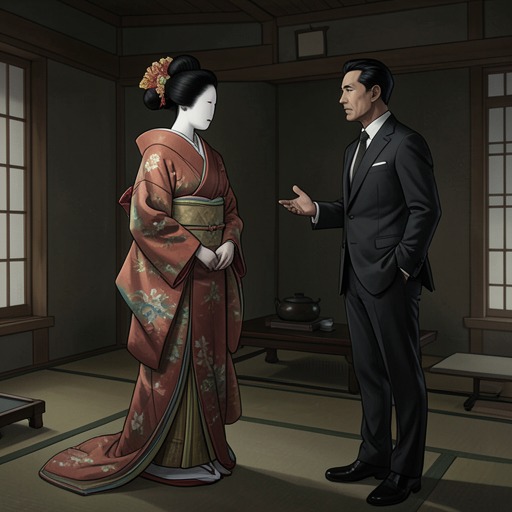
Hatsumomo’s dependence on the Nitta okiya
Memoirs of a GeishaHatsumomo’s dependence on the Nitta okiya is the central contradiction in her position as a successful geisha: she is popular and brings in money, yet she does not control the conditions of her own life. In the economy described by Sayuri, parties and reputation alone do not make a geisha independent. Without a danna, the resources to build a kimono collection, or adoption into an okiya, Hatsumomo remains reliant on the house that profits from her work. Her predicament makes the okiya at once a place of employment, a household, and a structure of financial control.
Popularity Without Independence
Mameha distinguishes success from popularity when explaining why Hatsumomo remains in the Nitta okiya. Mameha lives in a spacious apartment with two maids, while Hatsumomo, despite attending as many parties, still lives in the house. For Mameha, genuine success means having escaped another person’s power. A geisha might move toward that independence by assembling her own collection of kimono or by being adopted as an okiya’s daughter; Mameha’s own robes, she explains, came largely from her wealthy danna.
Hatsumomo has neither of these sources of security. She has not been adopted by Mrs. Nitta, even though the Nitta okiya is described as Gion’s wealthiest and has no heir. Mameha points out that adoption would give the house a successor and direct the geisha’s earnings to the okiya. Since Hatsumomo is already very successful, Mrs. Nitta’s decision not to adopt her suggests that there is a reason to keep this particular arrangement unchanged. The possibility of adoption therefore carries two meanings: it could remove the uncertainty of inheritance for the house, but it would also deepen its claim over Hatsumomo’s income.
The Danna and the Limits of Earnings
In Mameha’s account, a danna is the route by which earnings and patronage can become material independence. He may pay for kimono and other expenses, giving a geisha resources that her party income alone cannot provide. Mameha says her own danna bought most of her robes and contrasts that support with Hatsumomo, who has had no danna for years. The difference is not simply between two levels of popularity: it is between a geisha who has accumulated resources and one whose earnings do not free her from the okiya.
Sayuri’s explanation also distinguishes a long-term danna arrangement from being bought for a single night. A first- or second-tier Gion geisha cannot be hired that way, she says; a suitable man may instead negotiate a longer bond through the teahouse mistress. That arrangement could bring substantial income, but it depends on the geisha’s access to patrons and on negotiations carried out through the teahouse network. Hatsumomo’s lack of a danna thus reflects not a lack of public acclaim but her exclusion from a source of support that could change her economic position.
The Mizuki and a Damaged Route to Patronage
Hatsumomo had once had a danna, but her relationship with the mistress of the Mizuki, her principal teahouse, broke down. After she angered the mistress, men who later made inquiries about becoming Hatsumomo’s patron were told that she was unavailable. They could take this to mean she already had a danna, although she did not. The refusal to entertain inquiries closed off the very arrangement that might have helped her become independent.
The consequences spread beyond the Mizuki. Other teahouse mistresses would not risk damaging their relationship with it by helping Hatsumomo find a danna elsewhere. She could not simply change her registration and seek a more accommodating intermediary. Her popularity still produced enough income to keep Mother content, but not enough to let Hatsumomo leave the Nitta okiya once and for all. The system converted one conflict with a teahouse mistress into a durable economic constraint.
Debt, Adoption, and the Okiya’s Claim
The okiya’s financial power begins before a geisha can earn for herself. A girl owes it for her acquisition, meals, lessons, and, if she becomes ill, medical fees; the costs are entered in Mother’s account books and are to be repaid from later earnings. This arrangement makes training and care inseparable from debt. It also clarifies why the okiya’s decisions about adoption, instruction, and patronage carry consequences beyond family status: each can determine who ultimately receives the income generated by a geisha’s labor.
Mother’s negotiation with Mameha over Chiyo provides a concrete example of how that claim is managed. Mother says the house can initially offer only half the usual portion of Chiyo’s future earnings for Mameha’s work as older sister. She then proposes to pay the remainder, plus an additional thirty percent, if Chiyo repays her debts by the age of twenty. The proposal treats future success as an investment whose returns can be divided and deferred. Mameha’s response—that she has more generous offers and cannot take on a younger sister at a reduced fee—shows that the arrangement is also a negotiation between people with unequal but real financial leverage.
Hatsumomo’s situation is especially revealing because her success has not erased these dependencies. She can earn enough to satisfy Mother while remaining unable to convert her work into a home or a substantial personal collection of kimono. Her condition is not the same as a new apprentice’s debt, but both cases show how the okiya can retain control over income and opportunity while presenting itself as a household that provides for its members.
Adoption and the Contrast with Sayuri
The later adoption of Sayuri makes the financial logic particularly explicit. After Sayuri’s mizuage set a record in the eyes of those around her, Mother adopted her the following week. The fee was sufficient to repay Sayuri’s debts to the okiya; once she became its daughter, those debts ceased because the house absorbed them. But the exchange did not give Sayuri control of her earnings. The okiya kept her mizuage profits and all of her profits afterward. Her name changed from Sakamoto Chiyo to Nitta Sayuri, marking a shift in family status that simultaneously secured the house’s continuing financial claim.
Mameha describes adoption as one possible way for a geisha to escape the power of an okiya, but Sayuri’s experience shows that the outcome depends on which house adopts her and whose interests the arrangement serves. Adoption can absorb debt and confer a new position, yet it can also bind a geisha’s earnings to the adopting house. Read alongside Hatsumomo’s non-adoption, this contrast reveals that neither popularity nor adoption alone guarantees autonomy: control over patronage, debt, property, and income determines whether success can become independence.
Dependence as an Economic Condition
Hatsumomo’s dependence is sustained by connected restrictions rather than by a single failure. The Nitta okiya benefits from her work but does not adopt her; the damaged relationship with the Mizuki blocks inquiries about a new danna; other teahouses will not intervene; and her earnings, though substantial enough to please Mother, do not buy the independence represented by Mameha’s apartment and wardrobe. Each constraint reinforces the others, keeping Hatsumomo visible and successful while limiting her practical choices.
The later wartime arrangement with General Tottori offers a contrast in the uses of patronage, though it concerns Sayuri rather than Hatsumomo. The General covers expenses such as lessons, registration, and medical care, and his military position helps the okiya secure medicine for Auntie and deliveries of tea, sugar, and scarce chocolates. The arrangement benefits the household materially, even as Sayuri says it brings little change to her own daily life. This episode underscores the broader pattern: patronage matters not just as personal attention or prestige, but as a channel through which resources reach a geisha and the house around her.
Hatsumomo’s story therefore exposes the limits of the apparent equation between popularity and power. Her standing at parties does not release her from the Nitta okiya, and the network that might have supplied an alternative patron has been closed against her. In a world where debt, adoption, teahouse relationships, and danna support determine who controls earnings, success can increase a house’s return without giving the geisha the means to leave it.