Iwamura Ken
Memoirs of a GeishaIwamura Ken, known to Sayuri as the Chairman, is both the founder of Iwamura Electric and the man she recognizes from a formative childhood meeting by the Shirakawa Stream. His introduction at a sumo exhibition joins her private memory to his public identity, while the later history of his company reveals how closely his inventive direction depended on Nobu Toshikazu’s management and rescue of the business.
Identity and public standing
At the exhibition, Mameha identifies Iwamura Ken as the founder of Iwamura Electric, a company based in Osaka, and introduces Sayuri to him alongside Nobu Toshikazu, its president and his right-hand man. The company’s place in Sayuri’s life has a painful connection: it manufactured the heater that killed Granny. Its founder is therefore not merely a celebrated guest but a figure attached to both her emerging future in Gion and a loss in the household where she grew up.
Later, Sayuri pieces together Iwamura Ken’s background from old magazine articles. Born in 1890, he was a little over forty when she first met him by the Shirakawa Stream. She had then assumed that he chaired an unimportant company; she learns instead that Iwamura Electric was a prominent innovator in western Japan. Although smaller than its rival Osaka Electric, it had a stronger reputation for innovation, and Iwamura Ken and Nobu were more widely known than leaders of larger firms.
From inventor to founder
Iwamura Ken entered the electrical trade at seventeen, working for a small company in Osaka. He came to supervise crews installing factory wiring. As demand for electric lighting grew in homes and offices, he designed a fixture that let two bulbs operate in a socket intended for one. When his employer’s director declined to manufacture it, Iwamura Ken left to establish his own company at twenty-two, in 1912, shortly after marrying.
The new enterprise initially struggled. In 1914 it won a wiring contract for a new building on an Osaka military base, a job that brought Iwamura Ken into contact with Nobu, who was overseeing the work. Nobu, whose war wounds had made finding other employment difficult, became his friend; the following year, he accepted a position at Iwamura Electric. Their partnership would divide the work between Iwamura Ken’s inventive and strategic leadership and Nobu’s management of the company.
The Chairman and Nobu
Sayuri’s account presents Iwamura Ken and Nobu as a famous business partnership, often described through paired images: a tree and its roots, or a shrine and its gate. Their public roles are different but interdependent. Iwamura Ken gives the company its direction and drives its growth; Nobu handles its management, a less celebrated responsibility on which the company’s survival depends.
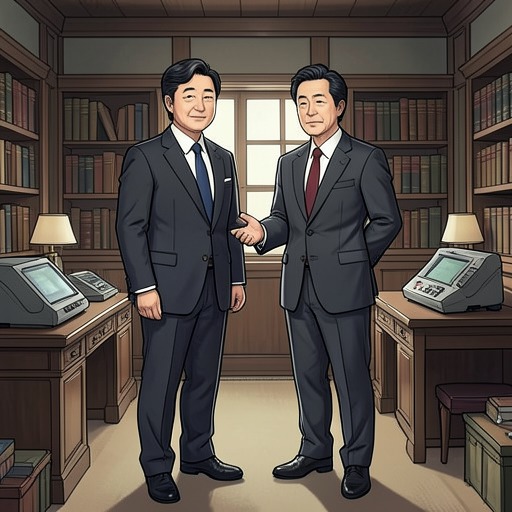
The contrast is visible in the recurring photograph Sayuri finds in the articles. Iwamura Ken wears a stylish three-piece wool suit and holds the company’s first product, a ceramic two-bulb socket. Nobu stands beside him in formal clothes, shorter and at attention. Their appearance supplies a public image for a partnership whose importance is not merely symbolic: Nobu brings in investors and saves the business from ruin in the early 1920s. Iwamura Ken publicly acknowledges that the company would not have survived several crises without Nobu’s abilities, and says he owes his partner a debt he can never repay.
The difference in their ages is small despite the impression their appearance creates. Iwamura Ken is only two years older than Nobu, though his prematurely gray hair and their difference in stature can make him seem almost like Nobu’s father. The remembered image thus emphasizes the asymmetry of their public presentation without diminishing their practical dependence on each other.
Recognition at the sumo exhibition
Mameha takes Sayuri to a sumo exhibition in a part of Kyoto she has never visited, where the two men are attending as guests and Nobu has helped organize the event. The exhibition is an important social introduction: Sayuri is presented as Mameha’s new younger sister, while Nobu watches her and Iwamura Ken appears curious. During the encounter, Sayuri serves tea and notices Iwamura Ken looking at her arm; Mameha’s conversation falls silent. The scene establishes the attention he gives the young apprentice without turning that moment into a claim about a relationship not yet developed in the evidence.
Before the formal introduction, Sayuri mistakenly prepares to address the man she expects to see as Mr. Tanaka. As Mameha bows to him and he turns, his face triggers recognition. He is not Mr. Tanaka but the Chairman—the man Sayuri had met once before by the Shirakawa Stream and had continued to imagine. The recognition transforms an anticipated encounter with another figure from her past into the return of a person who has occupied her memory for years.
Narrative significance
Iwamura Ken is drawn through two kinds of evidence: Sayuri’s emotionally charged recollection of a brief meeting and the documentary fragments she later gathers about his career. The first makes him a remembered presence before she understands his status; the second supplies dates, products, rivals, and the history of his partnership. Their juxtaposition gives the Chairman both the aura of a personal figure from Sayuri’s past and the concrete standing of an industrial founder.
His story also resists a solitary-inventor account of success. The two-bulb fixture begins with his design and the decision to found a company, but the company’s later endurance depends on Nobu’s management and ability to attract investors. The Chairman’s public acknowledgment of that debt clarifies the central relationship in his professional life: invention and direction are his, yet the enterprise cannot be separated from the partner who repeatedly sustains it.