Kaburenjo Gekijo
Memoirs of a GeishaKaburenjo Theater is a central Gion institution whose compound houses both a geisha school and the stage for the annual spring performance of Dances of the Old Capital. For Sayuri, it is first a place of apprenticeship, ordered by seniority and ritual; for Hatsumomo, its hidden basement becomes the setting for a secret she turns into leverage. The theater thus joins the visible discipline of performance to the less visible negotiations and vulnerabilities behind it.
Setting and Functions
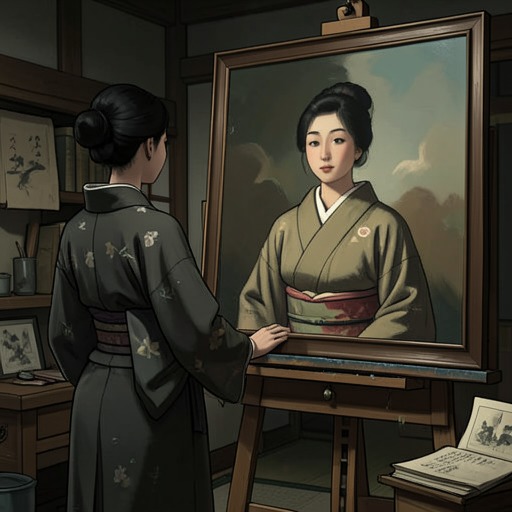
The compound first appears to Sayuri as an imposing garden of evergreen shrubs, twisted pine trees, and a decorative pond stocked with carp. A stone slab crosses the pond at its narrowest point, where two elderly women in kimono stand beneath lacquered umbrellas against the morning sun. Only later does Sayuri understand the buildings’ arrangement: a small portion of the grounds belongs to the school, while the massive structure at the back is the theater where Gion’s geisha perform Dances of the Old Capital each spring.
The school itself occupies a long wooden building that Sayuri initially mistakes for servants’ quarters. Its entrance is marked in her memory by the smell of roasted tea leaves, which later still recalls the prospect of lessons. Even the shoe cubbies make rank tangible. Pumpkin, one of the most junior girls, must climb the others like a ladder to reach her assigned place; on her first morning, Sayuri, still more junior, must use the cubby above Pumpkin’s. The school’s hierarchy is built into an ordinary act of arrival, and Pumpkin warns Sayuri that stepping on another girl’s shoes will bring a severe scolding.
Training and Performance
The theater compound belongs to the same professional world that trains its performers. Sayuri’s novice status becomes especially clear at her first banquet: she remains beside Mameha like a shadow, introduces herself as a novice, and receives no further conversation from the guests. Mameha, by contrast, performs with assurance. In the dance Chi-yo no Tomo, or “Friends Everlasting,” she turns a closed fan into the suggestion of flowing water, then opens it to become a sake cup. The episode links the school’s hierarchy and instruction to the public artistry for which the theater is known.
Kaburenjo Theater also figures in Sayuri’s later observations of Mameha’s professional skill. At a banquet, a young guest can offer only a remark about the warm weather. Mameha adapts her reply to his inexperience, answering with a suggestive story that leaves his fingers trembling when he sets down his sake cup. The theater itself is not the site of this exchange, but the episode illuminates the trained social performance that the school and its stage prepare geisha to undertake: movement, conversation, and attention to an audience all become parts of the work.
A Hidden Space and Its Consequences
The theater has a concealed underside as well as a public stage. Hatsumomo tells Korin that, after returning to retrieve something she had left there following a rehearsal, she heard what she took to be moaning from the basement stairs. She went down, switched on the light, and found Mameha’s maid with the theater’s custodian. Hatsumomo then used the discovery to pressure the maid into giving her Mameha’s kimono, describing the garment until the maid understood which one she meant.
This account turns the theater’s basement into the inverse of its stage. The stage presents rehearsed, visible performance; the basement holds an encounter meant to remain private. Hatsumomo’s ability to move between these spaces—and to make a private discovery serve a public rivalry—shows how the theater can function as more than a venue. It is part of the working geography of Gion, where rehearsal, training, performance, and concealed conduct meet, with consequences that extend beyond the compound itself.