Kyoto
Memoirs of a GeishaKyoto is both the destination that takes Sayuri from her childhood home and the city against which she later measures the limits of her world. Its railway stations, streets, Gion district, university, and riverbanks mark successive changes in her life: arrival with Satsu, entry into the geisha world, encounters with influential patrons, wartime exile, and an eventual return. In Sayuri’s recollections, the city is never merely a setting; it is at once a place she inhabits and a map of what she has lost or cannot reach.
Arrival and First Impressions
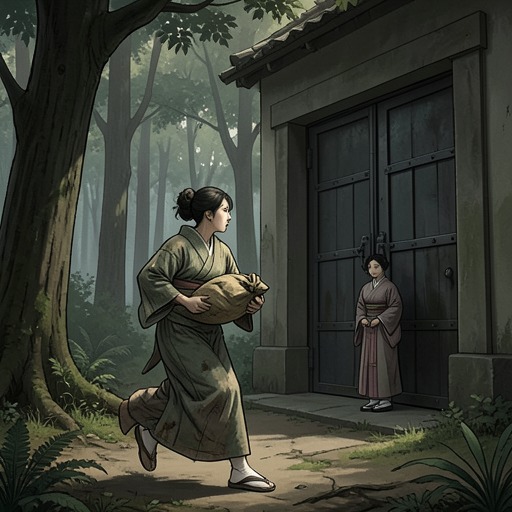
In around 1930, Mr. Bekku tells an older woman that the girls are going to Kyoto. The journey takes many hours and includes two trains. Sayuri and Satsu travel without food; she watches Mr. Bekku eat a sesame-sprinkled rice ball while she remains hungry and anxious. On the second train, the crowd is so dense that they must stand. As evening approaches, they reach Kyoto Station, where the scale of the city astonishes Sayuri: rooftops extend toward distant hills, and the streets and buildings seem as foreign to her as the bottom of the sea.
The station and its surroundings establish Kyoto as both a real destination and an intimidating expanse in the child’s imagination. Rickshaws wait outside in numbers that lead Sayuri to suppose they are the city’s ordinary means of transport. Mr. Bekku takes the girls by their elbows, and the three ride together to Tominaga-cho, in Gion. Sayuri does not yet know what awaits her there, but prefers to follow him rather than be left alone among unfamiliar streets. Years later, the sight of buildings from a train still recalls the fear and emptiness of this departure from home.
Kyoto Beyond Gion
As Sayuri grows up in Gion, the district becomes so dominant in her experience that she comes to treat it as though it were the whole world. Mameha’s engagements beyond its boundaries begin to unsettle that assumption. During a period when Hatsumomo’s ridicule has made Sayuri an exile from much of Gion’s social life, Mameha takes her on a train trip to Kobe and on a limousine tour of Kyoto with the former president of Nippon Telephone & Telegraph. The tour is Sayuri’s first experience of a car and of the broad city beyond the small social world she knows.
That wider view also exposes deprivation that Gion rarely brings before her. On the drive south along the river, Sayuri sees impoverished women nursing babies beneath trees near the railway tracks and men among the weeds in worn straw sandals. The sight alters her understanding of her own hardship: despite Hatsumomo’s cruelty and Sayuri’s precarious position, she recognizes that she has lived relatively fortunate circumstances through the Great Depression. Kyoto’s outskirts therefore broaden her perspective not through abstract reflection but through visible contrasts between the protected world of geisha engagements and people living in severe poverty.
Gion, the University, and Public Recognition
Kyoto University becomes an important threshold between Gion’s familiar customs and the wider public world. Mameha brings Sayuri to the university campus for a sumo exhibition, where Western-style buildings, an iron gate, and crowds of students make the apprentice geisha feel out of place. Young men stop to watch the two women and make jokes among themselves. The exhibition is held in Kyoto University’s old Exhibition Hall, a large, worn building whose rough appearance reminds Sayuri of her childhood home. The setting briefly joins two distant parts of her life: the rural house she left behind and the urban professional world she is beginning to enter.
At the exhibition, Mameha introduces Sayuri to Iwamura Ken and Nobu Toshikazu. Sayuri learns that the two men are famous business partners, as closely connected as a tree and its roots. The encounter also links Kyoto to an earlier moment in Sayuri’s life, since she recognizes Iwamura Ken as the man she had met by the Shirakawa Stream. As she serves tea, the Chairman looks at her arm, and she becomes aware of how his attention changes the encounter. Kyoto is thus the place where private memory and public recognition meet: a chance meeting from her childhood is reinterpreted within the influential company she is entering as an apprentice geisha.
The city also provides the setting for moments when Sayuri’s professional future becomes publicly visible. After returning from Hakone, she arrives at Kyoto Station exhausted and sees a new poster for that season’s Dances of the Old Capital. Drawn by Uchida Kosaburo, it depicts an apprentice geisha in a green and orange kimono standing on an arched bridge beneath the morning light. Sayuri realizes that she is the girl in the image. The poster turns her likeness into a public representation, and the station—once the place of frightened arrival—becomes the site where she encounters evidence of her growing recognition.
Exile, War, and Return
Kyoto remains close to Sayuri even when she cannot return to Gion. During the war she lives and works with the Arashino family, sewing parachutes and sharing the privations of the household. In spring 1944, the family watches aircraft pass overhead; the bombers leave Kyoto untouched, though fires in Osaka redden the moon and ash sometimes reaches the city. Sayuri worries about the Chairman and Nobu, whose company is based in Osaka and who also have homes there, and wonders what has become of Satsu. The city’s survival offers no assurance that those separated from one another are safe or that they can reunite.
After Japan’s surrender in August 1945, the geisha districts reopen within months, but Sayuri cannot go back until Mother summons her. Mother and Auntie remain on a small farm west of Kyoto, making a living by selling possessions to American soldiers, while Sayuri stays with the Arashinos. Although Gion is only a few kilometers away, she visits it only once during nearly five years away. About a year after the war, on her way back from Kamigyo Prefectural Hospital with medicine for the Arashinos’ grandson, she crosses from Kawaramachi Avenue into Gion. Poverty along the river and the absence of recognition from former acquaintances make the district feel estranged from her.
On that visit, familiar locations return as fragments of an earlier life: the Shirakawa Stream recalls walks with Mameha; a bench recalls an evening when Sayuri asked Pumpkin for help; and an alley recalls Nobu reprimanding her for accepting the General as her danna. Rather than restoring her former sense of belonging, these places reveal how far that life has receded. She visits the okiya and longs at the sight of its heavy iron padlock, but the city’s streets hold memories where a functioning home and community should be.
Rebuilding a Life in the City
Sayuri’s eventual return follows a letter she writes to Mother while living with the Arashinos. Auntie arrives with coal and food to thank the family for caring for Sayuri; the next day, Sayuri takes leave of them and goes back to Gion. The okiya must first be made livable again. Dust covers the woodwork, dead rodents remain in the well, and birds have damaged the tatami mats in Mother’s room. Mother, Auntie, and Sayuri undertake the cleaning together, with only limited household help. Return to Kyoto is therefore neither immediate restoration nor a simple resumption of her old life: it begins in a neglected house that bears the physical consequences of years away.
When the house is ready, Sayuri visits Mameha, who has returned to Gion and lives in a one-room apartment above a pharmacy near the Gion Shrine. The city brings former relationships back into reach, but not unchanged: Mameha has no danna to pay for a larger home, and the years of hardship are visible in her appearance. Across the narrative, Kyoto similarly gathers continuity and rupture. It is the vast city that once frightened a child, the stage on which Sayuri becomes known, the place she watches from outside during wartime, and the community she must rebuild a connection to after years of absence.