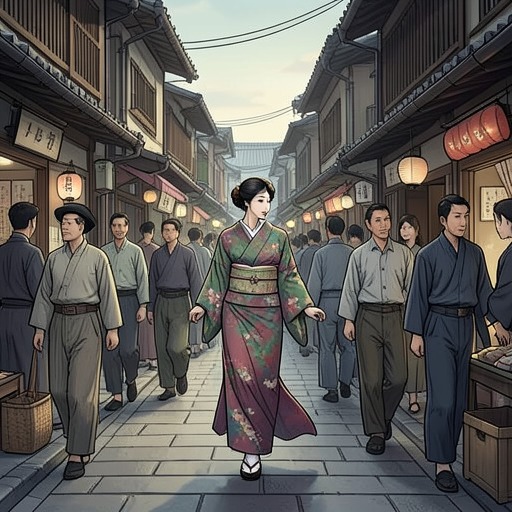
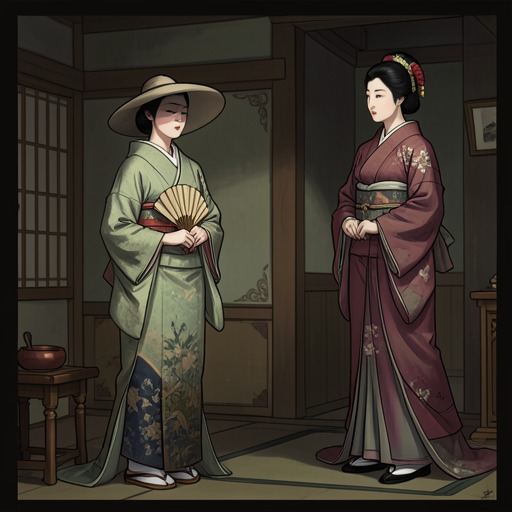
Mameha and Hatsumomo's rivalry
Memoirs of a GeishaMameha and Hatsumomo's rivalry is a contest over influence, reputation, and succession within the okiya. Mameha’s efforts to guide Chiyo bring her into direct conflict with Hatsumomo, whose campaign to make Pumpkin the okiya’s adopted daughter threatens to secure Hatsumomo’s own place there. Their opposition is not merely personal: it determines which apprentice can advance and who may be left without a future in the house.
The Rivalry in Public
At a gathering with men, Hatsumomo turns Chiyo’s presence into an opportunity for humiliation. She announces that a novice has appeared and pretends that telling the rest of her story would embarrass the girl. Chiyo hopes Mameha will take her away, but Mameha gives her an anxious look instead. Leaving Hatsumomo alone with the men, Mameha judges, would be like running from a house on fire; remaining gives them a chance to control the damage. The moment shows the practical constraint of their rivalry: Mameha has to protect Chiyo without surrendering the room to Hatsumomo.
The encounter ends in apparent sociability rather than open defeat. After the men laugh at a joke that seems to turn Hatsumomo’s own story against her, Mameha and Chiyo leave; Hatsumomo and Pumpkin follow. Hatsumomo calls the evening great fun and wonders why she and Mameha have not entertained together more often. Mameha agrees, then hints at her pleasure in what the future holds. Once the two women are away from Hatsumomo, Mameha gives Chiyo a satisfied look: she is relishing the prospect of seeing her rival destroyed. The cheerful exchange conceals, rather than resolves, the hostility between them.
That night, Hatsumomo makes the injury physical. She returns to the okiya unusually early and confronts Chiyo, striking her across the face. She says Chiyo had understood what she meant when she asked whether Chiyo had hair, and accuses her of making her look foolish; she promises to return the favor. The contrast with her public laughter is sharp: when an encounter has embarrassed her, Hatsumomo abandons the performance of civility and threatens retaliation directly.
Mameha’s Counterstrategy
Chiyo reports the slap to Mameha the next afternoon, but Mameha is more concerned with what Hatsumomo can accomplish in public than with the fact of the blow. Chiyo fears their next encounter. Mameha’s answer is to leave any party where Hatsumomo appears, even if they have only just arrived. Walking out may surprise the host, but it denies Hatsumomo another chance to humiliate Chiyo. Mameha also calls such a meeting a blessing, though Chiyo cannot yet see why. Her response is strategic: she avoids a contest on Hatsumomo’s terms while implying that the rivalry can be made to serve a larger plan.
Mameha reads Hatsumomo’s treatment of Pumpkin as evidence of how much is at stake. Hatsumomo has begun taking her younger sister everywhere. An apprentice geisha under sixteen is billed at half an ohana per hour, and a five-minute visit costs the host as much as a full hour. Yet the custom expects the apprentice to stay longer, so repeated brief appearances can make both Hatsumomo and Pumpkin look bad. The tactic may bring Pumpkin substantial earnings—perhaps three or four ohana an hour—but it risks her reputation. Mameha sees this costly promotion not as simple generosity but as a sign of desperation.
Pumpkin and the Stakes of Succession
Mameha explains that Hatsumomo wants Pumpkin to look desirable so Mrs. Nitta will adopt her as the okiya’s daughter. Adoption would assure Pumpkin’s future and, because Hatsumomo is her sister, protect Hatsumomo from being thrown out. Mameha makes the danger to Chiyo explicit: if Pumpkin is adopted, Chiyo may never be free of Hatsumomo unless Chiyo herself is expelled. The rivalry thus reaches beyond the two older geisha. Hatsumomo’s campaign uses Pumpkin’s standing to preserve her own, while Mameha’s effort to make Chiyo a popular apprentice is obstructed by that campaign.
For Chiyo, Mameha’s explanation transforms the earlier scenes. Hatsumomo’s conduct at parties, her pursuit of the appearance of popularity for Pumpkin, and her hostility toward Chiyo form parts of one contest over who will belong securely in the okiya. Mameha had hoped to see Chiyo become a popular young apprentice soon, but acknowledges that Hatsumomo has gotten in their way. Her counsel is not a promise that Chiyo is safe; it identifies the mechanism by which her rival can threaten her.
Escalation and the Planned Reversal
The rivalry changes when Chiyo is given a role in the seasonal dances, despite having had only about a month to rehearse. Her dance teacher helps her privately in the afternoons. Mrs. Nitta learns of the role days later through a rumor during mah-jongg and returns to the okiya to ask whether it is true. Chiyo confirms it, and Mrs. Nitta walks away with a puzzled expression. Hatsumomo is furious, but Mameha is unconcerned. She declares that the time has come for them to toss Hatsumomo from the ring.
The phrase marks a shift from defensive management to an intended reversal. Earlier, Mameha’s plan was to withdraw from gatherings rather than let Hatsumomo publicly humiliate Chiyo. Now Chiyo’s dance role supplies evidence of her growing opportunity, and Mameha treats Hatsumomo not as an unavoidable obstruction but as a rival they can remove from the contest. The surviving scenes establish the intention and its immediate cause, but do not themselves describe the outcome of this plan.
Relationship and Narrative Function
Mameha and Hatsumomo oppose one another through different forms of power. Hatsumomo uses social display, public mockery, and her influence over Pumpkin; Mameha reads the reputational costs of those tactics and counters by managing where Chiyo appears, interpreting the adoption stakes, and advancing Chiyo’s career. Their exchange of compliments at the gathering shows how hostility can be conducted beneath polished manners, while Hatsumomo’s slap reveals the violence that surfaces when that performance fails.
The rivalry also makes Chiyo’s apprenticeship inseparable from the okiya’s internal politics. Her advancement depends not only on training and performance but on whether Hatsumomo can secure Pumpkin’s adoption and thereby preserve her own position. Mameha’s protection gives Chiyo a guide through those stakes, yet it also draws her into a conflict in which a dance role, a brief party appearance, and a host’s impression can all alter the balance of power.