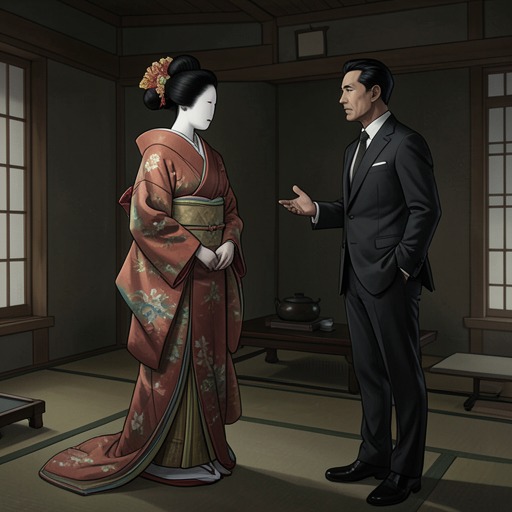
Mameha's kimono
Memoirs of a GeishaMameha's kimono is an exceptionally crafted green silk robe whose beauty and value make it more than a garment: Hatsumomo turns it into a weapon against Chiyo, compelling her to damage it and leaving her responsible for the cost. Its vine-like decoration, the threat behind its defacement, and the debt imposed afterward expose how geisha clothing can embody artistry and status while also serving as an instrument of power.
Appearance and Craft
The robe is described as powdery green silk, worked with a vine that climbs from the hem toward the waist. Heavily lacquered threads, bunched into a tiny cable and sewn into the fabric, make the vine seem almost capable of being plucked away. Its curling leaves appear to be drying and yellowing in autumn. The design's naturalistic delicacy makes the later act of writing on the cloth especially destructive: the marks deface not an anonymous piece of fabric but a painstakingly realized work of art.
The novel places that artistry within the elaborate material culture of geisha dress. A kimono's fit depends on careful folding and adjustment, while an obi requires several cords, clasps, and padding to hold its shape. The robe is valuable enough to be stored among the Nitta okiya's many carefully wrapped garments, in a collection whose worth makes Granny fear a fire. Clothing here requires skilled labor and costly materials; it is also a visible sign of the standing and resources attached to its owner.
Hatsumomo's Scheme
Hatsumomo obtains the robe by exploiting a compromising discovery at the Kaburenjo Theater. She says she found Mameha's maid with the theater's custodian in the basement and used the prospect of revealing the incident to pressure the maid into giving her Mameha's kimono. The leverage rests on the maid's fear that Mameha would be told, not on any wrongdoing by Mameha herself. Hatsumomo later makes Chiyo buy a second garment with her own money as well, extending the episode beyond the single robe.
At the okiya, Hatsumomo turns the robe's beauty into a trap. She makes Chiyo grind ink, places the brush in her hand, and orders her to practice calligraphy on the silk. When Chiyo protests, Hatsumomo's friend Korin warns that refusing to obey could cost Chiyo the chance to find her sister. Hatsumomo then dictates where and what Chiyo must mark, though the strokes have no meaning and are intended only as an artistic-looking defacement. Afterward Hatsumomo folds the kimono back into its linen wrapping. The sequence makes the coercion central: Chiyo's hand performs the damage, but Hatsumomo controls the brush, the instructions, and the threat.
Blame and Debt
When the incident comes to light, Mother refuses to accept Hatsumomo's story but rules that Chiyo must pay because the maid saw her holding the brush. Her decision turns the visible evidence of the act into a financial judgment, regardless of the pressure that produced it. Auntie objects that Chiyo already has enough debts and should not have to pay Hatsumomo's as well, but Mother maintains the charge. The robe's value therefore acquires a second force: it becomes a liability imposed on a girl already economically vulnerable.
Auntie explains that Hatsumomo's trick will cost Chiyo more than she can imagine and warns her never to trust Hatsumomo, even if she appears helpful. The kimono incident consequently marks more than a moment of humiliation or damage. It burdens Chiyo with debt and demonstrates how Hatsumomo can convert a valuable object, a staged act, and the okiya's rules into pressure on a rival's future.
From Luxury to Scarcity
The robe's significance gains a darker counterpoint during the war. Years later, Sayuri recalls that cosmetics and permanents were prohibited as luxuries by the military government, while lavish gifts had become almost unheard of. Her own belongings amounted to a few scrolls, inkstones, and bowls, alongside stereoscopic photographs and a silver viewer given by the Kabuki actor Onoe Yoegoro XVII. Against that diminished inventory, Mameha's richly worked silk belongs to a world of expensive garments and gifts that war steadily constricts.
The contrast continues in Sayuri's account of wartime life with the Arashino family. They sew parachutes, burn compressed leaves, newspapers, and magazines for warmth, and eat soybean dregs and fried rice bran in wheat flour when food is scarce. When hunger drives the family to sell kimono from Mr. Arashino's collection, Mother buys and resells such heirlooms through the gray market, often failing to return them when their owners hope to reclaim them. These later details do not establish the fate of Mameha's particular robe, but they show how the book's material world changes: garments once treasured for craft and status can also become assets traded for cash under scarcity.
Narrative Significance
Mameha's kimono binds together several kinds of value. Its vine is a crafted image of natural growth, but the robe's place in the okiya's storehouse also reflects the resources and labor invested in geisha clothing. Hatsumomo's scheme exposes the vulnerability beneath that refinement: a valuable garment can be appropriated, marked, and made the basis of another person's debt. The robe's episode therefore connects material beauty to institutional power without treating either as abstract. Its physical delicacy is precisely what gives Hatsumomo's coercion its force.
Across Sayuri's recollections, clothing and other possessions remain inseparable from the circumstances in which they are made, given, stored, sold, or lost. Mameha's robe first signifies exquisite workmanship and an adversary's power to exploit it; the wartime account later places treasured kimono within a system of forced exchange. The novel's attention to such objects makes changes in wealth and security tangible, from the brush pressed to silk to heirlooms passing through a gray-market trader's hands.