Miyagawa-cho
Memoirs of a GeishaMiyagawa-cho is the district south of Gion where Chiyo is sent to find her sister Satsu, and its first appearance is shaped by a reversal: the search offers a destination, but the district’s streets expose a social world of hardship rather than reunion. Seen through Chiyo’s recollection, its darkened alleys and houses mark the distance between the geisha quarter she knows and the precarious life she fears Satsu has entered.
Location and first approach
Hatsumomo tells Chiyo that Satsu is in a brothel called Tatsuyo, in Miyagawa-cho, just south of Gion. The information gives Chiyo a place to seek her sister, but nothing about the journey promises that the meeting will be welcome or safe.
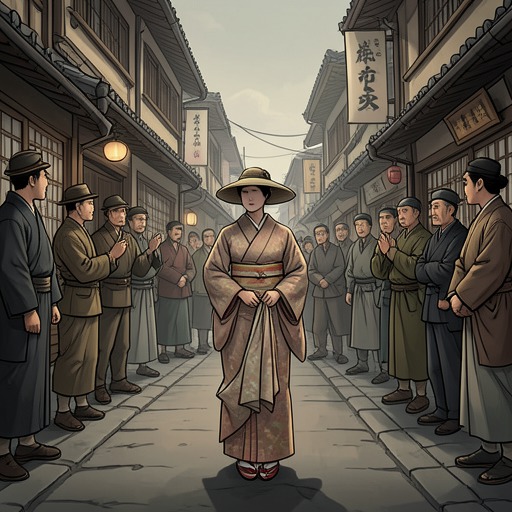
Chiyo reaches the district after walking through Gion in rain that has eased to mist. Lantern light glints gold on the paving stones as she makes her way through Tominaga-cho to the Minamiza Theater, then follows the street behind it when the road beside the river ends. Beyond the theater, the streets are nearly empty and have no streetlights. Chiyo later connects their quietness to the Great Depression: in another era, Miyagawa-cho might have been busier than Gion.
Streets and signs of a different world
At first, Miyagawa-cho seems superficially familiar. Its wooden facades resemble those of Gion, but Chiyo notices what is missing: trees, the Shirakawa Stream, and beautiful entryways. Open doorways, lit by exposed bulbs, are the main source of illumination; older women sit on stools, sometimes beside younger women Chiyo takes to be geisha.
The women’s appearance contains a practical sign that Chiyo does not yet understand. Their obi are tied in front, unlike the sashes she has seen tied at the back. She learns that this marks prostitution: a woman who must repeatedly put on and remove her sash cannot be expected to retie it behind her each time. The observation makes the district legible through a detail of dress, connecting its visible customs to the labor and conditions they signal.
Tatsuyo and Chiyo’s search
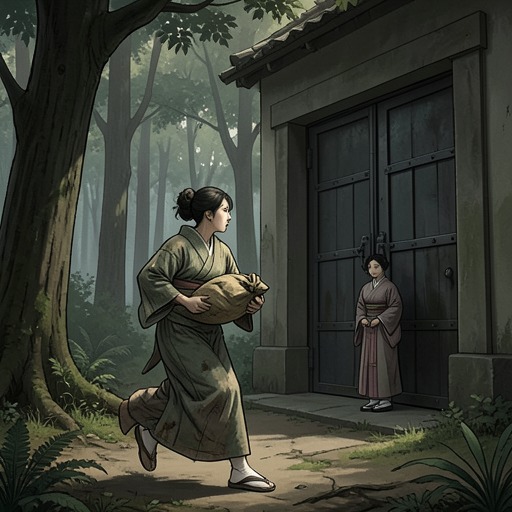
With help from one of the women, Chiyo finds Tatsuyo at the end of a dead-end alley containing only three other houses. Placards identify the houses. The sight of the sign reading Tatsuyo affects her physically; she feels a tingling throughout her body, as if she might burst. Her intense reaction reflects how much the address means to her after Hatsumomo’s revelation.
Outside Tatsuyo, an elderly woman sits in the doorway, talking with a younger woman across the alley. The old woman’s gray robe hangs partly open, and her coarse straw sandals, bare feet, and uneven toenails sharply contrast with the lacquered sandals and silk socks associated with Hatsumomo’s elegant dress. The contrast makes the district’s poverty tangible without making it a mere backdrop: Miyagawa-cho is encountered through bodies, clothing, and the conditions of its street life.
Narrative significance
Miyagawa-cho forms a physical and social counterpoint to Gion. The two districts share wooden buildings and geisha-like dress, yet their differences emerge in the absence of greenery and stream, the front-tied obi, and the poorly lit doorways. The details show that visual resemblance does not mean social equivalence.
For Chiyo, the trip is also a painful turn in her understanding of the past. Before reaching the district, she has already concluded that Mr. Tanaka took her from her parents, sold her and Satsu into different forms of exploitation, and was not the kind man she once believed him to be. Miyagawa-cho gives that realization a concrete destination: the search for Satsu is bound to the district where Chiyo has been told she is living, and the route through its quiet, unfamiliar streets brings her hope into contact with the harshness of their divided circumstances.