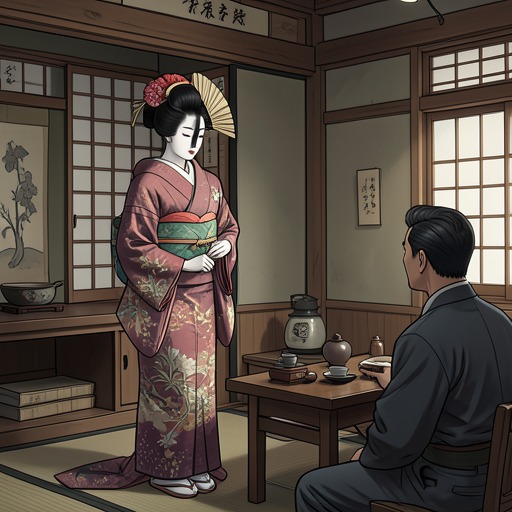
Mizuage
Memoirs of a GeishaMizuage is presented as both a sexual initiation and a transaction embedded in the geisha economy: patrons may compete for the privilege, the payment can settle an apprentice’s debts, and the rite can alter her standing within the okiya. Mameha first explains it to Sayuri through the “homeless eel” metaphor, describing male desire and territoriality in language designed to make the custom legible to an inexperienced girl. The later revelation that the bidding for Sayuri was not the contest Mameha had described, and that the ceremony leaves her with a lifelong patron but no special privileges for him, reveals the distance between the practice’s euphemistic explanations and its economic and personal consequences.
Meaning and Preparation
In Mameha’s explanation, men search for women whose sexual experience is believed to be untouched by another man; she calls the desired first encounter mizuage. The term itself is not given a settled, literal account: Sayuri notes that mizu can mean “water” and age “raise up” or “place on,” and that geisha offer different explanations of its origin. The gap between the suggestive image and the uncertain etymology suits a custom surrounded by indirect speech. Mameha tells Sayuri about it by stages, using the cave-and-eel conceit rather than immediately stating what the practice entails.
The custom is also a mechanism of patronage. Mameha says that Dr. Crab, who earns substantial money from his hospital, spends much of what remains after supporting his family in pursuit of mizuage. She describes herself as the kind of young girl he favors and recounts that he once paid a record amount for her own mizuage. Her account makes clear that fame can raise the price, and that wealthy men may compete for the arrangement: Dr. Crab bid against the businessman Fujikado, whose distance from Gion made him less concerned about offending a local rival. Mameha’s history thus supplies the precedent behind her plan for Sayuri: the rite is not only described as an intimate encounter but organized as a contest capable of producing a large payment.
Mameha sees a possible financial opening when Nobu appears taken with Sayuri at a sumo tournament. She regards him as resembling Fujikado, a self-made man Dr. Crab would find repellent, and hopes that interest from both men could generate competing bids. Sayuri is not likely to become famous in the ordinary way while Hatsumomo obstructs her, Mameha reasons, but a bidding contest might nevertheless make her mizuage valuable enough to repay her debts. She also thinks Hatsumomo’s pleasure at Nobu’s attention blinds her to the financial consequence: what Hatsumomo takes as evidence of Sayuri’s appeal may help raise the price.
Mameha’s strategy depends on sustaining Dr. Crab’s interest as well as Nobu’s. She believes that a man cultivating a relationship with a fifteen-year-old apprentice has mizuage in mind, and tells Sayuri that conversation is not what attracts him. Yet the later account complicates this confident rule: Nobu does bid aggressively at first, but his interest proves vague, and he withdraws once the bidding passes ¥8,000. Mameha’s theory makes the arrangement sound predictable; Sayuri’s eventual experience shows that a patron’s motives and willingness to compete cannot be inferred so neatly.
Signs, Gifts, and the Auction
When Mameha learns that Hatsumomo has planted in Dr. Crab’s mind the suspicion that Sayuri has already had a boyfriend, she recognizes it as an attempt to make him believe that Sayuri is no longer eligible for the kind of mizuage he seeks. Mameha also learns that Pumpkin’s adoption is approaching. She concludes that Sayuri’s mizuage must take place within the next few months, whether Sayuri feels ready or not. The looming adoption gives the plan a deadline: the contest is not an abstract prospect but a step in deciding Sayuri’s place and financial future in the okiya.
That same week, Mameha orders ekubo, dimpled sweet-rice cakes that apprentices present to men who patronize them when they become available for mizuage. Their name means “dimple,” and each cake has a small red circle in its indentation; Sayuri sees them as pillow-like, while acknowledging their suggestive associations. Apprentices commonly distribute boxes to a dozen or more men. Sayuri expects to offer them only to Nobu and Dr. Crab, if the scheme succeeds, and feels a measure of sadness that the Chairman will be excluded—alongside relief that he will not be drawn into an arrangement she finds distasteful.
The presentation turns patronage into a public, formal exchange of courtesies. At the Ichiriki, Sayuri and Mameha meet Nobu in a small room overlooking the entrance courtyard. Sayuri thanks him for summoning her to parties over the previous six months and for his gifts, including an antique ornamental comb he had given her. She slides the box of ekubo across the table, and the two women bow and thank him repeatedly. The ceremony is brief, but the box makes the intended possibility unmistakable: his generosity is being acknowledged while he is invited to take part in the contest.
A few days later, Mameha tells Sayuri that the bidding has begun, after receiving a message that morning from the mistress of the Ichiriki. She regrets that she must leave for Tokyo that afternoon and says Sayuri will recognize a high bid because events will begin to happen. When Sayuri asks what kinds of events, Mameha gives no precise answer. The warning underscores how little control Sayuri has over the process: the bids are mediated through the teahouse and her mentor, while she is left to interpret their consequences as they unfold.
The Actual Contest and Its Price
On returning to town the following day, Mameha learns that Mother has decided to adopt Sayuri. She tells Sayuri that the bidding between Dr. Crab and Nobu went as she hoped and ended at a considerable sum; once she learned the final figure, she says, she knew Mrs. Nitta would adopt Sayuri. Sayuri later discovers that this version concealed the crucial fact: the final contest was between Dr. Crab and the Baron, not Dr. Crab and Nobu. Mameha’s sudden reserve after the result, and her silence about what had happened, take on meaning in light of that change.
Nobu was involved, but only in the opening days. He bid aggressively until the amount passed ¥8,000, then dropped out—not, Sayuri concludes, because the price had become too high, but because his interest in the mizuage itself was only vague. Mameha had assumed his relationship with Sayuri signaled the same objective as Dr. Crab’s. In the event, the Baron became the rival bidder she had not anticipated. The discrepancy matters: Mameha’s financial plan succeeds in raising the price, but not through the pair of patrons on whom she thought the contest depended.
The payment reshapes Sayuri’s economic position through adoption. The mizuage fee is more than enough to repay her debts to the okiya. Once adopted as Mother’s daughter, Sayuri’s debts cease to exist because the household absorbs them; at the same time, all her profits belong to the okiya thereafter, not merely the mizuage proceeds. Adoption therefore removes the old debt while securing the household’s claim on her future earnings. A sum that appears to purchase freedom from accumulated obligations also changes who controls the income Sayuri will produce.
Ceremony and Aftermath
Sayuri’s mizuage takes place in early July 1935, when she is fifteen. In the afternoon she and Dr. Crab drink sake in a ceremony at the Ichiriki Teahouse that binds him to her as mizuage patron for the rest of his life. Mother, Auntie, and Mameha are present, as is the mistress of the Ichiriki. Mr. Bekku attends in his role as dresser, representing the geisha’s interests in such ceremonies. Sayuri wears the most formal costume available to an apprentice: a black robe with five crests over a red underrobe, whose color is associated with new beginnings. At Mameha’s instruction, she maintains a stern, humorless manner as she walks down the hallway with her kimono train pooled around her feet.
The formal binding is followed by dinner at Kitcho, where Sayuri speaks little and eats even less. Dr. Crab appears bored, looking down through his glasses as though at a business meeting. The contrast between the ceremony’s solemn importance to Sayuri and his detached manner sharpens the difference between the ritual’s emotional weight and the transaction’s institutional purpose. The ceremony establishes him as patron until his death, but it does not give him special privileges over her.
After the night together, Dr. Crab walks to the inn’s front door with Sayuri. He thanks her and gives her a small package. Unsure whether it contains a jewel or something from the bloody towel, she opens it only after asking Mr. Bekku what it is: Chinese herbs, to be made into tea once a day to discourage pregnancy. His advice is practical and costly, stressing caution without implying that the herbs are cheaper than an abortion. The package brings the bodily consequences of the arrangement into view, beyond its bid, ceremony, and change of patron.
Sayuri describes a shift in how she sees the women around her after the rite. Pumpkin, who has not yet undergone mizuage, seems inexperienced and childlike, even though she is older. Sayuri becomes newly conscious of the experience she shares with Mother, Auntie, Hatsumomo, and Mameha, and feels more worldly than apprentices who have not yet been through it. The change is registered visually as well as inwardly: an apprentice who has undergone mizuage wears a red silk band at the base of her pincushion bun instead of a patterned one. For a time, Sayuri notices these bands everywhere, reading them as signs of a threshold crossed.
Meaning and Consequences
Mizuage links sexuality to a system of money, reputation, gifts, and household ownership. Its preparation involves patrons, intermediaries, ceremonial sweets, a teahouse, and competing bids; its proceeds can settle an apprentice’s debt, but adoption then transfers her future earnings to the okiya. The custom’s public signs—a red collar for an apprentice’s underrobe, a formal costume, and, after the rite, a changed hair band—make changes in status visible, while much of the negotiation remains hidden from the young woman whose body and income are at stake.
The language used to explain the rite also shapes what Sayuri can understand. Mameha’s eel metaphor renders male competition vivid but reduces a woman’s experience to territory to be claimed; the cake’s dimple and red mark similarly turn an intimate threshold into a token circulated among patrons. Sayuri’s account resists treating that euphemistic system as a seamless tradition. Her uncertainty, her distaste, the practical herbs meant to prevent pregnancy, and her later discovery that the auction’s real rival was the Baron all expose different parts of the cost the explanation initially conceals. Mizuage marks a change in Sayuri’s social standing, but it does not end her dependence: debt is erased by an adoption that leaves the okiya entitled to her profits thereafter.