Mr. Bekku
Memoirs of a GeishaMr. Bekku is a dresser whose work in the Nitta okiya places him beside Chiyo at both the beginning of her displacement and one of the most consequential ceremonies of her apprenticeship. First encountered as a silent, unsettling man who helps take Chiyo and Satsu away from home, he later proves to be a regular professional presence: he helps Hatsumomo dress and, years afterward, prepares Sayuri for her mizuage and assists her through its aftermath. His recurring role links the abrupt rupture of Chiyo’s childhood to the formal routines by which she is remade as a geisha.
Identity and Introduction
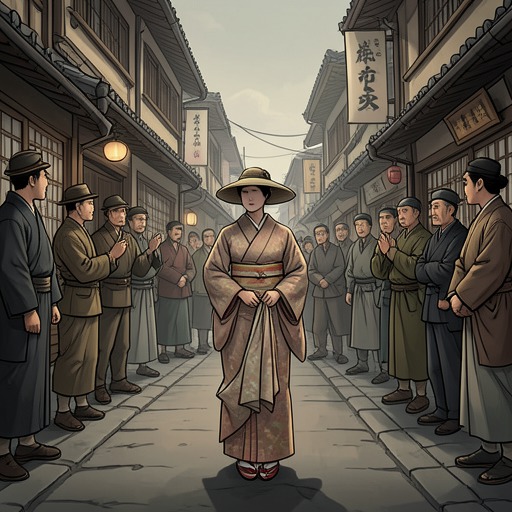
When Chiyo and Satsu are brought to a stopping place beside the train tracks, Mr. Bekku stands apart from the crowd of farmers and travelers. He wears a stiff kimono, carries a cloth bag suspended from a string, and has soft black hair. The adult Sayuri recalls that his appearance seemed out of place in the rural setting, and that she immediately felt frightened of him. The unease is sharpened by the scene’s uncertainty: Chiyo has already realized that the wagon is not heading to Mr. Tanaka’s home, and she does not yet know what the stranger’s arrival means.
Mr. Tanaka introduces the silent man as Bekku. He studies Chiyo closely and seems puzzled by Satsu, but says nothing. When Mr. Tanaka offers to have Sugi accompany him because Sugi knows the girls, Mr. Bekku declines. Once the train arrives, he wedges himself between the sisters and leads them by their elbows into the carriage. Chiyo is too confused to understand Mr. Tanaka’s last words; she cannot tell whether he has called after them to say they will meet again or to wait. Mr. Bekku’s first importance is thus practical and immediate: he is the person who physically guides the girls onto the train, while the meaning of their separation remains beyond their grasp.
Work in the Nitta Okiya
Chiyo later sees Mr. Bekku waiting near a full-length mirror while Hatsumomo prepares to dress. By then she has learned that he is not, as his first appearance had suggested, someone whose occupation is to take girls from their homes. He is a dresser who comes to the okiya every day to help Hatsumomo put on her elaborate kimono. That explanation revises Chiyo’s first impression without erasing it: the same man who ushered her into a train now belongs to the daily working life of the household.
The mirror and the clothing nearby make his profession part of the visible preparation of a geisha’s public appearance. In this early scene, Auntie smooths the robe laid out for the evening as Hatsumomo changes into an underrobe; Mr. Bekku waits close by. The evidence establishes his regular service to Hatsumomo, though it does not describe him as choosing her clothes or directing the broader household. His work is specialized assistance, repeated day after day, and it gives him a position at the edge of both the okiya’s routines and its ceremonies.
Role in Sayuri’s Mizuage
In early July 1935, when Sayuri is fifteen, Mr. Bekku takes part in her mizuage. The ceremony at the Ichiriki Teahouse binds Sayuri and Dr. Crab as patron and geisha; Mother, Auntie, Mameha, and the mistress of the teahouse are present as well. Mr. Bekku attends as Sayuri’s dresser, a role the narration identifies as customary at ceremonies of this sort because the dresser represents the geisha’s interests. His presence therefore extends beyond clothing: he is included among the people formally assembled around the occasion.
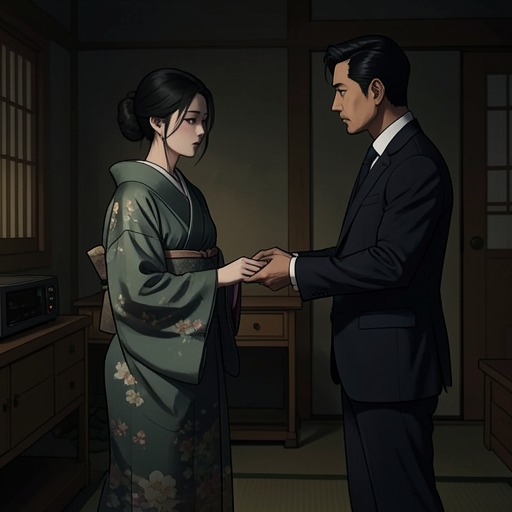
After dinner at Kitcho, Mr. Bekku escorts Sayuri by rickshaw to an inn on the grounds of Nanzen-ji Temple. He has already gone ahead to arrange her clothing in an adjoining room. There he helps her out of her formal kimono and into a more casual one, tying the obi so that its knot will come undone easily and requires no padding. When Sayuri is nervous, he helps her back into her room and positions her near the door to await Dr. Crab. These actions make his part in the ceremony concrete and carefully bounded: he prepares the clothes, assists with the change, and sees that she is ready for the next stage of the evening.
Assistance After the Ceremony
After the evening, Sayuri taps on the door of Mr. Bekku’s room while Dr. Crab is still bathing. A maid comes to change the bedsheets, and Mr. Bekku helps Sayuri put on a sleeping robe. The next morning, after breakfast, Sayuri sees Dr. Crab to the entrance and helps him into his shoes. He gives her a small package before leaving. Unsure what it contains, she asks Mr. Bekku about it; he identifies the contents as Chinese herbs and explains that they are to be made into tea once a day to discourage pregnancy, warning her that they are costly but less so than an abortion. The exchange shows him serving as a practical source of information after the formal event, though the account does not make him the person who supplied the herbs.
The contrast with his first appearance is telling. At the station, Chiyo understands Mr. Bekku only as the strange, silent adult who leads her away from home; in the okiya and at the inn, his work becomes legible through repeated acts of dressing, preparation, and assistance. He does not control Sayuri’s major decisions, but he is present where the systems around her become material: in the clothes she wears, the ceremonies she enters, and the arrangements that follow them. His recurring, limited service gives continuity to a life that changes names, households, and status.