Nitta Chiyojo
Memoirs of a GeishaNitta Okiya is the geisha household in which Chiyo begins her life in Kyoto, and the setting where shelter, training, work, and debt become inseparable. Governed by Mother and Granny, it offers the possibility of becoming a geisha while making a girl’s place in the house conditional on the approval of its elders. For Chiyo, the okiya is at once a home to enter, a hierarchy to navigate, and a confinement from which she will try to flee.
House and Household
When Chiyo first arrives, Auntie explains that the building is an okiya, a place where geisha live, and that hard work could allow her to become a geisha herself. But this future is not promised: another girl had recently been rejected by Mother and Granny after only a month. Auntie is reluctant even to learn Chiyo’s name before the household decides whether to keep her. The okiya’s first offer is therefore also a test of acceptance.
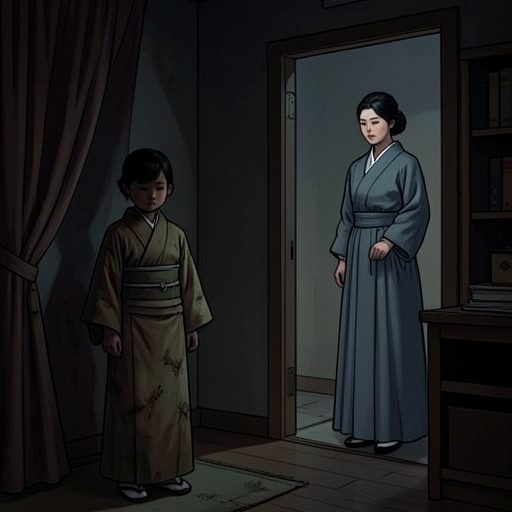
The house contains a courtyard with stepping-stones leading toward a storehouse, and a small shed with toilets along one side. Auntie washes Chiyo there and gives her a plain, coarsely woven dark-blue cotton robe, more elegant than anything she had previously worn. When the cook and elderly maids gather to stare, Auntie sends them away. The episode establishes a domestic world in which newcomers are observed and assessed, but where Auntie can still intervene to protect Chiyo from the household’s scrutiny.
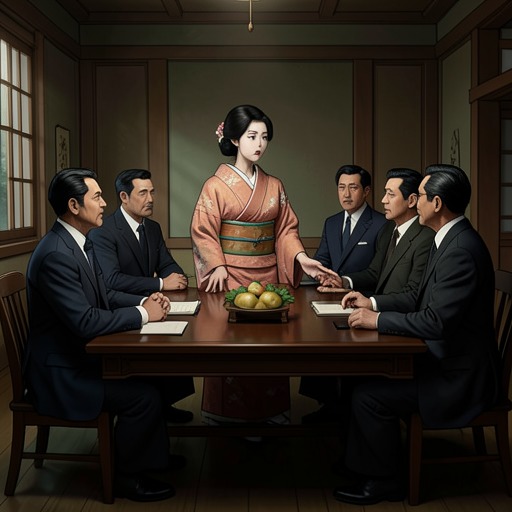
Mother and Granny embody the authority that Auntie prepares Chiyo to face. She tells the girl to bow low, avoid eye contact, and leave answers to Auntie if Granny questions her; Granny, she warns, has never liked anyone. Mother is described as more approachable, but chiefly concerned with one thing. The warning makes the household’s social rules legible before Chiyo can understand their full consequences: deference is expected, and approval from the person who controls the house matters most.
Work, Training, and Status
The okiya is also the base from which its girls enter the geisha profession. During a visit to Pumpkin’s lessons, Chiyo learns from a teacher that she lives in the Nitta household with Hatsumomo. She confirms that Hatsumomo is the only geisha currently living there. This makes Hatsumomo’s position unusually prominent: she is not simply one member of a crowded group of established geisha, but the house’s sole working geisha and an influential presence within it.
The household’s financial structure helps explain the tensions around status. Mameha points out that Mother has not adopted Hatsumomo, despite the okiya’s wealth and the absence of an heir. Adoption would make Hatsumomo Mother’s daughter and bring all of her earnings into the household, without paying any of them directly to Hatsumomo. Mameha suggests that Mother’s refusal has a reason: adopting a successful geisha with Hatsumomo’s forceful character might be like releasing a tiger from its cage. The okiya’s arrangements thus connect family position to economic control, while leaving Hatsumomo powerful enough to threaten the household’s balance.
That imbalance is visible in the younger girls’ training and prospects. In the spring of 1934, after Chiyo has spent more than two years in training, Mother and Hatsumomo arrange Pumpkin’s debut as an apprentice geisha without informing Chiyo. Pumpkin returns to the okiya wearing the momaware hairstyle, the “split peach,” which marks her new status. Chiyo sees the change in the entrance hall, but Pumpkin’s eyes meet hers only briefly; she is under orders not to speak with Chiyo. The household’s decisions can advance one girl while keeping another outside both the news and the ceremony.
Pumpkin’s formal presentation makes the okiya’s role in professional transition especially clear. She appears in a black kimono bearing the Nitta crest, with a plum-and-gold obi, white makeup, and the elaborate dress of an apprentice. Mother, Auntie, and Hatsumomo accompany her to the Mizuki Teahouse for the ceremony binding Pumpkin to Hatsumomo as sisters; Chiyo is not invited, though she watches from the entrance hall. Mother even gives Auntie a camera and sends her outside to photograph the flint-sparking ritual for good luck. The okiya does not merely house its girls: its senior women direct their advancement and mark that advancement through public ritual.
Rules, Discipline, and Confinement
The house’s authority reaches into daily movement. After Chiyo is accused of leaving the okiya when she should not have, Yoko confirms the departure to Mother. Mother orders the front door locked to prevent Chiyo from going out again. Auntie keeps the only key around her neck, even while sleeping, and Chiyo’s evening task of sitting by the door is transferred to Pumpkin. Pumpkin must then wake Auntie to have the door unlocked when Hatsumomo returns. A household routine has become a system of surveillance and controlled access.
Discipline also reaches beyond the person accused. Following trouble over Hatsumomo’s boyfriend being allowed into the okiya, Mother punishes the maids by denying them dried fish for six weeks. The maids blame Chiyo, and Pumpkin cries when she learns of the order. Mother also charges Chiyo for an obi brooch Chiyo says she never saw or touched. Chiyo suspects Mother does not truly believe she stole it, but that Mother is willing to buy a replacement at Chiyo’s expense to keep Hatsumomo happy. The episode shows how the okiya’s economic power can be used to impose costs, and how one resident’s standing can shape punishments across the household.
With the door locked and the key inaccessible, Chiyo spends nights trying to devise an escape. The restriction is physical, but it also sharpens her determination: she thinks that whatever makes life harder only strengthens her resolve to run away. Even the courtyard becomes a place for concealed distress. While pretending to weed, she squats on the stones and broods; later, when washing the maids’ floor, she notices water running toward a back corner and momentarily sees it as flowing uphill. The house’s corners and thresholds gather the pressure of a life increasingly shaped by blocked routes and the search for another way out.
Memory and Narrative Significance
Chiyo’s memory of Nitta Okiya is not only a record of confinement. The household is where her life in Kyoto changes course, where she is taught what is expected of a girl who hopes to be kept, and where she witnesses the uneven distribution of training and opportunity. It also becomes the setting in which her separation from her former life takes on a new meaning. After being parted from her sister, she remembers burying a moth beneath the house’s foundation; much later, she retrieves it and sees it as unchanged, while her own existence has been unstable and altered.
When Chiyo touches the moth, it turns to ash without a sound. The discovery brings her past into focus: her parents are dead, her sister is gone, and she cannot recover what has vanished. Yet she recognizes that she herself is not gone, and turns her attention from the past toward the future. The moth is buried beneath the house, but its reappearance marks a shift in Chiyo’s understanding of her life. Nitta Okiya is therefore both a material enclosure and a repository for the memories through which she makes sense of change.
The household’s importance lies in this double role. Its doors, rooms, courtyard, and rules govern what Chiyo can do, while its elders’ decisions determine who advances and on what terms. At the same time, the house furnishes the setting for her first encounters with the structures that will shape her future: professional apprenticeship, economic dependence, rivalry, and the possibility of escape. It is neither a simple refuge nor merely a prison, but the institution in which those conflicting meanings first take form.