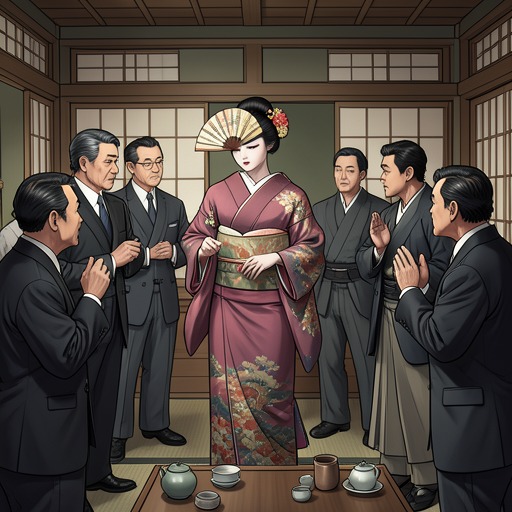
Nobu’s proposal to make Sato Sayuri’s danna
Memoirs of a GeishaNobu’s proposal to make Sato Sayuri’s danna was a deliberate offer that was never meant to succeed. After Sato intervened in the Occupation authorities’ case against Iwamura Electric, Nobu asked about the possibility of the Minister becoming Sayuri’s patron, while privately knowing that the company would not pay for the arrangement. The offer gave Nobu a way to acknowledge the company’s debt to Sato without handing over Sayuri—and brought his own long-delayed desire for her into the open.
The proposal and its hidden terms
Nobu told Sayuri that he and the Minister had spoken with the proprietress of the Ichiriki about the possibility of Sato becoming her danna. The question was not an ordinary business arrangement. A danna could support a geisha and cover substantial expenses, but the relationship also carried personal and professional consequences. Sayuri had earlier seen how Mother regarded a danna’s offer as a financial opportunity, while her own history with Nobu made the prospect of being assigned a patron inseparable from her feelings and choices.
Nobu explained that Sato had helped Iwamura Electric when the Occupation authorities were preparing to make a final judgment against the company. The company could have been seized, and Nobu and the Chairman might have been barred from working in business. Sato had the case reopened and persuaded the authorities that the company was being treated too harshly. Nobu considered this help a debt he had to recognize, even though he disliked Sato and resented being indebted to him.
But the proposal was a sham in a precise sense: Nobu had already decided what the answer would be. He told Sayuri that Sato could not have afforded to be her danna and that he had led the Minister to believe Iwamura Electric might pay, though the company would not. He would not have asked unless he knew the arrangement would fail. Sato was disappointed, and Nobu admitted that for an instant he almost felt sorry for him. The apparent offer therefore served as a controlled refusal: Nobu could make the inquiry Sato wanted without making Sayuri available to him.
A patronage arrangement turned inside out
The proposal draws on the economic logic of geisha patronage established earlier in Sayuri’s account. Mameha explained that her wealthy danna had bought most of her robes, helping make her more successful than Hatsumomo, who had not had a danna for years. A patron’s support could underwrite the expensive clothing and other costs that a geisha’s career required. Later, the General’s alliance with the Nitta okiya covered Sayuri’s lessons, registration, and medical expenses, and his position in military procurement brought the household practical benefits, including a doctor and scarce supplies.
Against that background, the question of Sato’s patronage was never merely about whether he could pay. Nobu used the possibility of company money as a pretext while ensuring that the answer would be no. He drew a boundary between repaying Sato through business and surrendering Sayuri to him personally. When Sayuri began to interpret the proposal as being given to the Minister, Nobu corrected her: no one was giving her to Sato, and Sato could not have afforded the role in any case. His explanation insists that the company’s obligation did not confer ownership of Sayuri.
The boundary was especially pointed because Nobu had once made an offer for Sayuri’s mizuage and had since sought her company more often than any other man. Mother then treated his later offer to become Sayuri’s danna as one no sensible person should refuse. For Sayuri, accepting Nobu would have closed off the possibility of a life with the Chairman. Nobu’s objection to Sato is thus not detached from his own history: his resentment and his protective refusal coexist with a desire he has held for years.
Sato’s place in the Gion gatherings
Sato’s repeated visits to Gion make the proposal’s personal stakes visible. Through the winter and following spring, Nobu brought him to parties once or twice a week. Sayuri found Sato preoccupied with whether she was beside him and whether his sake cup was full; Nobu, meanwhile, grew short-tempered when her attention turned too much toward the Minister. The Chairman, Mameha, and Pumpkin provided company around them, like packing material that kept the strained arrangement from pressing too directly on Sayuri.
Sato’s presence was also difficult in less figurative ways. On one occasion, he became so drunk that he ended up in the snow; Nobu went down into the garden in his stocking feet to bring him around. Sayuri returned to find Sato unconscious again, peeled his wet socks from his feet, and kept her distance while doing so. Nobu’s dry assessment that Sato seemed not to hear even when conscious makes their personal contempt plain, even as Nobu continues to bring him to Gion.
The proposal follows this sustained performance of hospitality. Nobu had spent months treating a man he disliked well, because Sato had helped the company. When Sayuri wondered whether Nobu’s insulting remarks meant he did not feel grateful, he distinguished gratitude from submission: Sato had helped because it was his job, and Nobu would continue treating him well, but that did not oblige him to give up what he had waited more than ten years for. In Nobu’s telling, the false danna proposal is the limit of what he is willing to offer in return.
The refusal exposes Nobu’s desire
Nobu’s account of the Minister’s reaction shifts the exchange from corporate obligation to personal rivalry. After learning the arrangement would not happen, Sato reportedly sat in disappointment and asked whether it could be arranged just once. Nobu said he refused even the idea of granting him a brief private encounter with Sayuri, asking why Sato should have her and insisting that she was not his to give. His refusal expresses both possessiveness and an acknowledgment of its limits: Nobu wants Sayuri, but he cannot claim her as property or transfer her to another man.
He then made the feeling explicit. Nobu said that the moment he had waited years for had finally arrived, after enduring Sayuri’s relationship with the General and now the prospect of Sato. He described himself as a one-armed man and recalled being called a lizard, revealing how his own bodily difference shaped his sense of himself as a possible partner. Yet he did not retreat into self-deprecation. He told Sayuri that he would not let the Minister have what he had waited for, and asked whether she would have agreed if he had come to her with Sato’s request.
The proposal consequently resolves one question while intensifying another. Sato will not become Sayuri’s danna through Iwamura Electric, but Nobu’s own claim is neither granted nor settled by that refusal. The exchange makes clear that the apparent business decision is also a declaration of desire, and that Nobu’s care for the company, resentment of Sato, and hope for Sayuri cannot be separated cleanly.
Narrative function and aftermath
The episode is narrated retrospectively by Sayuri, who can distinguish the arrangement’s stated terms from the feelings beneath them. Earlier scenes show her learning how a danna’s resources can sustain a geisha’s work: Mameha’s robes, the General’s payment of Sayuri’s professional expenses, and the scarce tea, sugar, and chocolate he secured for the okiya. Here the same patronage system becomes a test of who may make an offer, who controls the money, and whether financial obligation can dictate an intimate relationship.
Nobu’s declaration does not produce a reunion or a settled partnership. Sayuri later recalls that the Chairman became her danna, and that the arrangement ultimately required her to stop working as a geisha while remaining a member of the Nitta household. The Chairman was already married, and the decision to keep her out of Gion also kept her from Nobu’s sight. Sayuri describes the result as a loss of Nobu’s friendship and, through that loss, a banishment of herself from Gion. The false proposal therefore stands at a painful crossroads: Nobu rejects Sato as a rival, but Sayuri’s eventual future with the Chairman leaves Nobu’s hope unfulfilled.