Older-sister system (geisha)
Memoirs of a GeishaThe Older-sister system (geisha) is a formal mentorship and professional sponsorship arrangement in which an established geisha guides an apprentice through training, introductions, and the social world of Gion. Sealed by a wedding-like ceremony, the bond turns professional obligation into kinship language: the women call one another Older Sister and Younger Sister, and the older sister may become the most consequential person in the younger woman’s working life. Its support is personal, but never merely private; the apprentice’s advancement can repay her debts and generate fees and business for the wider Gion network.
Formation and Kinship
A girl preparing to debut as an apprentice needs a relationship with a more experienced geisha. The seniority required is surprisingly small: an older sister need be only one day senior to the girl she trains. The title therefore describes a function rather than a fixed age hierarchy. In Sayuri’s account, Hatsumomo’s older sister had been the great Tomi-hatsu, already an old woman when she trained Hatsumomo, but the system does not require such a difference in age or standing.
The relationship is created by a ceremony likened to a wedding. Afterward, the women address each other as sisters and are expected to regard one another almost as members of the same family. The ceremony gives the professional bond a durable, intimate form, but the narrator distinguishes its promise from its performance: some geisha do not take the role as seriously as they should. When the older sister does fulfill it, she becomes far more than a technical instructor; she is a central guide to the apprentice’s social and working life.
Training and Introduction to Gion
The older sister’s instruction covers both conduct and craft. She teaches the younger woman how to answer a man’s improper joke by blending embarrassment with laughter, and helps her choose the right grade of wax for her makeup. These small, practical lessons prepare the apprentice to perform the expected role in company, where demeanor and appearance are part of her professional competence.
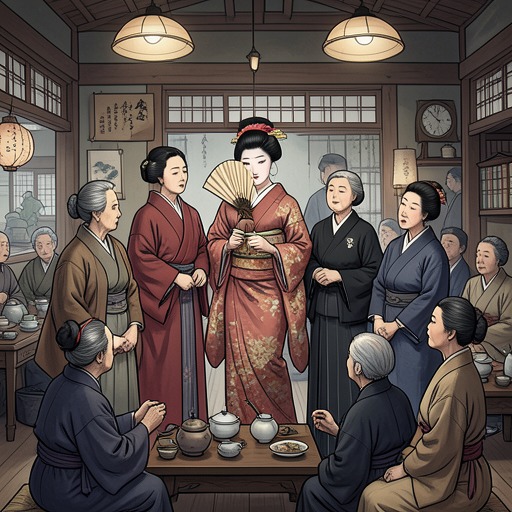
Training also means making the apprentice known. By day, an older sister takes her around Gion and presents her to the women who run the appropriate teahouses, the wigmaker who supplies performers, and chefs at important restaurants. At night, she brings the young woman to entertain alongside her and introduces her to customers and patrons accumulated over years of work. The introduction is an act of advocacy: the senior geisha asks guests to remember the novice’s name and encourages them to summon her on a future visit. A fourteen-year-old may not attract high fees immediately, but the older sister and teahouse mistress continue promoting her until a customer gives her a chance. If he likes her, he may in time become her patron.
The system thus converts established reputation into a younger woman’s visibility. The apprentice does not enter Gion’s professional network on skill alone; the older sister’s introductions connect her to the teahouses, service providers, and customers on whom her future work depends. The path remains uncertain, since a prospective patron may simply not like the girl, but repeated advocacy can turn an introduction into continuing custom.
Shared Investment and Unequal Responsibility
The older sister’s role involves substantial labor and risk. The younger woman depends on her much as a passenger depends on a train, while misconduct by the apprentice can make the senior woman answer for her. The burden is therefore not only instructional: the older sister lends her reputation to a girl whose behavior and success she cannot entirely control.
That effort has material returns. An apprentice can gradually pay off her debts and, if fortune favors her, become the mistress of a wealthy man. The older sister receives a share of the younger woman’s fees, as do the mistresses of the teahouses where she entertains. Other businesses—including the wigmaker, hair-ornament shop, and sweets shop from which an apprentice buys gifts for patrons—may not take a direct portion of her fees, yet can benefit when a successful geisha brings customers into Gion. The system’s personal service is consequently embedded in a commercial network: the apprentice’s advancement can support many people and businesses, not just the two women bound as sisters.
Access to that support is constrained by competing interests. An established geisha will not risk her reputation by choosing a girl she considers dull or unlikely to appeal to her patrons. Conversely, an okiya mistress that has already spent heavily on an apprentice’s training will not simply wait for an unsuitable volunteer to appear. Successful geisha receive more requests than they can accept, and some requests are difficult to refuse. An apprentice’s prospects therefore depend on a relationship that she may have little power to choose, even while the senior woman has sound professional reasons to be selective.
Sayuri and Mameha
For Chiyo, the need for a suitable older sister is bound up with the hostility inside her okiya. Mother may initially have expected Hatsumomo to train her: Hatsumomo had already served as older sister to at least two well-known young geisha and had behaved properly toward them. Those earlier arrangements, however, had been her choice and brought her money. Chiyo believes Hatsumomo could not be trusted to guide her fairly; she imagines that, if ordered to introduce her to the mistress of the Mizuki Teahouse, Hatsumomo might instead take her to the Kamo River and push her in. The contrast exposes the system’s vulnerability: a formal obligation cannot by itself make a hostile mentor provide genuine care.
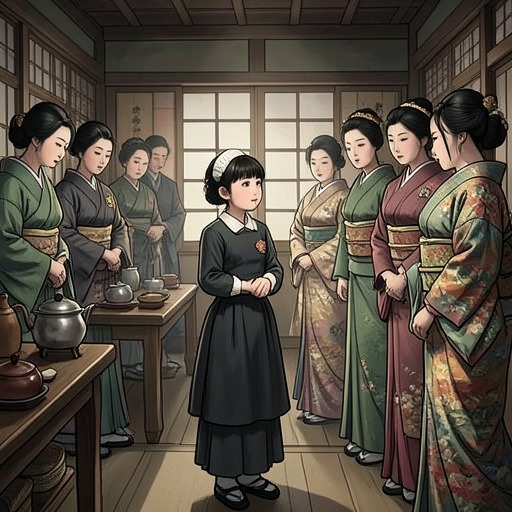
Mameha becomes Chiyo’s older sister, and their bond is publicly formed at the Gion Shrine before the ceremony at the Ichiriki Teahouse. Chiyo thanks Mameha and pledges to honor and respect her; together they clap their hands and announce to the gods that they will soon be bound as sisters. Chiyo also gives thanks for the wish she had made three and a half years earlier—to become a geisha. At the Ichiriki, the ceremony itself lasts about ten minutes: Mameha and Chiyo drink three sips from each of three sake cups, passing each cup between them. From then on, Chiyo is no longer known by that name in her professional life but as Sayuri, a novice geisha.
The new name marks an entry into work, not an immediate independence. During her first month as a novice, Sayuri cannot dance or entertain on her own without Mameha and spends much of her time watching and learning. Her first banquet makes this dependence visible: she stays beside Mameha like a shadow, bows to guests, and introduces herself as a novice who begs their indulgence, but says nothing further and receives no conversation in return. Mameha’s presence gives her a place in the room, while the limits of her novice status keep her from acting there as an independent geisha.
The bond extends beyond instruction and ceremonial recognition into material sponsorship. Mameha explains that her danna bought her most of her kimono and connects that support to her greater success compared with Hatsumomo, who has had no danna for years. The exchange shows why an older sister’s work takes place within a broader economy of patrons, fees, clothing, and professional standing: access to resources can help sustain the image and working capacity on which a geisha’s success depends.
Continuity, Duty, and Separation
Sayuri’s later life shows that the sisterly tie remains meaningful as circumstances change. When Nobu proposes making her his danna, Mother insists that business decisions be left to her and that no one should pass up his offer. Sayuri recognizes the prospect as a consequential change in her future, rather than a decision she can make outside the household’s financial interests. Later, General Tottori’s alliance with the okiya covers expenses including Sayuri’s lessons, registration, and medical costs. When Auntie falls ill in March 1939, the General’s military connections help secure a doctor and medicine. The episode shows how patronage can sustain both a geisha and the okiya in which her career is rooted.
The story’s mature form of dependence is not the apprentice’s reliance on her older sister but the practical aftermath of that guidance. After Sayuri becomes the Chairman’s mistress and ends her geisha career, she remains closely attached to Mameha. They drink tea together several times a week, and Sayuri buys her an eighteenth-century silk painting of a woman teaching a young girl calligraphy. The image recalls their relation as teacher and pupil, while Sayuri’s gift registers her sense of indebtedness for what Mameha has done since her childhood.
The Older-sister system (geisha) is therefore at once a bond of ritual kinship, a curriculum in professional behavior, and a mechanism for distributing access and income. Its obligations can expose a young apprentice to the judgment and choices of others, and they cannot guarantee that every mentor will act in good faith. In Mameha and Sayuri’s relationship, however, the system’s formal structure becomes a sustained personal connection: the first sisterly ceremony sets Sayuri’s professional life in motion, and the relationship endures beyond her departure from Gion.