Postwar reopening of the geisha districts
Memoirs of a GeishaThe postwar reopening of the geisha districts marks the end of Sayuri’s enforced wartime separation from Gion, but it does not immediately restore her place there. Although the districts reopen within months of Japan’s surrender, Sayuri remains with the Arashino family until Mother summons her. Her eventual return begins not with a revived geisha life but with a letter, Auntie’s arrival, and several days spent making the neglected Nitta okiya habitable again.
Reopening Without Immediate Return
The geisha districts reopen soon after the surrender, yet Sayuri cannot simply go back. Mother and Auntie remain on a small farm west of Kyoto, where Mother earns money selling kimono, artwork, and Japanese swords to American soldiers; Sayuri, meanwhile, continues working with the Arashino family. The contrast separates the reopening of the profession as a public fact from the personal circumstances that determine who can resume it. For nearly five years, Gion is only a few kilometers away, but Sayuri visits it just once, about a year after the war ends.
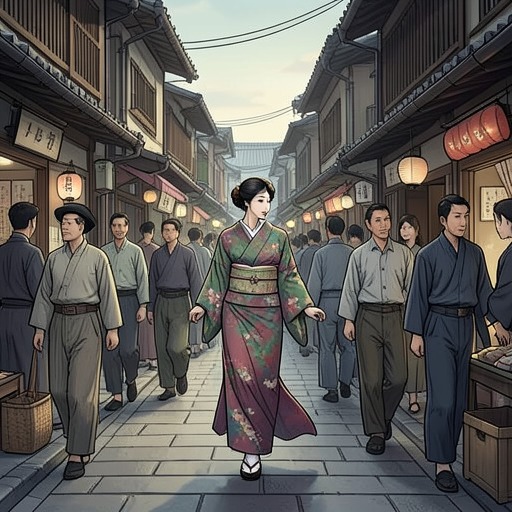
That solitary visit makes the distance emotional as well as practical. Sayuri walks through Gion without speaking to the geisha who do not recognize her, seeing the district through memories of Mameha, Pumpkin, and Nobu rather than as a place she can re-enter. The familiar streets have become a landscape of absence: the district is open, but her former life there remains inaccessible.
Wartime Work and Dependence
The years before her return are defined by labor and scarcity. At the Arashino home, Sayuri helps sew parachutes and sleeps with the family’s daughter and grandson on futons laid across the workshop floor. With little charcoal for warmth, they burn compressed leaves, newspapers, and magazines. Food is so scarce that they eat soybean dregs ordinarily given to livestock and a fried mixture of rice bran and wheat flour; potatoes, dried whale meat, seal sausage, and sardines appear only occasionally. The material detail makes clear how far daily survival stands from the regulated lessons, fees, and household arrangements of her former life in Gion.
The okiya’s prewar economic structure also gives the prospect of return a particular weight. Chiyo had been told that the cost of acquiring her, along with meals, lessons, and medical care, would be entered as debt she must repay through geisha work. When Mameha agrees to become her older sister, Mother negotiates over the share of Sayuri’s future earnings: she offers only half the customary amount at first, promising the balance plus an additional thirty percent if Sayuri repays her debts by twenty. Later, after Sayuri’s mizuage brings in enough to cover those debts, Mother adopts her; the okiya absorbs the debt, but also takes all her profits, then and thereafter. These arrangements show that the household’s capacity to reopen and support its members is inseparable from its control over their labor and earnings.
The Call Back to Gion
The decisive turn comes when Sayuri writes to Mother by the light of burning tadon beneath the dye vats. She does not know whether the letter persuades Mother or merely coincides with a decision already made. A week later, Auntie appears at the Arashinos’ door carrying coal and food as thanks for the family’s care of Sayuri. The return is thus mediated by the people and material provisions that make it possible: the Arashinos’ years of shelter and work, Sayuri’s appeal to Mother, and Auntie’s visit.
The following day, Sayuri takes a tearful farewell and goes back to Gion with Mother and Auntie. The okiya is not ready to receive her as though the intervening years had vanished. Dust blankets the woodwork; dead rodents remain in the well; birds have torn up the tatami in Mother’s upstairs room and used the straw to build nests in the alcove. Sayuri and the others spend four or five days tackling the worst damage. Mother works alongside them because the household can afford only a cook and one adult maid, as well as Etsuko, a nine-year-old girl whose age recalls Sayuri’s own arrival in Kyoto as a child.
Restoration and Its Limits
Once the house is livable, Sayuri begins paying her respects around Gion. Mameha, now living in a one-room apartment above a pharmacy near the Gion Shrine, has returned to the district but has no danna to pay for more spacious quarters. The reunion reveals that reopening has not restored the old security even for an established geisha. Mameha’s altered circumstances stand beside the repaired okiya as evidence of a wider, uneven recovery: the district and its practitioners have returned, but not to the conditions that preceded the war.
The episode therefore treats reopening as a threshold rather than a clean reversal. Gion’s doors are open, yet Sayuri’s return depends on a summons and on rebuilding a household damaged by years of absence. Work, debt, patronage, and control of earnings continue to shape what returning means. The restored okiya offers a way back into the profession, but its dust, broken tatami, and changed finances preserve the marks of the history that reopening cannot erase.