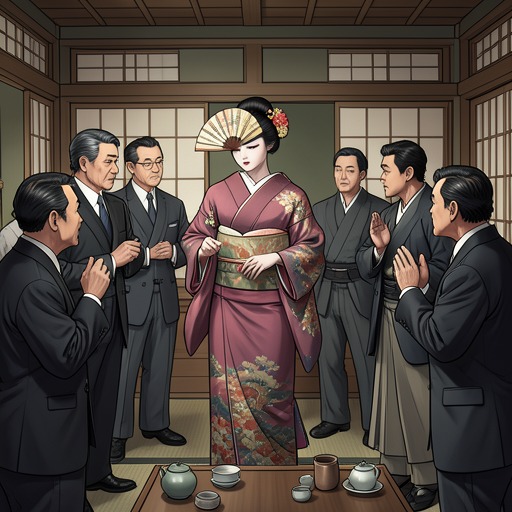
Pumpkin brings the Chairman to the theater
Memoirs of a GeishaPumpkin brings the Chairman to the theater at the worst possible moment for Sayuri: while Sayuri is alone with the Minister, having deliberately arranged a dangerous encounter in the hope of ending her bond with Nobu. The unexpected witness does not merely expose the meeting; it turns Sayuri’s calculated attempt to shape her future into a crisis of love, shame, and betrayal, and reveals that Pumpkin has never forgiven her for taking Pumpkin’s place as the daughter of the okiya.
Background and Stakes
Sayuri has brought the Minister to an empty theater as part of a plan to make Nobu encounter them together. She wants Nobu to see a compromising scene and reject her, severing the bond between them. The plan requires a particular witness: Sayuri has asked Pumpkin to bring Nobu, and believes Pumpkin will do so. Her decision to put herself in danger is deliberate, but it depends on controlling who arrives and what that person sees.
That calculation is already precarious. Sayuri is physically distressed and trying to reach a piece of rice paper in her obi as the Minister lies collapsed upon her. She is disgusted and distracted enough that she nearly fails to hear someone approach. The scraping of a person on the stone steps announces that the scene is about to acquire an audience; when the door opens, sunlight floods the room and Pumpkin appears beside a man who is not Nobu.
The Arrival at the Theater
The man is the Chairman. Sayuri recognizes that Pumpkin has brought him instead of the person she requested, but at first cannot understand why. The substitution changes the meaning of the staged encounter at once. Sayuri intended to provoke Nobu’s rejection; instead, the Chairman, the man she has long loved, finds her with the Minister. The scene’s central reversal is not simply that her plan fails, but that the person whose judgment matters most to her becomes its unexpected witness.
The account dwells on the break between the instant the door opens and Sayuri’s later recovery. She remembers little of what followed: the Minister climbed off her, or perhaps she pushed him away, and she wept while asking whether he had seen the Chairman too. The sun behind the Chairman made his expression difficult to read. Sayuri imagines that she saw shock in it, yet questions whether she was reading her own pain onto his face. Her uncertainty leaves the discovery emotionally decisive without claiming knowledge of what the Chairman thought.
The reversal also exposes the risk Sayuri had accepted. Before the door opened, she had felt her life expanding like a river and believed she was taking a drastic step to change its course. In retrospect, that sense of agency is overtaken by the possibility that the consequences will wash away what she hoped to protect. Her own comparison to a child on a precipice captures the gap between calculated danger and an outcome she had not imagined: the intended collision with Nobu becomes an entirely different catastrophe.
Aftermath and Confrontation
After the scene, Sayuri finds herself in a dark room at the inn, lying on tatami and unable to remember leaving the theater. Mameha is kneeling beside her. Later, Mameha explains that Sayuri had asked the proprietor for somewhere quiet to rest; recognizing that she was unwell, he went to find Mameha. Mameha appears willing to believe that Sayuri is truly ill and leaves her to recover. The interruption and the lost stretch of memory make the theater encounter feel less like a controlled performance than a shock from which Sayuri can barely reassemble herself.
On her way back toward the room, Sayuri sees Pumpkin step into the covered walkway. Sayuri expects an apology, but Pumpkin does not approach her in that spirit. Instead, she turns toward Sayuri with deliberate hostility. Sayuri asks why Pumpkin brought the Chairman rather than Nobu and says she does not understand. Pumpkin answers that Sayuri finds it hard to accept a life that does not work out perfectly. The exchange shifts the scene from unexplained sabotage to a direct reckoning between former friends.
Pumpkin says she once thought Sayuri was her friend, but that time has passed. She accuses Sayuri of taking her place as the okiya’s daughter, recalling that she had helped Sayuri approach Dr. Crab despite the risk of angering Hatsumomo. In Pumpkin’s account, Sayuri then took what had been hers. Her resentment makes the substitution an act of retaliation: she has used what she knows of Sayuri’s plan to make the intended encounter go wrong in the most painful way she can.
Sayuri asks why Pumpkin did not simply refuse to help. Pumpkin replies that she knows how Sayuri feels about the Chairman, accusing her of openly watching him whenever no one else is looking. Sayuri realizes that Pumpkin meant to hurt her as badly as possible. Her anger is visible in her bitten lip, the lipstick on her teeth, flared nostrils, and burning expression. The hostility is no longer concealed beneath the practical appearance of assistance; Pumpkin’s explanation makes the personal wound behind the act explicit.
Betrayal and Its Consequences
Pumpkin frames the encounter as repayment for an older injury: Sayuri took something from her long ago, so Pumpkin has now made Sayuri feel the loss herself. The comparison to Hatsumomo’s spirit breaking free inside Pumpkin presents the betrayal as a release of long-contained anger, while also recalling the destructive force of Sayuri’s earlier rivalries. The action is therefore both a specific intervention in Sayuri’s plan and the culmination of a damaged friendship whose past Pumpkin has interpreted as dispossession.
The consequences persist through the rest of the evening. Sayuri remembers only a blur and dreads what lies ahead. While the others drink and laugh, she manages to pretend to join them; Mameha periodically touches her neck to check whether she has a fever. Sayuri sits as far from the Chairman as possible so their eyes will not meet, and she succeeds in avoiding a direct confrontation for the evening. Her distance is an effort to contain the shame of what he may have seen, not evidence that the discovery has been settled.
Later, as the group prepares for bed, Sayuri enters the hallway just as the Chairman is returning to the room. She could have moved aside, but instead gives a brief bow and hurries past, making no attempt to conceal her unhappiness. The encounter thus ends without a conversation between them. What remains is the painful imbalance between Sayuri’s certainty that the Chairman was at the door and her inability to know what he saw or made of it—a silence made sharper by Pumpkin’s deliberate choice of witness.
Narrative Significance
The event turns on the difference between a plan’s intended audience and its actual one. Sayuri tries to engineer a rejection by Nobu, but Pumpkin redirects the scene toward the Chairman, transforming a calculated sacrifice into an involuntary exposure. The reversal strips Sayuri of control at the moment she has tried most boldly to exert it, and makes the emotional cost of her maneuver immediate even before the Chairman’s response is known.
It also converts an apparent act of cooperation into evidence of a broken friendship. Pumpkin has not merely failed to carry out Sayuri’s request; she has understood enough of Sayuri’s feelings to choose the person whose arrival will wound her most. Her explanation links that choice to the earlier transfer of the okiya’s daughterly place and to Sayuri’s past assistance from Pumpkin. The scene’s force comes from that double exposure: the Chairman sees Sayuri in a compromising situation, while Sayuri discovers that the friend she relied on has been nursing a grievance and has acted on it.