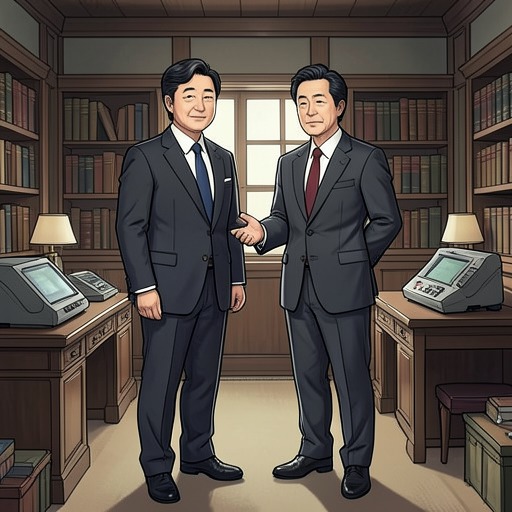
Sato Noritaka
Memoirs of a GeishaSato Noritaka is the newly appointed Deputy Minister of Finance whose political influence helps avert the seizure of Iwamura Electric during the Allied Occupation. He enters the postwar story not as a friend of Sayuri or Nobu but as an unwelcome obligation: his intervention benefits the company, while the debt of gratitude surrounding it makes Sayuri’s return to Gion useful to Nobu and potentially costly to her independence.
Identity and Introduction
Before the postwar crisis, Sato had attended parties as a guest of the Prefectural Governor during the final two years before Gion closed. Nobu remembers him as a man who sat across the table from Sayuri so he could stare at her, and who spoke little. By the time Nobu asks Sayuri to come back to Gion, Sato has been appointed Deputy Minister of Finance. His position makes him more than an irritating former party guest: he is now a public official whose influence may affect the future of Iwamura Electric.
Nobu’s description makes Sato’s presence feel like a personal trial as well as a political calculation. He calls the task of entertaining him awful, warning Sayuri that Sato is irritating and behaves like a pig. Sayuri initially treats the assignment lightly, saying she has entertained worse guests. Nobu insists that she will understand the difficulty if she remembers Sato. Their different assessments establish the imbalance at the center of the encounter: Sayuri can joke about the proposed work, but Nobu sees a man whose importance cannot be avoided.
The Man at the Teahouse
Nobu’s later account of taking Sato to a teahouse reveals how difficult he finds the official to manage. Sato sits without speaking for an hour, then complains that the venue is not the Ichiriki. When Nobu points out that Sato is not in Gion and that Sayuri is no longer there, Sato answers that Sayuri entertains at the Ichiriki. The exchange makes Sayuri’s absence conspicuous: even outside Gion, Sato reduces the conversation to where she can be found and whether she will entertain him.
Nobu recounts that Sato then takes up his sake cup, leaving the incident’s next action unstated in the account available here. The pause itself preserves Nobu’s exasperation. The story also clarifies why he says there are no other geisha who can serve the purpose he has in mind: Sato is not merely a guest to be placated, but a man specifically fixated on Sayuri’s presence at the Ichiriki. In another gathering, Pumpkin recognizes Sato by Nobu’s description and calls him piglike; the Chairman identifies him by name and office. The group laughs, briefly turning Nobu’s private irritation into shared banter, but the laughter does not lessen Sato’s political leverage.
Political Leverage and the Danna Proposal
The stakes become explicit when Nobu tells Sayuri that he and Sato have spoken with the proprietress of the Ichiriki about the possibility of Sato becoming Sayuri’s danna. Nobu says plainly that this is not what he wants. He presents it instead as a concession forced by the company’s precarious position: the Occupation authorities were prepared to issue a final judgment against Iwamura Electric, which would have resulted in the company’s seizure and barred Nobu and the Chairman from working in business again.
According to Nobu, Sato persuaded the authorities to reopen the case and convinced them that the company was being treated too harshly. Nobu regards that judgment as just, but the intervention still creates an obligation. The proposed patronage arrangement gives that political help an intimate and professional consequence for Sayuri: the company’s survival and the possibility of making Sato her danna become entangled. Sato’s power is therefore exercised indirectly. The account establishes neither a personal relationship between him and Sayuri nor an outcome in which he becomes her patron; it shows instead how his official influence prompts others to consider placing her in that role.
Narrative Role
Sato’s characterization is conveyed chiefly through other people’s reactions and through reported incidents. Nobu describes his silence, staring, and complaints; Sayuri responds with initial amusement; Pumpkin supplies a blunt visual comparison; and the Chairman identifies his official position. This chain of descriptions makes Sato a presence that dominates scenes even when he is not shown speaking directly. His quietness does not make him politically passive: the crucial action attributed to him is that he intervenes in the case against Iwamura Electric.
That contrast gives Sato his narrative importance. In Gion, Sayuri’s ability to entertain powerful men has long been bound up with professional expectation, but the postwar proposal places that labor within a new political economy of corporate survival and Occupation scrutiny. Sato’s assistance may help preserve the company; the cost under consideration is Sayuri’s service as his danna’s geisha. The evidence leaves the arrangement unresolved, but makes its pressure clear: gratitude to a powerful official can be converted into a claim on someone else’s working life.