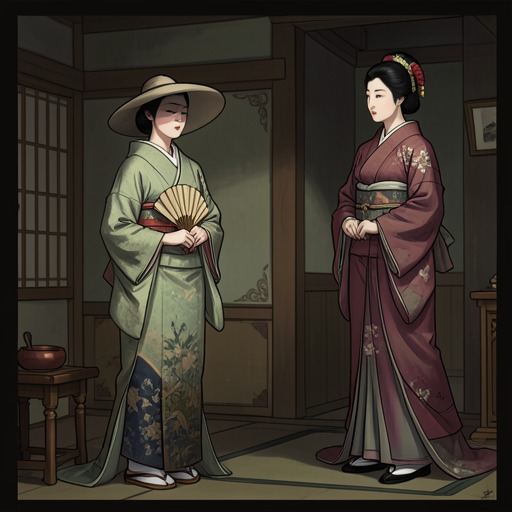
Sayuri and Hatsumomo's hostile relationship
Memoirs of a GeishaSayuri and Hatsumomo's hostile relationship is a prolonged struggle over whether Sayuri can establish herself as a geisha despite the older woman’s power within the Nitta okiya and Gion. Hatsumomo makes the rivalry personal through mockery and a slap, then strategic by interfering with Sayuri’s approach to Dr. Crab; Sayuri’s composure and Mameha’s planning eventually help reverse the balance, though the conflict also leaves Sayuri’s debut at a standstill and her temporarily exiled from Gion’s social life.
Unequal Positions and Public Humiliation
The hostility is already palpable when Sayuri, still a novice, returns to the Komoriya Teahouse with Mr. Snowshowers and discovers Hatsumomo waiting at the party. Pumpkin is beside her. Hatsumomo greets the sight of Sayuri with a smile that the narrator associates with her pleasure in making others suffer. She announces, “Oh, my goodness! What a peculiar coincidence. Why, it's a novice! I really shouldn't tell the rest of this story, because I might embarrass the poor thing.” The mock innocence is a public weapon: it identifies Sayuri as inexperienced and threatens to make her the subject of a humiliating story in front of the men at the table.
Mameha does not immediately take Sayuri away. She gives her an anxious glance, recognizing that leaving Hatsumomo alone with the men could make the situation worse. Her decision to remain is a form of damage control, and it reveals the unequal conditions of the contest: Hatsumomo can exploit Sayuri’s novice status in public, while Sayuri depends on Mameha’s judgment and protection. Pumpkin’s presence at Hatsumomo’s side also places the young apprentice within the social world from which Sayuri is trying to advance.
The verbal encounter becomes physical after the party. When Hatsumomo returns to the okiya, she finds Sayuri in the entrance hall answering Auntie’s questions about her day. She has come back early specifically to confront her, and her lips are pressed together rather than arranged in her familiar cruel smile. She slaps Sayuri across the face. The narrator remembers seeing Hatsumomo’s clenched teeth just before the blow, a sharply physical detail that turns the rival’s polished appearance into an image of contained aggression.
Hatsumomo then threatens to slap the other side of Sayuri’s face if the girl embarrasses her in public again. She explains that Sayuri had understood the implication behind Hatsumomo’s earlier question about whether she had hair, yet made Hatsumomo look foolish. She promises to return the favor. Sayuri asks what she did to embarrass her, but the exchange does not settle the dispute; Hatsumomo leaves the okiya, with Pumpkin waiting in the street to bow to her. The threat makes the contest explicitly reciprocal in Hatsumomo’s mind: she regards Sayuri’s public response as an affront to be repaid.
Sayuri’s Response and the Cost of the Rivalry
Sayuri reports the slap to Mameha the following afternoon. Mameha is relieved that it left no mark, but does not treat the incident as a reason to abandon their course. She asks whether Sayuri expected Hatsumomo to be pleased by her comment. Sayuri, in turn, is less concerned with the past blow than with what may happen the next time they meet. The exchange shows the practical limits of Mameha’s protection: she can advise Sayuri and plan around Hatsumomo, but she cannot prevent every direct confrontation.
The rivalry changes Sayuri’s perception of Hatsumomo after Hatsumomo brings her debut to a standstill. Sayuri recalls an officer’s pistol from a later wartime party: its smooth curves and richly grained wooden handle first seemed beautiful, until she considered what the weapon was for. She uses that remembered contrast to describe her changed view of Hatsumomo. She had always envied Hatsumomo’s loveliness, but after the damage to her debut she no longer did. Hatsumomo can still appear striking, her white makeup glowing above a dark robe like the moon through haze, yet beauty no longer softens Sayuri’s judgment; she feels hatred and hears her pulse hiss in her ears.
The material consequence is not simply wounded pride. While Sayuri ought to be attending nightly banquets and numerous additional parties, she is instead confined to the okiya to practice dance and shamisen as if the previous year had never ended. Mameha tells her that she is an exile for the moment and urges her to feel more determined to destroy Hatsumomo. Until Mameha has devised another plan, Sayuri is told not to follow her around Gion. Hatsumomo’s power therefore reaches beyond isolated scenes of insult: it interrupts Sayuri’s public emergence and cuts her off, temporarily, from the places and encounters that could help establish her career.
The Contest Over Dr. Crab
Later, Hatsumomo’s interference targets Mameha’s plan to bring Sayuri into contact with Dr. Crab. Sayuri and Mameha arrive at the Shirae Teahouse to meet him and find Pumpkin putting on her shoes to leave; Hatsumomo then appears in the entryway. Sayuri immediately understands that Hatsumomo has somehow got ahead of them. Hatsumomo greets Mameha and pointedly describes Sayuri as the apprentice the Doctor used to be fond of. Mameha conceals her shock and counters with a compliment about Hatsumomo’s appearance, keeping the exchange outwardly courteous while the women test each other’s knowledge and composure.
Hatsumomo’s choice of target is calculated. The Shirae has few men of consequence among its patrons, and Dr. Crab is known in Gion as a mizuage specialist. Sayuri comes to understand that Hatsumomo would have thought of him as soon as she recognized Mameha’s intentions. After the visit, Dr. Crab will not even speak with Mameha and Sayuri. Their intended meeting has been compromised before they can carry out their plan.
Pumpkin later tells Sayuri what happened at the teahouse. Hatsumomo chatted with Dr. Crab and pretended that something had reminded her of a story. She began with an account of a young apprentice named Sayuri who lived in her okiya. When Dr. Crab heard Sayuri’s name, he sat up sharply and asked whether Hatsumomo knew her. Hatsumomo answered that Sayuri lived in her okiya, then implied that she was concealing an important secret for the girl. Pumpkin cannot remember everything Hatsumomo said, and the account stops as Sayuri asks what the secret was. Even without the final disclosure in this evidence, the maneuver is clear: Hatsumomo trades on Dr. Crab’s interest in Sayuri and plants suspicion while presenting herself as a knowing insider.
Reversal and Continuing Conflict
Hatsumomo’s ability to disrupt Sayuri’s prospects does not give her lasting control over the outcome. Sayuri remembers keeping her face like a mask when Hatsumomo spoke to her during a period when Sayuri’s prospects had improved and she and Mameha had kept a plan from Hatsumomo. Sayuri’s first impulse is to smile, but she suppresses it and is pleased that she has revealed nothing. Hatsumomo gives her an odd look, suggesting that she senses something has passed through Sayuri’s mind, but Sayuri steps aside and considers the encounter over. The guarded expression marks a change from the novice who could be publicly exposed to a rival who can protect information and deny Hatsumomo the satisfaction of reading her.
The decisive reversal arrives when Sayuri receives a role in the seasonal dances, an opportunity she had not even had the previous year. She has only about a month to rehearse, and her dance teacher works with her privately in the afternoons. Mother learns the news several days later through a rumor during a game of mah-jongg; Hatsumomo does not tell her. Mother asks Sayuri whether the rumor is true, then walks away with a puzzled expression. The achievement is concrete evidence that Sayuri’s prospects can advance despite Hatsumomo’s hostility.
Hatsumomo is furious at the news, but Mameha is not concerned. She says the time has come to toss Hatsumomo from the ring. The image turns their long contest into a struggle with an approaching resolution: Hatsumomo’s attacks have delayed Sayuri’s emergence and repeatedly threatened to damage her prospects, but Sayuri’s guardedness, Mameha’s counterplanning, and the new dance role show that the balance is shifting. Their relationship remains defined by antagonism, yet its later stages are no longer only about Sayuri enduring Hatsumomo’s power. They become a contest over whether that power can still keep Sayuri from moving forward.