Sayuri and Mameha's mentor–apprentice relationship
Memoirs of a GeishaSayuri and Mameha’s mentor–apprentice relationship turns professional training into a lasting personal bond. Mameha does not merely teach Sayuri how to perform: she introduces her into Gion, protects her from Hatsumomo’s sabotage, prepares her to make strategic impressions on powerful men, and helps shape the patronage arrangements that transform her life. Their relationship survives Sayuri’s departure from the geisha profession, but it also bears the consequences of Mameha’s role in advancing a future built around the Chairman.
A mentor’s practical education
Mameha’s instruction begins in public, through the demanding work of becoming known across Gion. On the day Sayuri is introduced as Mameha’s younger sister, the two visit roughly twenty okiya and teahouses. At each, Mameha presents her to the mistress; Sayuri bows and offers the conventional request for favor. The circuit is exhausting, and it reaches only the fifteen or sixteen teahouses where Mameha regularly entertains, rather than the many more establishments in Gion. Yet the introductions make visible what apprenticeship means: Sayuri’s prospects depend not only on lessons but on relationships Mameha has already established.
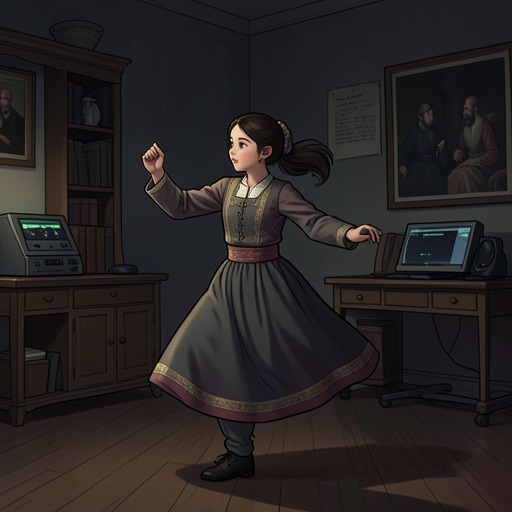
That work continues into the evening. After the rounds, Mameha gives Sayuri only a brief nap before preparing her for her first engagement as a novice geisha, a banquet at the Kansai International Hotel. Sayuri stands beside her like a shadow, repeats her name and status when introduced, and otherwise has little to say. Mameha’s dance, performed with another geisha, offers a different kind of lesson. In “Friends Everlasting,” her folding fan suggests flowing water, then becomes a cup for sake; the audience pays little attention, but Sayuri watches, entranced. The scene sets the distance between novice and teacher while showing the skill and expressive control Sayuri hopes to acquire.
Mameha also teaches by example how a geisha can manage a conversation rather than merely endure it. When a guest remarks on the warm weather, she has different replies ready for an old lecher, an arrogant young businessman, or a nervous young man at his first party. In the last case, she turns a banal observation into a sensual story that leaves the young guest’s fingers trembling as he sets down his cup. The lesson is not a simple formula for flirtation: Mameha reads the person before her and chooses how to unsettle, amuse, or redirect him. Sayuri’s apprenticeship includes learning this emotional and conversational labor as part of professional performance.
Protection, timing, and strategy
Mameha’s mentorship is tested when Hatsumomo obstructs Sayuri’s debut. With Sayuri forced back into practice instead of attending the engagements she should be working, Mameha calls her an exile for the moment and warns that Hatsumomo’s ridicule could damage her standing among both men and women in Gion. She does not offer an immediate rescue or encourage Sayuri to confront Hatsumomo recklessly. Instead, she asks Sayuri to trust her and promises an engagement in a place Hatsumomo will not find them, withholding the location and date until the proper time. Her protection depends on secrecy and timing, not reassurance alone.
Mameha’s care also means preparing Sayuri for situations in which a mistake could have lasting consequences. When an injury brings Sayuri to the hospital, Mameha insists that the ordinary advice for apprentices—to impress other geisha rather than worry about men—will not apply in her case. Sayuri’s future, she says, depends on two men, and she is about to meet one of them. The urgency of the warning reveals the strategic character of Mameha’s guidance: she is teaching Sayuri to navigate a career in which professional opportunity is entangled with the judgments and resources of powerful patrons.
Her own economic position helps explain what she teaches. Mameha tells Sayuri that her wealthy danna bought most of her kimono, and contrasts her success with Hatsumomo’s lack of a patron. For Mameha, the elegant wardrobe is not simply decoration; it makes the financial structure of a geisha’s life visible. She explains that a danna is not a husband, since geisha do not marry and continue working as geisha, and distinguishes established professional relationships from arrangements in which lower-status women accept men’s offers of fees. Mameha’s instruction therefore includes both the material conditions of success and the boundaries by which a geisha’s profession is understood.
Gifts, patrons, and consequential choices
The relationship’s influence extends to the objects and patrons through which Sayuri’s prospects are negotiated. At a gathering, Nobu picks up Sayuri’s hair ornament and asks for the package he has brought. He gives her an antique comb, red and decorated with bright flowers, explaining that he had meant to give it to her later. The Chairman notices Nobu’s wistful attention to the ornament and calls him sentimental. Mameha’s lessons take place in a world where gifts, display, and male patronage carry meaning beyond their material value; Sayuri’s career advances through the same world she is being taught to read.
That world becomes explicit when Mother tells Sayuri that only a fool would reject Nobu Toshikazu’s offer. Sayuri understands that Nobu may one day become her danna: he had bid for her mizuage and had sought her company more often than any other man. But the prospect threatens the future she associates with the Chairman. Mameha’s role in Sayuri’s professional life has helped bring her to this crossroads, though the choice is not reducible to a lesson imparted by her mentor. Patronage can offer security and opportunity while closing off another desired attachment.
The consequences are especially clear when Sayuri becomes the General’s geisha. The General covers the cost of her lessons, registration, medical expenses, and other needs, while his position as director of military procurement gives him influence useful to the okiya. When Auntie falls ill in March 1939 and ordinary doctors cannot help, a call to the General brings an important military-hospital doctor to the house with medicine that cures her. The arrangement thus provides benefits beyond Sayuri’s own expenses. Yet the General does not provide the lavish gifts, dance recitals, or leisure she had imagined a patron might offer, and Nobu stops inviting her to parties. Sayuri loses both his company and access to Iwamura Electric’s gatherings, diminishing her chances of seeing the Chairman. The practical calculations Mameha has taught her to understand have intimate and painful consequences.
A bond beyond apprenticeship
Mameha remains a presence in Sayuri’s life after Sayuri leaves Gion. When the Chairman negotiates with Mother to become Sayuri’s danna, the agreement eventually requires Sayuri to stop working as a geisha. She continues living in the Nitta household but no longer attends lessons, makes formal rounds, or entertains at night. The Chairman pays the okiya a considerable monthly sum for permission to end her career. Mameha’s part in the arrangement is bound up with her earlier role on the Chairman’s behalf, and Sayuri understands herself to be deeply indebted to her for what she has done since Sayuri’s childhood.
Their closeness persists in ordinary visits: they have tea several times a week. Sayuri gives Mameha an eighteenth-century silk painting of a woman teaching a girl calligraphy, an image that recalls Mameha’s benevolent watchfulness over her pupil. Yet this quieter intimacy is shadowed by Sayuri’s hope that Nobu may one day forgive her. She asks Mameha whether he has inquired about her, until Mameha’s sigh and sad look make clear how painful it is to keep hoping. Mameha’s care includes no easy reconciliation to offer; the bond remains strong enough for silence and disappointment to register between them.
The relationship’s lasting significance lies in this combination of instruction and consequence. Mameha gives Sayuri access to Gion, models the artistry of social performance, and teaches her to treat patronage as a material force rather than a romantic abstraction. She also helps direct Sayuri toward a future that requires leaving the profession in which she was trained. After the apprenticeship ends, their affection remains, but it cannot erase what their shared choices cost: Sayuri’s separation from Gion and her continuing loss of Nobu’s friendship.