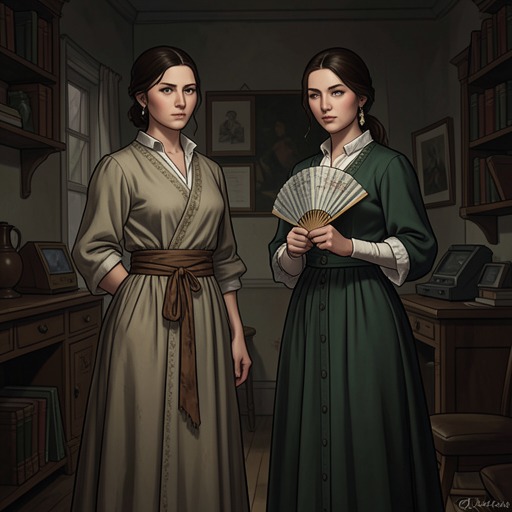
Sayuri and Pumpkin's friendship
Memoirs of a GeishaSayuri and Pumpkin’s friendship is an early bond of recognition and mutual care that briefly reawakens when Sayuri turns to her for help, but is ultimately strained by the unequal choices imposed by the Nitta household. Pumpkin knows the pain of living under Hatsumomo’s control; Sayuri recognizes her exhaustion and tries to ease it. Yet Pumpkin’s dependence on Hatsumomo and the prospect of her own adoption place limits on what that affection can accomplish. Later, Sayuri understands her own adoption as a rupture much like the one that had already damaged their friendship: advancement brings shelter and opportunity, but also makes the girls’ paths diverge.
A Bond Under Hatsumomo’s Control
By the time Sayuri sees Pumpkin at a gathering where Hatsumomo is speaking about the hardships of novice life, Pumpkin has become a full-fledged apprentice; only six months earlier she had been a novice herself. When Hatsumomo asks whether she agrees that being a novice is difficult, Pumpkin stares down at the table with her hands in her lap. Sayuri reads the small wrinkle at the top of her nose as a sign of distress. Pumpkin answers Hatsumomo deferentially, but her restrained response makes visible the strain beneath the obedience.
That strain is sharper when Sayuri later finds Pumpkin laboring to carry out Hatsumomo’s demands. Pumpkin has been sent to find noodles and expects to be made to eat them, though she fears she will vomit. Her face droops with exhaustion beneath the weight of her clothes. Sayuri calls her Pumpkin’s old name, Chiyo-chan, and takes over the errand; Pumpkin hands her the money and sits on a bench beside the Shirakawa Stream. The small exchange reverses the direction of care for a moment: the overburdened Pumpkin accepts Sayuri’s practical help, and Sayuri treats her exhaustion as something to tend rather than ignore.
Confiding by the Shirakawa Stream
After bringing the bowls, Sayuri wakes Pumpkin gently and admits she needs a favor. Pumpkin says that nothing makes her happy anymore. Sayuri explains that Hatsumomo has spoken to Dr. Crab and that he no longer wants to see her; she fears the conversation may determine her future. Pumpkin did not know about the damage to Sayuri’s prospects, but her response quickly reveals a deeper grievance: she cannot understand Hatsumomo’s cruelty, and hates that Hatsumomo imagines she admires her and wants to become like her. The disclosure links their confidences. Sayuri speaks of the threat to her own future, while Pumpkin names the pain of being treated as Hatsumomo’s admirer when she feels only hatred.
Sayuri asks what Hatsumomo told the doctor. Pumpkin recounts how Hatsumomo found out that Sayuri had been entertaining him at the Shirae Teahouse: after Sayuri seemed unmoved by a taunt about the German Ambassador, Hatsumomo suspected a scheme and checked the teahouses where Sayuri had been billing. Once she learned about the Shirae, she and Pumpkin went there twice before finding Dr. Crab. Pumpkin then describes Hatsumomo presenting Sayuri to the doctor as a young apprentice who was secretly seeing a young man. By claiming that she had been covering up this supposed relationship from Mother, Hatsumomo turned an invented secret into a warning that Sayuri was untrustworthy.
Pumpkin’s account gives Sayuri a view of the maneuver that has jeopardized her future. It also shows Pumpkin’s conflicted position: she has been present with Hatsumomo, but she does not endorse the cruelty she reports. When Sayuri explains that Hatsumomo might force her back into a maid’s life, she makes her need for Pumpkin’s help plain. Her metaphor of being a cockroach under Hatsumomo’s foot makes the danger vivid; Pumpkin laughs, and Sayuri laughs with her. In the pause between tears and laughter, Sayuri smooths Pumpkin’s smeared makeup with her handkerchief. They embrace. For a moment their shared history is not an abstract promise of loyalty but a physical act of consolation.
Affection Bounded by Dependency
The warmth of the reunion does not remove the practical limits on Pumpkin’s help. She wants to assist Sayuri, but has already been away too long. If Hatsumomo comes looking for her and finds them together, Pumpkin risks further trouble. Her warning interrupts the intimacy of the conversation with the household’s ordinary surveillance and authority: she cannot choose freely between friendship and obedience when her own daily life remains subject to Hatsumomo.
Even so, Pumpkin has offered what she can: she has listened, admitted her hatred of Hatsumomo, and supplied the information Sayuri needs to understand the doctor’s rejection. Sayuri thanks her repeatedly and apologizes for the years she has spent as Hatsumomo’s slave. Pumpkin answers that something good may come of those years: Mother has recently decided to adopt her, and Pumpkin hopes this will give her a permanent home. Her hope makes the exchange emotionally uneven. Sayuri is pleased for her, but knows that Mameha’s plan depends on Mother adopting Sayuri instead. Their affection is real, yet each girl’s possible security is entangled with the same household’s choices.
Adoption and the Friendship’s Cost
The conflict between the girls’ prospects later becomes part of Sayuri’s understanding of what she has lost. When Mother considers Nobu’s offer to become Sayuri’s danna, Sayuri sees how earlier turns in her life—the plans of Mameha and Hatsumomo, her adoption, and her mizuage—have shaped the choice before her. The friendship’s fracture is not simply an absence of feeling; it is bound to a system in which adoption and patronage determine where a girl belongs and what future she can pursue.
Much later, reflecting on her withdrawal from Gion after the Chairman becomes her danna, Sayuri identifies her adoption as a precedent for the damage a coveted position can do to a friendship. She compares the division between herself and Pumpkin with the problem of a man possessing a prize his friend also covets: keeping the prize out of sight or risking harm to the friendship. The comparison does not claim that the girls’ circumstances were identical. It shows how Sayuri has come to read their separation as part of a recurring pattern, in which advancement for one person can leave another behind.
The friendship therefore persists in Sayuri’s memory not as a simple story of reconciliation, but as a relationship in which tenderness survives without overcoming dependency or rivalry over security. At the Shirakawa Stream, the girls recover a moment of closeness through noodles, laughter, tears, and a repaired face. But Pumpkin must return to Hatsumomo, and Sayuri knows that Mother’s adoption decision may favor her own future instead. The later distance gives that brief embrace its weight: care is restored for an evening, while the conditions that divide them remain.