Sayuri moves to New York and opens a teahouse
Memoirs of a GeishaSayuri’s move to New York City turns a conversation about missing her former work into a consequential choice: she leaves Japan, opens a teahouse for visiting Japanese businessmen and politicians, and breaks the Nitta household’s control over her finances. The move also gives practical form to her relationship with the Chairman. By suggesting that she might take their child permanently away from Japan, she forces him to face the possibility of losing her—and removes the obstacle to Nishioka Minoru’s adoption as his heir.
The Proposal at Eishin-an
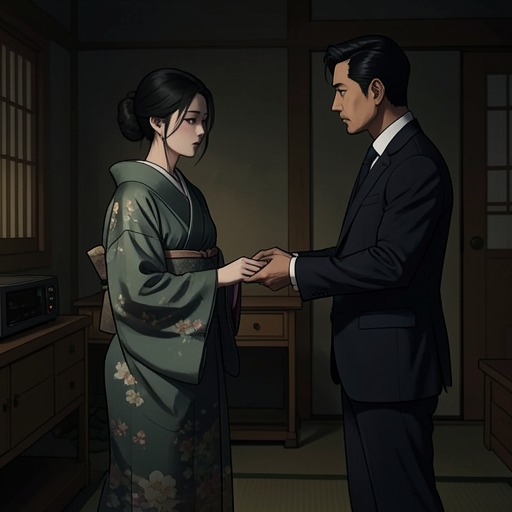
A week or so after Nishioka Minoru changed his mind, Sayuri raised the subject with the Chairman at Eishin-an. They sat outdoors after dinner on the veranda overlooking the moss garden. He had been brooding and silent since before the meal, while she approached a delicate matter indirectly: she said she had begun thinking of the Ichiriki Teahouse and recognizing how much she missed entertaining. The Chairman said nothing at first, taking a bite of ice cream and setting down his spoon.
Sayuri acknowledged that she could not return to work in Gion, then asked whether there might be room for a small teahouse in New York City. Her proposal was not simply a plan for a business. Japanese businessmen and politicians were increasingly traveling to New York, she observed, and many were men she had known for years. The Chairman, meanwhile, had told her that he planned to open a branch of his company in the United States and would spend more time there. Her suggestion connected her own future to that anticipated American presence, even as he immediately protested that there was no reason for her to leave Japan.
A Departure Made Possible by Implication
When the Chairman said he was in no mood to discuss the matter, Sayuri continued. She shifted from talking about a teahouse to the consequences of raising a child between two cultures. A mother who moved to the United States with her child, she suggested, might sensibly make the country their permanent home—and might never bring the child back to Japan. The implied choice transformed an abstract business proposal into a threat of separation.
The Chairman understood that Sayuri was proposing to remove from Japan the one obstacle to Nishioka Minoru’s adoption as his heir. For an instant he looked startled. Then, as he seemed to picture her leaving him, his peevish humor gave way, and a single tear appeared at the corner of his eye before he quickly blinked it away. The scene turns on the gap between Sayuri’s measured, indirect speech and its emotional effect: she does not announce an ultimatum, but the future she describes makes the possible loss unmistakable.
Establishing the Teahouse and Breaking with the Nitta Household
In August of that year, Sayuri moved to New York City to set up a very small teahouse for Japanese businessmen and politicians traveling through the United States. Mother tried to make the venture an extension of the Nitta okiya, but the Chairman refused to allow that arrangement. Sayuri’s departure therefore changed not only where she lived and worked but also the terms on which the Nitta household could claim authority over her. Mother’s power had held while Sayuri remained in Gion; by leaving, Sayuri broke those ties.
The separation had a concrete financial consequence. The Chairman sent two accountants to ensure that Mother gave Sayuri every last yen to which she was entitled. His intervention prevented the proposed New York business from becoming a continuation of the okiya’s control, and the teahouse became Sayuri’s own enterprise rather than a Nitta extension. The action marks a transfer of practical independence, secured through Sayuri’s move and the Chairman’s refusal to let Mother retain her claim over the new venture.
Making a Home in New York
Sayuri recalls feeling afraid when the door of her apartment at the Waldorf Towers first closed behind her. That fear did not define her life there for long: New York soon came to feel at least as much like home as Gion had. Her recollection links this gradual belonging to the many long weeks she spent in the United States with the Chairman, which made her American life richer in some respects than her life in Japan.
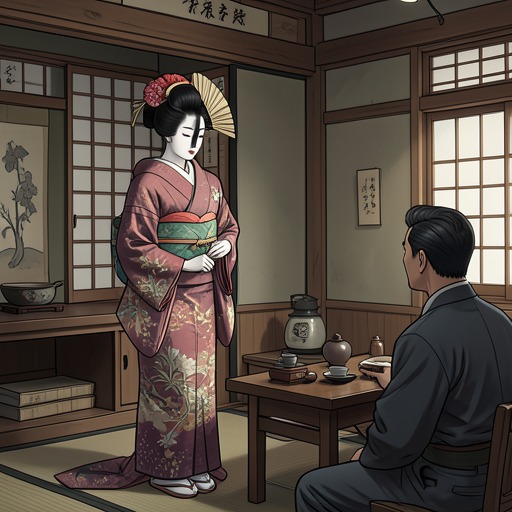
The teahouse stood on the second floor of an old club off Fifth Avenue and was modestly successful from the beginning. Geisha came from Gion to work with Sayuri, and Mameha sometimes visited. Sayuri later went to the establishment herself chiefly when close friends or old acquaintances were in town. The business thus sustained a continuing connection to the people and practices of Gion while placing them in a different city and under Sayuri’s independent management.
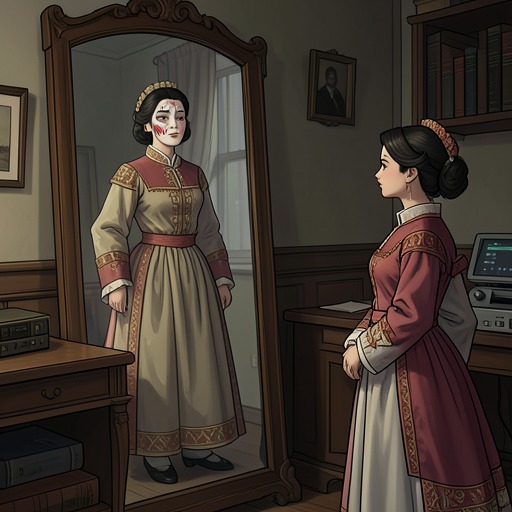
Her routine also extended beyond the teahouse. In the mornings she often joined local Japanese writers and artists to study subjects such as poetry, music, or the history of New York City during a month-long session. She lunched with a friend most days, and in the afternoons prepared for parties at her makeup stand, sometimes in her own apartment. Lifting the brocade cover on her mirror brought back the milky odor of the white makeup she had so often worn in Gion. The familiar preparation persisted, but it now belonged to a life whose setting and social rhythms had changed.
Distance, Memory, and Gion’s Decline
Sayuri dearly wished she could visit Gion, yet suspected that seeing its changes would disturb her. Photographs brought by friends from trips to Kyoto made the district seem to her like a poorly kept garden thinning out and overrun with weeds. After Mother’s death, the Nitta okiya itself was torn down and replaced by a small concrete building, with a bookshop on the ground floor and two apartments above. The site that had once anchored Sayuri’s life in Gion had become a different kind of place.
The decline extended beyond the okiya. Eight hundred geisha worked in Gion when Sayuri first arrived; by the time she recounted her later life, fewer than sixty remained, with only a handful of apprentices, and the number continued to dwindle. Against that contraction, New York offered not a return to her former life but a setting in which some of its social world could continue: her teahouse hosted geisha from Gion, and old acquaintances still came to see her. The possibility of going back remained emotionally powerful, while the photographs and dwindling numbers suggested that the Gion she missed was itself passing away.
On the Chairman’s last visit to New York, the two walked through Central Park and talked about the past. At a path through pine trees, he stopped and closed his eyes, standing with both frail hands on his cane as he breathed in the scent of the past. Sayuri knew that he was remembering the pines along the street outside Osaka where he had grown up. The scene places their shared life in New York beside his own remembered landscape: the move has given them a home together, but memory continues to carry each of them toward places that can no longer simply be recovered.