Sayuri returns to Gion
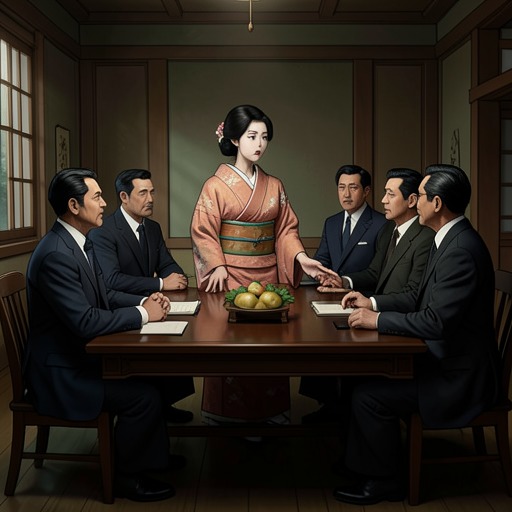
Memoirs of a GeishaSayuri’s return to Gion after five years away begins not with a ceremonial homecoming but with a letter written by the light of burning charcoal. The okiya she comes back to is damaged and neglected, and the people waiting there bear the marks of the intervening years. Only after she and the others restore the house does she prepare to reappear as a geisha, turning her return into a test of whether a life and a community disrupted by war can be resumed.
The Decision to Reopen the Okiya
While living with the Arashino family, Sayuri writes to Mother at night, under the dye vats’ glow. She cannot tell whether the letter persuades Mother to act or whether Mother had already decided to reopen the okiya. A week later, Auntie arrives at the Arashinos’ door carrying coal and food as thanks for their kindness to Sayuri. Her sunken cheeks and gray complexion show the toll of the years, but she remains strong enough to carry the supplies herself.
The next day, Sayuri tearfully bids farewell to the Arashinos and returns to Gion. She, Mother, and Auntie set about making the okiya livable again. The years of neglect are registered in the work itself: dust coats the woodwork, dead rodents remain in the well, and birds have torn the tatami in Mother’s upstairs room to line a nest in the alcove. The house does not simply stand ready to receive its former occupants; they must reclaim it through several days of cleaning and repair.
Mother works alongside them, in part because the household can afford only a cook and one adult maid. A young girl, Etsuko, also helps; she is the daughter of the farmer with whom Mother and Auntie had been living. At nine, Etsuko is the age Sayuri was when she first came to Kyoto. She watches Sayuri with the same fear Sayuri once felt toward Hatsumomo, making the return a sharp reminder that the house’s old hierarchy may be awaiting another child. Sayuri smiles at her, but the resemblance between their positions makes the girl’s presence unsettling.
Reunion with Mameha
Once the okiya is livable, Sayuri begins paying her respects around Gion, starting with Mameha. Mameha has returned to the district a year earlier and now lives in a one-room apartment above a pharmacy near the Gion Shrine. Without a danna to pay for a larger home, she occupies a far more modest space than the one associated with her former standing.
Their reunion makes the passage of time visible on both women. Mameha is startled by Sayuri’s protruding cheekbones; Sayuri, in turn, finds that Mameha’s face retains its beautiful oval shape while her neck has become sinewy and aged. Her teeth had become loose during the war and still hurt, though Sayuri can see no outward difference. The encounter joins affection and recognition to an unvarnished accounting of what the intervening years have done.
They discuss whether Dances of the Old Capital might resume the following spring, since it has not been performed for several years. Mameha answers with a practical suggestion for a theme, “Dance in the Stream.” The exchange points toward a possible cultural revival, but the immediate task of returning to Gion is more personal: Sayuri must find out whether she can once again inhabit the public role she left behind.
Preparing to Appear Again
About a week after her return, Sayuri makes ready for her first appearance as a geisha since the interruption. The preparation is exacting and material: she goes between the hairdresser and fortune-teller, soaks her hands to remove the remaining stains, and searches Gion for makeup. Nearing thirty, she is no longer expected to wear white makeup except on special occasions. Instead, she spends half an hour trying different shades of Western-style face powder to conceal how thin she has become.
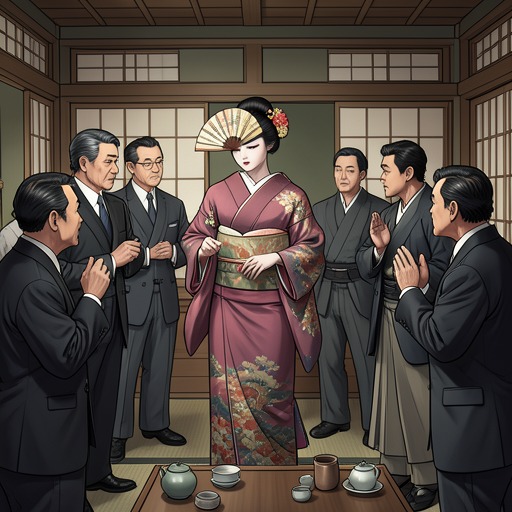
When Mr. Bekku comes to dress her, Etsuko watches. Sayuri recognizes the scene’s echo of her own childhood, when she watched Hatsumomo; now she occupies the transformed figure under the young girl’s gaze. It is Etsuko’s astonishment, more than Sayuri’s view in the mirror, that convinces her she looks like a geisha again. The return is therefore not secured by private memory alone: it becomes legible in the eyes of someone encountering the image for the first time.
That evening, snow blankets Gion, so fine that a slight wind clears it from the roofs. Wrapped in a kimono shawl and carrying a lacquered umbrella, Sayuri feels as unrecognizable as she had on the earlier occasion when she visited Gion dressed like a peasant. She recognizes only about half the geisha she passes. Those who lived in Gion before the war offer a small courtesy bow even when they do not seem to know her; others give no more than a nod. The differing greetings reveal a social landscape divided by memory and by the years in which Sayuri was absent.
Homecoming and Historical Rupture
Sayuri’s return restores her connection to the okiya and gives her the means to appear in Gion again, but it does not restore the world she left. The damaged house, Mother and Auntie’s altered appearances, Mameha’s reduced circumstances, and the unfamiliar faces on the street all make absence tangible. Even the work of preparing for a public appearance has changed: approaching thirty, Sayuri no longer needs white makeup as a routine part of her role, and she uses Western-style powder to hide the effects of hardship.
The episode makes return a double movement: Sayuri resumes the visible identity of a geisha while discovering that neither the community nor the people within it have stood still. Etsuko’s watchful presence carries the strongest echo of the past, repeating Sayuri’s former position before Hatsumomo without making their circumstances identical. The household is reopened, Mameha is found again, and Sayuri steps out into the snowy streets; these are concrete beginnings, not a restoration of the years lost.