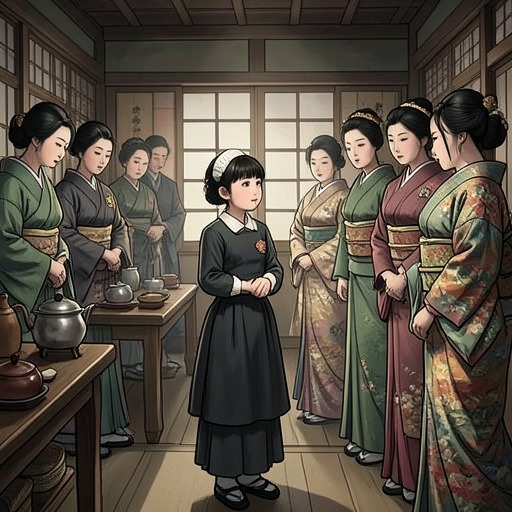
Sayuri’s erikae into a geisha
Memoirs of a GeishaSayuri’s erikae into a geisha occurs in the summer of 1938, when she is eighteen, and turns a visible change of collar into a consequential shift in status and economic value. After years of parties, lessons, and dance performances, she leaves apprenticeship behind; Mother’s delight makes clear that the white collar signifies not only professional recognition but also the prospect of greater income from Sayuri.
The Change of Collar
For two years, Sayuri continued studying and attending parties and outings, taking part in dance performances whenever she could. In the summer of 1938, at eighteen, she made the transition from apprentice to geisha. The change was called “turning the collar”: apprentices wore red collars, while geisha wore white ones.
The collar distinguished the two ranks, but the rest of their appearance reinforced the difference. An apprentice’s elaborate, long-sleeved kimono and dangling obi could make her look like a Japanese doll; a geisha’s clothing was simpler and conveyed a more womanly appearance. Thus the transition altered both the formal marker at the neckline and the overall presentation through which the profession’s stages were recognized.
Work and Public Performance
The promotion followed years of public practice rather than a single debut. At her first banquet, Sayuri introduced herself as a novice and remained beside Mameha like a shadow, pouring sake and chatting only briefly with guests. She had little opportunity to speak beyond her introduction, while Mameha and another geisha performed the dance “Friends Everlasting.” The gap between that novice’s limited role and the standing she later achieved gives the collar change its place within a longer professional trajectory.
Sayuri’s account also presents geisha work as skilled social performance. She observes Mameha answering a guest’s bland remark about the warmth with a succession of responses tailored to the man’s age and manner, turning an awkward exchange into entertainment. Years of parties and study taught Sayuri the setting in which such skills mattered: the geisha’s work involved conversation and performance as well as formal rank.
Mother and the Economics of Status
Mother regarded the day of Sayuri’s transition as one of the happiest of her life. Sayuri later interprets that reaction as financial: unlike an apprentice, a geisha could be available to a man for more than pouring tea, provided the terms were suitable. Because Sayuri had Mameha’s backing and was popular in Gion, Mother saw her new status as an opportunity for income. Her excitement, Sayuri concludes, amounted to excitement about money.
Mother made the consequence explicit when she told Sayuri that, a month later, she would have a danna. Sayuri objected that she was only eighteen; Mother answered that Hatsumomo had not had one until she was twenty, and urged Sayuri to be pleased. The exchange links the white collar to the patronage economy surrounding a geisha’s career, while exposing the distance between Mother’s financial hopes and Sayuri’s youth.
Meaning and Retrospective Perspective
The transition therefore carries two meanings at once. Within Gion, it recognizes Sayuri’s move beyond apprenticeship and the more mature appearance associated with a geisha. Within the Nitta household, it changes how Mother can calculate Sayuri’s earning potential and brings the prospect of a danna close. The same new status that validates years of training also makes Sayuri more valuable to the household that manages her career.
Looking back from New York, Sayuri compares how Westerners misunderstand the word geisha with the way they regard a wealthy man’s kept companion. She identifies herself as having been a kept woman in her own day. That retrospective comparison casts the 1938 change in a sharper light: the white collar marked professional advancement, but it did not free Sayuri from the unequal arrangements through which her work and relationships could be valued.