Sayuri’s expatriate life in New York
Memoirs of a GeishaSayuri’s expatriate life in New York is both a chosen departure from Gion and a hard-won independence from the Nitta okiya. After recognizing that she could not return to work as a geisha, she turned the Chairman’s expanding business presence in the United States into a proposal for a new life: a small teahouse serving Japanese businessmen and politicians. In leaving, she also broke Mother’s hold over her finances and future. New York became not merely a place of exile, but a home whose present could coexist with the remembered world of Gion.
Departure and Independence
Sayuri’s move took shape in conversation with the Chairman, who had told her of plans to open a branch of his company in the United States. She argued that Japanese businessmen and politicians were increasingly traveling to New York and that many were men she had known for years. She also framed the move around the child she expected to have: a mother who raised a child between cultures, she suggested, might sensibly make the United States their permanent home rather than bring the child back to Japan. The Chairman understood the implication: her departure would remove the obstacle to Nishioka Minoru’s adoption as his heir. His startled response, and the tear he quickly blinked away, made plain the personal cost embedded in the plan.
In August of that year, Sayuri moved to New York and opened a small teahouse for Japanese businessmen and politicians traveling through the United States. Mother attempted to make the venture an extension of the Nitta okiya, carrying the okiya’s reach across the ocean. The Chairman refused that arrangement. In Gion, Mother had exercised power over Sayuri; leaving allowed Sayuri to sever those ties. The Chairman sent two accountants to ensure that Mother paid Sayuri every last yen due to her, turning the move into a concrete financial break as well as a geographic one.
Building a New Home
The first time the door of her apartment in the Waldorf Towers closed behind her, Sayuri felt afraid. That fear did not define the new life for long: New York soon came to feel at least as much a home as Gion had. Her modest teahouse, on the second floor of an old club off Fifth Avenue, was successful from the beginning. Geisha from Gion came to work there, and Mameha sometimes visited. The establishment preserved connections to Sayuri’s former world, but on ground she had made for herself rather than under the Nitta household’s control.
As the business became less central to her daily labor, Sayuri developed other routines. She went there herself mainly when close friends or old acquaintances were in town. In the mornings, she often joined Japanese writers and artists from the area to study subjects such as poetry, music, and, in one month-long session, the history of New York City. She usually had lunch with a friend, then prepared for parties in the afternoons at her makeup stand, sometimes in her own apartment. These practices give the expatriate life a shape beyond mere survival or commerce: work, study, friendship, and social performance all have a place in it.
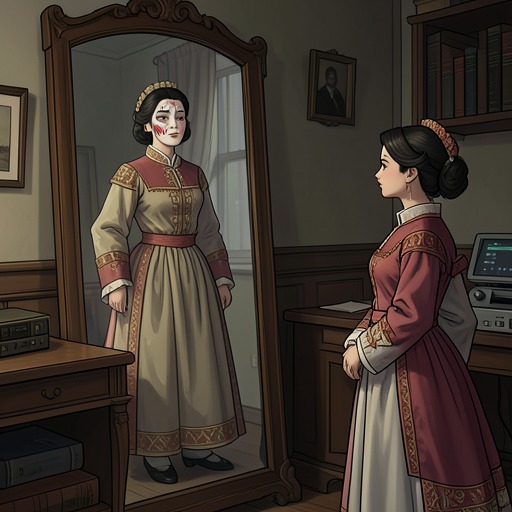
The makeup stand also carried a material memory of Gion. When Sayuri lifted the brocade cover from her mirror, she remembered the milky odor of the white makeup she had so often worn there. The familiar act of preparing for a party persisted, but its setting and meaning had changed. In New York, the ritual belonged to her private apartment and the life she had assembled, rather than simply marking her place within Gion’s professional world.
Gion at a Distance
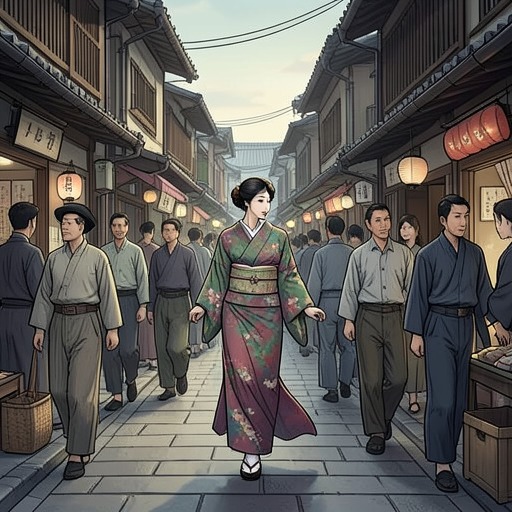
Sayuri wished she could return to Gion for a visit, yet feared that its changes would disturb her. Photographs brought by friends made the district seem thinned out, like a poorly kept garden overrun with weeds. After Mother’s death, the Nitta okiya itself was demolished and replaced by a small concrete building, with a bookshop on the ground floor and two apartments above. The replacement turns a vanished household and workplace into ordinary urban space; the institution that once claimed Sayuri’s earnings and directed her life no longer stands in its old form.
The change was also measurable in the shrinking geisha community. Eight hundred geisha worked in Gion when Sayuri first arrived; by the time she described it from New York, fewer than sixty remained, with only a handful of apprentices. The decline makes her distance more than a personal separation: the world she left was itself disappearing. Her reluctance to revisit Gion therefore holds two truths together. It remains the place of her formative life, but a return would expose the gap between remembered community and altered streets.
Memory, Objects, and Belonging
Sayuri’s New York life does not erase Japan; memory makes the new city a place where earlier relationships continue to be felt. She describes crossing Park Avenue among yellow taxis and women carrying briefcases, conscious that a little old Japanese woman in kimono appears unusual to those around her. But she questions whether Yoroido would seem any less exotic if she returned. The comparison unsettles the idea that belonging depends simply on going back: the once-familiar home, too, has become distant through time and change.
Objects elsewhere in Sayuri’s story show how economic dependence and personal meaning become attached to things. The kimono she sees stored in the okiya represent wealth on a scale that makes Granny fear fire; the collection is worth more than the villages of Yoroido and Senzuru together. A damaged kimono becomes a debt Chiyo must repay through future geisha earnings, including the cost of meals, lessons, and medical care. Later, Mother’s adoption of Sayuri absorbs those debts into the okiya but also claims all of Sayuri’s profits. Against that history, the accountants’ insistence that Mother return every yen due to Sayuri marks a reversal: money is no longer only a mechanism of institutional control but part of the independence secured by departure.
The same material world changes under wartime scarcity. Sayuri’s possessions before leaving the okiya include a silver stereoscopic viewer given by the Kabuki actor Onoe Yoegoro XVII, alongside scrolls, inkstones, and bowls; lavish gifts have become rare, and cosmetics and permanents have been banned as luxuries. In the countryside, she lives with the Arashino family, sewing parachutes by day and sleeping on workshop futons at night; the family burns compressed leaves or newspapers for warmth and eats soybean dregs and rice-bran food as scarcity deepens. After the war, Mother grows rich in the gray market by buying and selling other people’s heirlooms, including kimono Mr. Arashino hopes to recover. These episodes sharpen the contrast with Sayuri’s later New York business: across her life, objects move through systems of debt, scarcity, resale, and ownership, while the right to decide what a life will be becomes the more consequential possession.
Exile, Choice, and the Past
Sayuri’s departure is bound to the story of a life repeatedly redirected by other people’s decisions. As a child, she is taken from her home and placed under obligations she had not imagined: the okiya charges her for her acquisition as well as her upkeep and training. Mother later negotiates over the share of Sayuri’s future earnings promised to Mameha, and, after the mizuage brings in enough to clear the debt, adopts Sayuri so that all profits belong to the okiya. Against this history, leaving for New York is not simply another change of address. It is an action through which Sayuri claims control over her earnings and chooses where to build a future.
At the same time, she does not present that choice as proof that the past can be escaped or made permanent. Looking back, she recalls believing that her life would have been easier if Mr. Tanaka had not taken her from her home in Yoroido. She no longer sees the world as a stable place that could have been preserved by a different turn. Its struggles and triumphs, she concludes, eventually blur like watery ink on paper. New York, like Gion and Yoroido, is subject to change; the new home matters not because it escapes impermanence, but because Sayuri can make a life in it while carrying what came before.