Sayuri’s mizuage
Memoirs of a GeishaSayuri’s mizuage took place in July 1935, when she was fifteen, and became a decisive turning point in her public identity and financial position. A record-setting payment by Dr. Crab brought the ceremony to its formal conclusion, while Mother’s adoption of Sayuri made the okiya the beneficiary not only of the proceeds but of her future earnings. The episode presents a transition framed as custom and ceremony yet governed by adult bargaining and the economic structure of the geisha house.
Bidding and the Price
The contest that secured Sayuri’s mizuage was not the contest Mameha initially described. She told Sayuri that the bidding between Dr. Crab and Nobu had gone as she hoped, and that its high final figure would persuade Mrs. Nitta to adopt her. In fact, the final competition was between Dr. Crab and the Baron. Mameha concealed this, and the narrator later understands that the revelation explains her temporary coldness after she returned to town.
Nobu did participate at first, bidding aggressively until the figure passed ¥8,000, but then withdrew. His withdrawal did not mean that the price had simply exceeded his means: Mameha had believed he could bid against anyone, but had misjudged his interest. Whatever drew Nobu to Sayuri, it was not a desire to acquire her mizuage. His early involvement nevertheless helped shape the impression of a contest that continued after he had left it.
The mistress of the Ichiriki Teahouse manipulated both remaining bidders to push the price higher. Dr. Crab was led to believe that offers coming from Osaka were Nobu’s, though they were actually the Baron’s. The Baron knew he was bidding against Dr. Crab, but became distressed at the thought of losing. When he considered withdrawing, the mistress told him that the other bidder might not go higher, a suggestion designed to provoke another bid; she expected Dr. Crab to top the Baron’s final offer. The bidding thus depended not only on what the men wanted, but on information selectively supplied to make each continue.
Dr. Crab ultimately agreed to pay ¥11,500, then the highest mizuage price recorded in Gion and possibly in any geisha district in Japan. The figure is set against the period’s ordinary costs: an hour of a geisha’s time cost about ¥4, and an extravagant kimono might sell for ¥1,500. The payment was also more than a laborer might earn in a year. Although Sayuri later notes that the record was disputed and eventually surpassed or reassigned in other accounts, at the time the sum was treated as a new record, and it immediately attracted Mother’s attention.
Ceremony and Setting
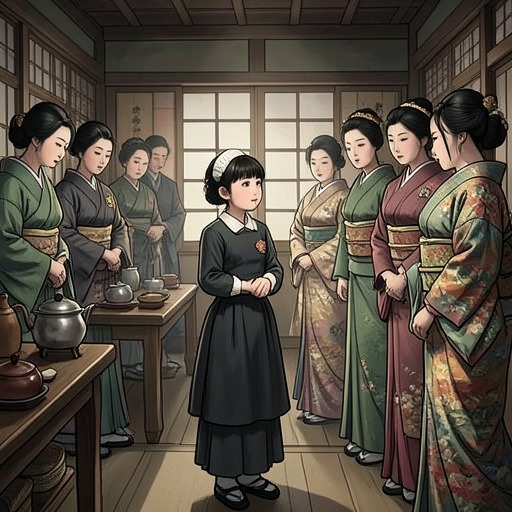
The formal proceedings began at the Ichiriki Teahouse, where Sayuri and Dr. Crab drank sake in a ceremony binding him to her as her mizuage patron for the rest of his life. The presence of Mother, Auntie, Mameha, the mistress of the Ichiriki, and Mr. Bekku made the event an institutional undertaking, not simply a private arrangement between patron and apprentice. Mr. Bekku attended in his role as dresser, representing the geisha’s interests in a ceremony of this kind.
Sayuri wore an apprentice’s most formal costume: a black robe with five crests and a red underrobe, whose color marked new beginnings. Mameha instructed her to maintain a stern demeanor. Nervousness made that performance easy as she walked down the hallway, her kimono train gathered around her feet. Dress, posture, and controlled expression gave the occasion a composed public face even as Sayuri approached a future she did not yet understand.
Afterward, the group went to Kitcho for a solemn dinner. Sayuri spoke little and ate even less, keeping her eyes lowered to appear innocent. Dr. Crab, by contrast, looked to her like a man attending a business meeting. The difference between her enforced role and his apparent detachment sharpened the scene’s underlying imbalance: the ceremony bound them formally, but the participants did not enter it with the same knowledge or emotional stakes.
From the restaurant, Mr. Bekku escorted Sayuri by rickshaw to an inn on the grounds of Nanzen-ji Temple. He had arranged her clothing in an adjoining room earlier that day and helped her change into a less formal kimono. Its obi needed no padding, and he tied it so that it would come undone easily. Her nervousness was so acute that he had to help her back into her room and position her near the door to wait. The careful preparation of clothes and room made the next stage orderly, but could not make Sayuri feel at ease.
The Private Encounter
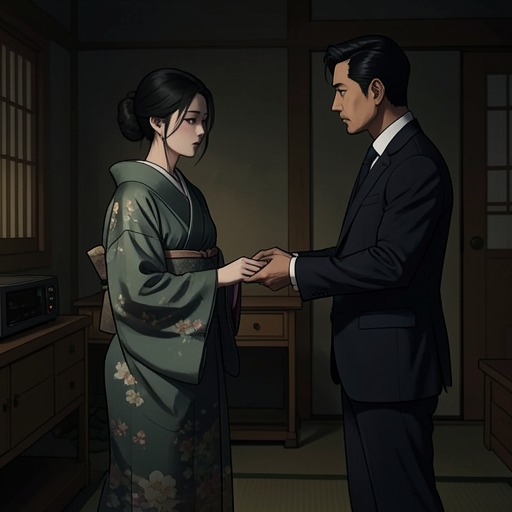
When Dr. Crab arrived, he asked Sayuri to order sake while he bathed. They later sat on a small wooden balcony, drinking and listening to the crickets and the stream below. A maid laid out their futons side by side. These quiet domestic arrangements sit beside the formal ceremony and the large sum paid for the occasion, underscoring how the transaction’s public scale narrowed into a private encounter over which Sayuri had little control.
Dr. Crab explained that the event could involve blood and brought out a wooden case containing many labeled glass vials and medical instruments. The labels identified samples associated with other geisha, including Mameha and Hatsumomo’s friend Korin. His interest in collecting specimens made the encounter feel partly clinical to Sayuri; it also revealed that he had pursued similar samples from women in his professional and social world. The case transformed what might have remained an abstract custom into a display of his established practice.
After the encounter, Dr. Crab took a piece of the bloodied towel and a cotton ball, placing them in a vial bearing Sayuri’s misspelled name. He bowed formally and thanked her, then went to bathe. The procedure ended not with a romantic gesture but with the preservation of a sample and a mark of professional formality. Sayuri later laughed quietly at the disparity between the elaborate bidding, the money spent, and the experience itself, while recognizing that the event had changed the course of her future.
Sayuri stayed at the inn overnight, as Mameha had instructed, in case Dr. Crab awoke and needed something. She tried to remain awake but eventually fell asleep, then made herself presentable before he saw her the next morning. After breakfast she accompanied him to the door. His parting gift proved to be Chinese herbs; Mr. Bekku explained that she should make them into tea once a day to discourage pregnancy. The gift therefore extended the patronage arrangement beyond the ceremony while making its practical consequences explicit.
Adoption and Aftermath
The bidding’s record sum supplied the immediate reason for Mother’s decision to adopt Sayuri. The fee exceeded the debt Sayuri owed the okiya, and adoption changed who controlled the money: had she not become the okiya’s daughter, some of the proceeds would have gone to her. Once adopted, her debts were absorbed by the okiya, but so were all her profits, not just the mizuage payment. The arrangement converted a large one-time sum into a lasting claim on her earnings.
The adoption followed the next week. Sayuri’s given name had already changed; now her family name changed as well. The child once known as Sakamoto Chiyo became Nitta Sayuri. That renaming makes the economic result visible as a change of identity: the ceremony’s consequences reach beyond the patron and the payment, formally relocating her within the household that would profit from her work.
Narrative Significance
The episode’s chronology is recounted retrospectively. The adult Sayuri corrects the account Mameha first gave her, distinguishing the visible story of a contest involving Nobu from the concealed contest between Dr. Crab and the Baron. The delayed disclosure makes the event a lesson in how a geisha’s apparent choices can be shaped by negotiations she cannot see. It also prevents the high price from being mistaken for evidence that Sayuri had secured greater personal freedom.
Public ritual, elaborate dress, and disciplined behavior coexist with bidding, deception, and the transfer of future income. The event changes Sayuri’s legal and household position, pays off her debts only by making her earnings the okiya’s property, and binds Dr. Crab to her as patron. Its decisive turn is therefore double: a new name and a formally recognized place in the household arrive alongside a deeper economic dependence.