Second World War
Memoirs of a GeishaThe Second World War reshapes the material and social world of Gion, first allowing a privileged okiya to remain unusually well supplied and then stripping it of its protection and resources. Through Sayuri’s retrospective account, the war is not a single event but a succession of changes in which political power, scarcity, and displacement alter what people can keep, trade, and remember.
Wartime Privilege and Its Material Signs
During the war’s early years, General Tottori’s influence helped the Nitta okiya retain access to food, tea, linens, cosmetics, and even chocolate after rationing had begun. Its supplies were not simply kept behind closed doors: Mother passed some along to others in Gion, a community Sayuri describes as interdependent, while the okiya’s special protection still placed it among the district’s most favored households. When military police discovered a maid carrying far more ration coupons than her okiya was allowed, they sent her to the Nitta household for safekeeping because General Tottori had instructed them to leave it alone.
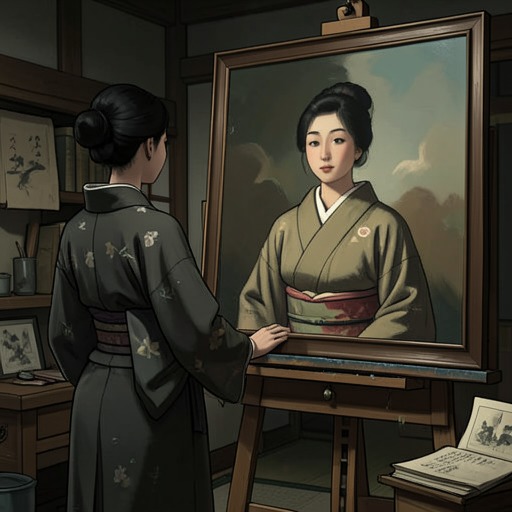
The contrast between the okiya’s wartime security and the broader shortages was also visible in its possessions. Before the crisis deepened, Hatsumomo’s elaborate kimono and the okiya’s crowded storehouse of garments represented accumulated wealth: a single outfit could cost as much as a policeman or shopkeeper earned in a year, and the stored collection was worth more than the villages of Yoroido and Senzuru. Such luxury became increasingly difficult to sustain. The military government banned cosmetics and permanents as luxuries, and lavish gifts grew rare, leaving Sayuri with only a few scrolls, inkstones, bowls, and a silver stereoscopic-photo viewer given to her by the Kabuki actor Onoe Yoegoro XVII.
The Loss of Protection
The Nitta okiya’s favored position ended in December 1942, when a military policeman arrived and questioned Sayuri about the household’s conduct. He listed violations including hoarding cotton, failing to surrender metal and rubber, and misusing ration tickets. Sayuri acknowledges that the okiya had committed these offenses, as had others in Gion, but suggests that its greater good fortune and better survival made it a conspicuous target. Mother returned while the policeman was there and dealt with him privately; soon afterward, the household lost the supplies and goods that other families had already gone without.
The consequences reached beyond food and clothing. The neighborhood association began taking the okiya’s ceramics and scrolls for sale on the gray market, where household possessions were converted into cash. These confiscations punished the household as well as benefiting others, and the association’s head—herself the mistress of a nearby okiya—could only carry out the military police’s orders. The change is marked in Sayuri’s memory as a sudden extinguishing of the small measure of security the household had managed to preserve.
Scarcity, Displacement, and Survival
By about the middle of 1943, the geisha community had begun to fear that the military government would close the geisha districts. The possibility altered the atmosphere of daily life: people no longer felt able to enjoy themselves, and even the bleak humor of Raiha’s remark about the future and past served as a brief release from anxiety. War thus threatened both the community’s immediate livelihood and the existence of its social world.
During the following years, the novel sets survival against any expectation of status or safety. Sayuri learns that Raiha died in the Tokyo firebombing while staying with family, and that Mameha survived by working as a nurse’s assistant in Fukui Prefecture. Pumpkin survived repeated bombings near the lens factory where she worked outside Osaka. The same account records the deaths of Mameha’s maid Ta-tsumi and dresser Mr. Itchoda, while Mr. Bekku and General Tottori survived. These outcomes lead Sayuri to recognize how little security a person’s apparent prominence or comfort could offer during wartime.
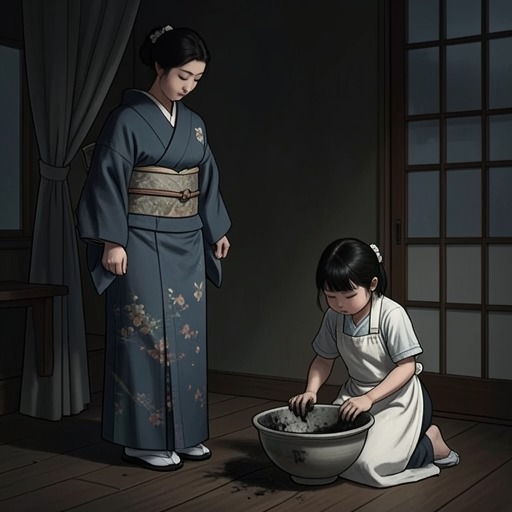
Sayuri herself lives with the Arashino family, sewing parachutes by day and sleeping on workshop futons with their daughter and grandson. With charcoal scarce, the household burns compressed leaves, newspapers, and magazines for warmth; meals include soybean dregs and fried rice bran, with potatoes, whale meat, seal sausage, and sardines appearing only occasionally. When the Arashinos’ grandson cries from hunger, Mr. Arashino sometimes sells another kimono to obtain food. The once-luxurious garment becomes a resource to exchange for immediate survival, while Sayuri’s description of “onion life” captures the repeated loss and hardship of those years.
Memory and the Meaning of the War
The war also changes the meaning of objects that survive it. The small mortuary tablets Mr. Tanaka sends to the okiya preserve what remains of Sayuri’s childhood; much later, after a painful separation, she treats the Chairman’s handkerchief as the keepsake that will represent the rest of her life. These objects connect private losses across different periods, while wartime displacement and scarcity make the preservation of anything precious feel uncertain.
In old age, Sayuri remembers the Chairman reflecting that memories can seem more real than present sights. That recollection places the war within a larger account of how personal lives are shaped by historical upheaval and then reconstructed through memory. The conflict’s consequences continue after the fighting: the former protections and material abundance of the okiya have vanished, and Gion itself later appears to Sayuri as a diminished community. The war is therefore both a period of deprivation and a decisive break between the world in which she was formed and the altered world she remembers.