Shirakawa
Memoirs of a GeishaThe Shirakawa is a stream in Gion that gives the novel one of its most enduring images of movement, memory, and connection. Its waters first accompany Chiyo’s conviction that life is passing her by; later, the same stream frames her meetings with Mameha’s household and, in recollection, the afternoon when the Chairman gave her his handkerchief. It therefore serves not merely as scenery but as a place whose significance changes as Sayuri’s understanding of her past changes.
Setting and Everyday Life in Gion
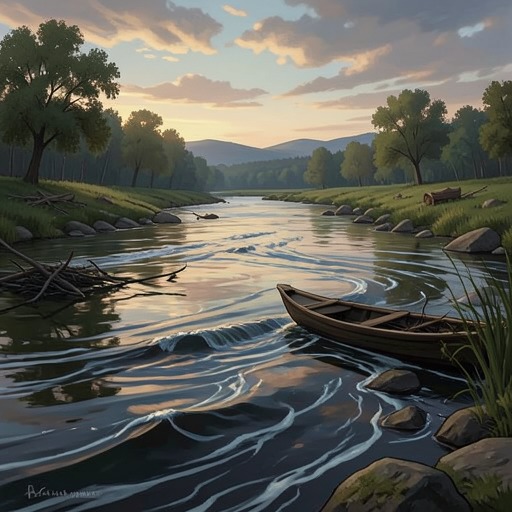
The stream runs through a landscape of bridges, streets, and teahouse districts. Chiyo follows its banks after leaving Shijo Avenue, and later walks beside it toward the arched bridge leading into the Motoyoshi-cho section of Gion. Men and geisha stroll there beneath weeping cherry trees, whose drooping tendrils reach the water. The setting belongs to a busy social world: its paths bring people through the district, while the water continues beneath their movement.
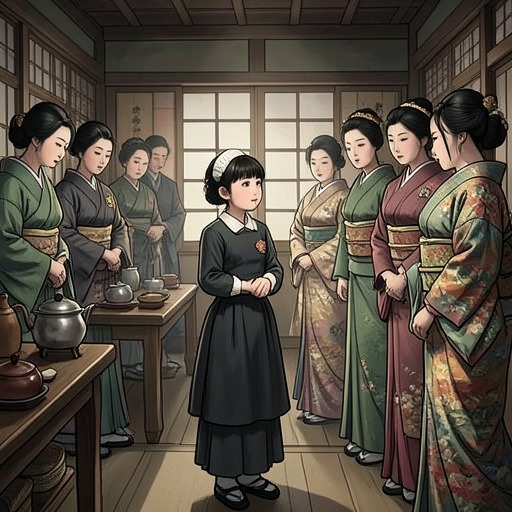
The stream is also part of the soundscape of Mameha’s apartment. While Chiyo waits there, she listens to water pass over a knee-high cascade outside the open window. This detail connects the elegant interior to the public stream beyond it. For a girl accustomed to being treated as a maid, the tea served in the apartment and the sound of water outside mark an unfamiliar interval of being received as a guest, before she knows why she has been summoned.
A Landscape of Despair and Motion
After Hatsumomo tells Chiyo that she will become a geisha while Chiyo never will, Chiyo stands in the school garden watching girls her age stream past. She imagines their lives moving from one purposeful activity to another, while her own future seems to lead only back to scrubbing the courtyard stones. Leaving the garden, she passes the Minamiza Theater, where banners announce the Kabuki play Shibaraku and crowds climb the steps. Geisha in brilliant colors stand out among the theatergoers, intensifying her sense that other people possess full, directed lives from which she has been excluded.
Chiyo turns away from the avenue and follows a side street along the stream. Yet even there, men and geisha hurry on with purpose. The water seems to repeat the same message: it glides toward the Kamo River, then onward toward Osaka Bay and the Inland Sea. Against this image of a current that has somewhere to go, Chiyo feels herself to be an abandoned island without either a past or a future. She throws herself onto a low stone wall beside the stream and weeps. The landscape does not soothe her; its movement sharpens her fear of being left behind.
Her despair is interrupted beside the water when a man speaks to her, remarking that the day is too pretty for such unhappiness. This encounter gives the stream a second, contrasting association. It has been the setting for Chiyo’s isolation, but it is also where an unexpected human voice reaches her at the moment she believes none can.
Meetings, Routes, and Reversals
Later, when Mameha’s maid tells Chiyo to arrange an errand and meet her at three o’clock at the little bridge over the Shirakawa, the stream becomes a threshold between Chiyo’s constrained life in the okiya and a meeting whose purpose she does not know. Chiyo persuades Pumpkin to send her out under the pretext of buying shamisen strings and Kabuki magazines. Walking beside the stream on a warm afternoon, she sees men and geisha admiring the weeping cherry trees. Foreign tourists point at her, and she crouches as if searching the ground to hide her embarrassment.
The maid leads Chiyo over the bridge and along the water to a doorway associated with an earlier frightening incident involving Hatsumomo, Korin, and a kimono. Chiyo expects further trouble. Instead, she is brought into Mameha’s apartment and served tea by one of Mameha’s two maids. The route beside the stream thus leads not to the reprimand Chiyo anticipates but into a new relationship with Mameha and a more refined household. Its familiar path becomes the approach to a turning point she cannot yet recognize.
The Stream in Memory and Recognition
As an adult, Sayuri returns to the stream in telling a story about her childhood. At a gathering, she begins to recount how, as a girl, she went to its banks upset and began to cry. The memory is private in a way the surrounding conversation is not: she hopes the Chairman will recognize its significance, imagining that the story might create a more intimate exchange between them than they have ever had. When he does not appear to be listening, her hope falters. The stream’s remembered scene therefore carries both the possibility of recognition and the pain of not knowing whether the other person shares the memory.
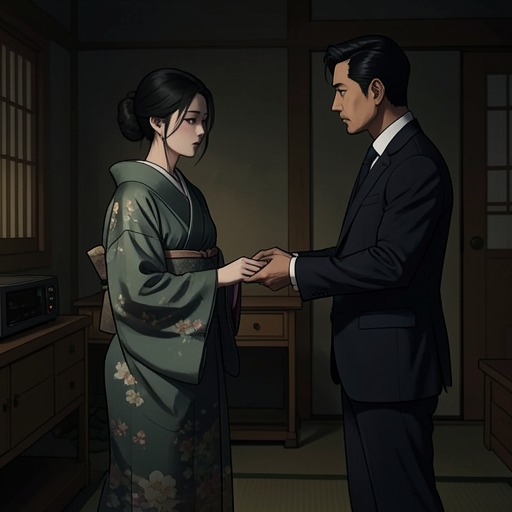
The Chairman eventually supplies the other side of that afternoon. He recalls that, eighteen years earlier, after lunch at the restaurant Tsumiyo with associates and the geisha Izuko, he suggested a walk by the Shirakawa on the way to the theater. As he tells the story, Sayuri lays his old handkerchief on the table and smooths it until his monogram is visible. The linen has yellowed and one corner is stained, but he recognizes it and asks where she got it. Sayuri explains that he gave it to her on that afternoon, on his way to see Shibaraku, along with a coin.
The revelation joins the separate memories to a specific place and gesture. Sayuri had recognized the Chairman when she saw him again at the sumo tournament, though she had wondered whether he remembered the little girl he had comforted. The Shirakawa is where their connection began before either could understand what it would mean; the handkerchief, carried through the years and finally displayed beside the Chairman, turns a childhood encounter into shared knowledge. The stream’s recurring presence binds Chiyo’s despair, the adult Sayuri’s guarded hope, and the Chairman’s recollection into one continuous geography of memory.