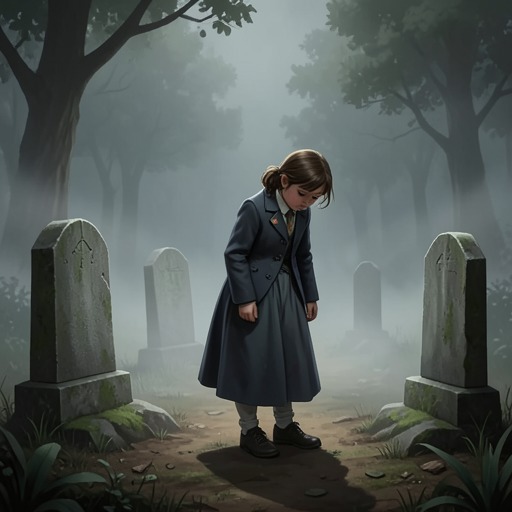
The moth turning to ash
Memoirs of a GeishaThe moth turning to ash is the image through which Sayuri recognizes that the past is irretrievable and that her life, unlike the moth’s seemingly unchanged form, has continued to change. Recalled while she is sweeping the courtyard, the moth returns from a hidden corner beneath the house: first as a small remnant of her earliest days in Kyoto, then as ash at the instant she touches it. Its disappearance makes loss tangible and turns a morning of unsettled feeling into a decision to look forward.
The moth’s burial and return
Only a day or two after being separated from her sister, Sayuri had been sent to wash rags when a moth fell onto her arm. She flicked it away, expecting it to fly, but it landed in the courtyard. Unsure whether it had already been dead or whether she had killed it, she was touched by its death and admired the pattern of its wings. She wrapped it in one of the rags and hid it beneath the foundation of the house.
The moth surfaces again much later, after Sayuri wakes from a peculiar dream and spends the morning turning over a thought she cannot resolve. While sweeping the stepping-stones, she remembers the insect and goes on her knees to look beneath the house. The recovery is not simply a discovery of an old object: it brings her face to face with a remnant from the first week in Kyoto, a time she had not consciously revisited.
When she unwraps the moth’s makeshift funeral shroud, it seems startlingly beautiful and perfectly preserved. Its subdued gray-and-brown coloring recalls the robe Mother wore to mah-jongg games. The detail connects the moth to the household and its remembered past, while its unaltered appearance gives Sayuri a momentary image of a life that has remained untouched by time.
Apparent permanence and sudden change
The contrast between the moth and Sayuri gives the image its force. She thinks of her existence as unstable, like a stream, changing in every way; the moth seems instead like stone, fixed and unchanging. For a brief interval, its preserved form appears to answer her longing for something in her life to have remained as it was during her first week in Kyoto.
That impression ends when she reaches out to feel the moth’s velvety surface. At her fingertip it turns at once into a pile of ash, with no sound and no visible interval of crumbling. The abrupt transformation breaks the apparent stillness that had made the moth seem different from Sayuri. What looked permanent was only an old, fragile remnant; touching it exposes rather than overcomes its transience.
The scene’s movement from preserved beauty to ash also changes the direction of Sayuri’s thought. The morning’s circling uncertainty stops, and she understands that the past is gone. Her parents are dead, and she cannot change that fact; her sister is gone as well. She acknowledges that she too has been, in a sense, dead during the preceding year, but distinguishes her own continued existence from the losses around her: she is not gone.
Turning toward the future
The moth’s disappearance is therefore not a recovery of the past but the moment that makes its absence unmistakable. Sayuri imagines herself turning around: rather than facing backward, she now faces forward. The question that follows is not how to restore what has been lost, but what her future will be. The image concentrates bereavement, separation, and survival into a small physical event without suggesting that these losses can be repaired.
The recollection also completes the morning’s change in perspective. Before remembering the moth, Sayuri can only sense that the world feels different, as though she were looking through the window opened in her dream. After the moth becomes ash, she gives that altered feeling a direction: the past has closed, and the future is the matter before her. The dream’s opened window thus anticipates a change in orientation rather than supplying a detailed prediction of what will happen.
The sign and the image’s significance
Once the question of the future forms in her mind, Sayuri feels certain that she will receive a sign during that day. In the dream, the bearded man had opened a window and told her to watch for the thing that would show itself, because finding it would mean finding her future. The remembered moth and its sudden transformation give this expectation a context: the scene has already moved her from backward-looking grief to forward attention, even though it does not yet specify what the future will bring.
The image works through a precise reversal. The moth first seems to embody permanence because it has kept its shape since Sayuri buried it; a touch reveals that the appearance of preservation cannot make the past live again. Its ash does not erase the importance of the memory. Instead, the brief return of the moth gives Sayuri a way to recognize both the finality of what is gone and the fact that she remains alive to face what comes next.