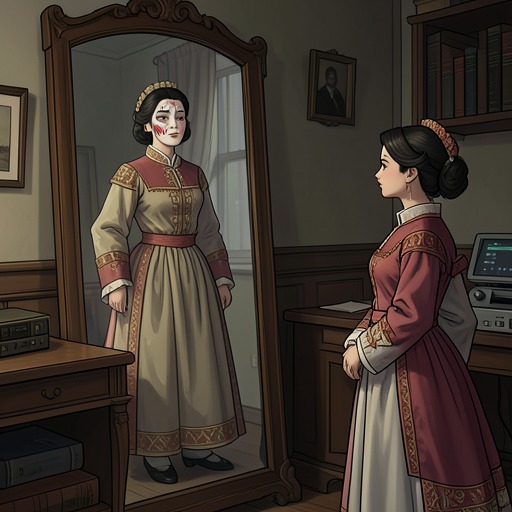
Turning the collar
Memoirs of a GeishaTurning the collar is the visible and professional transition from apprentice to geisha: the apprentice’s red collar gives way to the geisha’s white one. Sayuri made this change at eighteen, in the summer of 1938, after two years of parties, outings, study, and dance performances. The change marks an advance in status, but the novel also reveals its material and economic stakes: Sayuri’s new standing made her more valuable to Mother and opened the possibility of arrangements beyond serving tea.
The Collar and the Change of Status
The distinction is expressed through a small part of the dress, but it signals a larger change in role. An apprentice wears red; an established geisha wears white. The collar’s meaning becomes clear in the contrast between their full attire: the apprentice’s elaborate, long-sleeved kimono and dangling obi suggest a Japanese doll, while the geisha’s simpler appearance seems more womanly. Turning the collar therefore marks both an occupational threshold and a change in how the wearer is presented.
The custom belongs to a world in which clothing requires careful labor as well as carrying information about rank. Auntie sewed a silk collar onto Hatsumomo’s underrobe each day and removed it the next morning for cleaning; because Hatsumomo was already a geisha, her collar was white. Mr. Bekku’s work dressing her included shaping the kimono at the waist and tying the heavy obi with cords, clasps, and padding. Against that elaborate preparation, the red-to-white collar change is a compact, legible sign of a transition embedded in the practices of dress.
Sayuri’s Turning Collar
Sayuri’s transition came after two further years of parties and outings, while she continued her studies and took part in dance performances whenever she could. She became a geisha in the summer of 1938, at eighteen. Her account places the change at the end of sustained preparation, not as an isolated alteration of costume: study, performance, and social appearances had all preceded the new status.
The day was one of the happiest in Mother’s life, or so Mother appeared. Sayuri later understands that reaction in economic terms. As a geisha, unlike an apprentice, she could be available to a man for more than pouring tea, if suitable terms were agreed. Sayuri’s connection with Mameha and her popularity in Gion gave Mother reason to expect income. The apparent family celebration thus carries a sharper meaning: professional advancement for Sayuri also increased the value of her labor to the household that controlled her earnings.
Dress, Wealth, and Wartime Scarcity
The material world surrounding geisha dress underscores how status depended on costly objects and skilled work. A kimono storehouse held lacquered cases, some containing about fifteen robes apiece; the collection was estimated to be worth roughly twice as much as the villages of Yoroido and Senzuru combined. The most expensive garments were stored elsewhere in a rented vault and reserved for apprentice geisha. These details show that clothing was not merely decorative: it represented substantial wealth, was carefully stored, and was allocated according to professional status.
That abundance later gave way to wartime scarcity. When Sayuri moved her belongings across the hall in the okiya, cosmetics and permanents had been banned as luxuries by the military government, and lavish gifts had become rare. She had accumulated only a few scrolls, inkstones, and bowls, along with stereoscopic photographs and a sterling-silver viewer given by Kabuki actor Onoe Yoegoro XVII. During the war, Mother made money in the gray market by buying and selling other people’s heirlooms, including kimono that Mr. Arashino hoped to recover. Set beside the expensive wardrobes associated with geisha rank, these later exchanges expose how vulnerable the material foundations of status were to changing political and economic conditions.
Professional Identity and Social Meaning
The collar’s shift is consequential because it joins visible appearance to a change in what the profession permits and what others can demand from its practitioners. Sayuri’s later reflection on Western assumptions about geisha makes the tension explicit: she recognizes that people may reduce the role to prostitution, and compares her own former position to that of a kept woman. Her account does not treat the white collar as proof of freedom or security. It marks advancement within a system in which professional distinction, male patronage, and household income remain closely connected.