Uchida Kosaburo
Memoirs of a GeishaUchida Kosaburo is a celebrated but eccentric artist whom Mameha brings Sayuri to meet as part of her effort to make the novice geisha visible in Gion. The visit seems at first to fail: Uchida is absorbed in his untidy studio and scarcely looks at Sayuri. Yet, when she stands in the sunset studying the orange light on her hands, he watches her with sudden concentration. He later says that this sight gave him the idea for his famous ink painting of a young woman whose eyes glow, a claim Sayuri remembers but does not quite believe.
Identity and Introduction
Mameha introduces Uchida as a marvelous artist who, she expects, will take a liking to Sayuri’s eyes. She warns that he can become distracted and that his studio is a mess, instructing Sayuri to keep her eyes where he can see them. The strategy is purposeful: Uchida’s artistic attention could help make Sayuri’s unusual eyes part of her public identity, but Mameha knows the encounter will require patience.
The studio itself makes an unusual entrance. Mameha and Sayuri reach it through an alley containing a miniature red Shinto gate, then pass pavilions and climb stone steps through autumn-colored trees. Water swept from the steps sounds to Sayuri like the tide; at the top, Uchida stands in full sunlight, initially seeing the visitors only as shapes beneath the trees. His setting and appearance establish him as a figure at once associated with artistic beauty and domestic disorder.
Temperament and the Studio Visit
Uchida looks disheveled: his gray hair and kimono are in disarray, a large mole sits at the corner of his mouth, and his bushy eyebrows resemble caterpillars. When Mameha teases him about not having a maid to tidy the place, he tells her to leave. She refuses, insisting that a friend would straighten the studio before going. Uchida storms out, kicks aside the broom she has left by a tree, and nearly slips on the wet steps.
Mameha and Sayuri spend the next half hour putting the studio in order. As she predicted, Uchida returns in a better mood, though he is far from cheerful. He chews at the mole in the corner of his mouth and avoids looking directly at either visitor, seeming embarrassed by his earlier behavior. Even once the room is tidier, his attention does not turn to the feature Mameha hopes he will notice. When she directly asks whether Sayuri is pretty and whether he has bothered to look at her, he gives Sayuri only a brief glance. With the afternoon light fading, Mameha and Sayuri rise to leave.
The Sunset and the Painting
Outside, Sayuri pauses to look at the sunset behind the distant hills. Its rust and pink colors make her hands seem to glow orange, an effect she finds more striking than the color of even a magnificent kimono. She raises her hands and gazes at them. Mameha mistakes her invitation to look for a comment about the sunset and turns toward the sky, but Uchida remains motionless in the entryway, combing his fingers through a tuft of gray hair and studying Sayuri instead.
The sudden reversal gives the visit its lasting significance. Uchida had been asked to notice Sayuri’s eyes and had seemed not to notice her at all; the encounter ends with him intent on her at the very moment she is absorbed in the light on her hands. The scene makes artistic attention arrive indirectly, after Mameha’s planned appeal has failed, and through a moment Sayuri herself describes as looking foolish rather than performing for an audience.
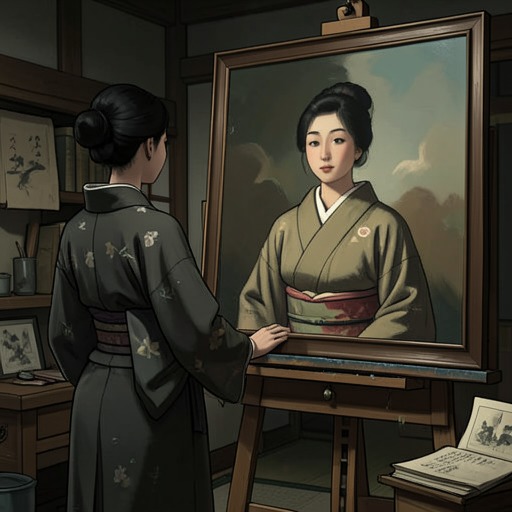
Uchida later insists that what he saw that afternoon inspired his famous ink painting of a young woman in a kimono, standing in a rapturous state with aglow eyes. Sayuri records his explanation but remains skeptical: she cannot imagine such a beautiful painting arising from a girl simply staring at her hands in the sunset. The episode therefore leaves both an origin story for the artwork and a gap between the artist’s interpretation of the moment and Sayuri’s own memory of it.
Narrative Role and Significance
Uchida’s brief appearance belongs to the sequence of encounters that begins to alter Sayuri’s prospects. Looking back, she describes that startling month as a release from the feeling of being as unnoticed in Gion as a drop of tea spilled on a mat. She still does not understand Mameha’s plan or know whether success as a geisha will bring her closer to the Chairman, but Uchida’s attention offers a concrete instance of her becoming visible to someone whose response can shape her image.
The encounter also turns on a contrast between deliberate display and unplanned perception. Mameha tries to direct Uchida’s gaze toward Sayuri’s eyes; the artist responds only when Sayuri, outside the studio and no longer trying to hold his attention, looks at her own hands in the sunset. His later claim converts that accidental instant into artistic inspiration, while Sayuri’s doubt preserves its ambiguity. Uchida thus functions less as a fully developed figure than as the observer through whom the narrative stages the uncertain passage from a private visual moment to a public work of art and a new kind of recognition.