Wartime closure of Japan’s geisha districts
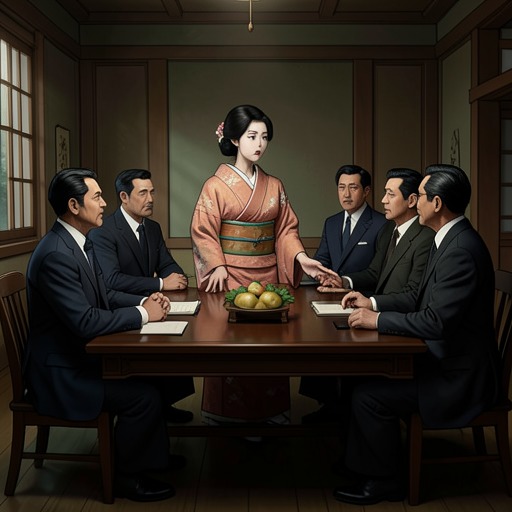
Memoirs of a GeishaThe wartime closure of Japan’s geisha districts is the policy announcement that makes the wartime upheaval of Gion immediate and personal. In a snowy January, a shopkeeper calls out the news to geisha waiting in line for rice: the government has ordered the districts closed, and they must report to a registry office the next morning. For Sayuri and those around her, the announcement means the possible loss not only of their profession but of the network of patrons and protectors on which their survival depends.
Background: Protection in a closing wartime world
Before the closure, General Tottori’s influence had allowed the Nitta okiya to enjoy a measure of protection and access to scarce supplies. Even as rationing tightened, the house received food, tea, linens, and some luxuries; Mother shared some of these goods with others in Gion, a district whose households were bound together by need as well as custom. In fall 1941, a maid caught with far more ration coupons than her okiya was permitted to hold was sent to the Nitta house for safekeeping while arrangements were made to take her to the countryside. The military police left the house alone because General Tottori had instructed them to do so.
That protection did not make the household innocent of wartime restrictions. In December 1942, a military policeman arrived with a list of violations, including hoarding cotton goods, failing to surrender metal and rubber for the war effort, and misuse of ration tickets. Sayuri acknowledges that the okiya had committed these offenses, as had others in Gion; its distinction was that it had enjoyed better fortune and survived longer in better condition. The contrast between the household’s relative abundance and the mounting scarcity around it shows how much its safety rested on unequal access and official favor.
Announcement and immediate stakes
The closing order reaches Sayuri while she is standing in a rice-store line in falling snow, holding her ration coupons. She is dressed in peasant clothes and a heavy shawl; kimono have already disappeared from daytime life. A geisha ahead of her asks whether the war has ended, and the shopkeeper clarifies that it is the geisha districts, not the war, that the government is closing. Everyone must report to the registry office the following morning.
The news leaves the women with a stark question: which of the men they know can save them from factory labor? The scene shifts the crisis from a distant government policy into an immediate contest for refuge. Though General Tottori had been Sayuri’s danna until the previous year, she knows other geisha may also seek his help, so she sets out at once for the Suruya Inn, where he is rumored to be staying. The inn’s mistress does not recognize her, a sign of how far Sayuri has fallen from the public identity and standing she once possessed in Gion.
Sayuri’s search for refuge
Sayuri’s effort to reach General Tottori does not secure her safety. She turns instead to Nobu, whom she has not seen for more than four years and whose anger over their past estrangement remains unresolved. He tells her that he can provide a haven, but insists that she acknowledge how wrong she was in what happened between them. His offer is inseparable from reproach: he believes she wasted years on a man who, in his view, has shirked his obligations to the country and to her.
Sayuri eventually bows low before Nobu. He then explains that the refuge is the home and workshop of his friend Arashino Isamu, a kimono maker whose household lives on the shallows of the Kamo River, about five kilometers upstream from Gion. The family had once made Yuzen-style kimono, but wartime demands had put kimono makers to work sewing parachutes. Nobu arranges for Sayuri to join them and gives her the address. Her survival now depends not on the restoration of her geisha role, but on being taken into a different household and learning a different form of work.
Consequences: A life outside Gion
The Arashino household treats Sayuri kindly, but refuge entails hardship. She works with the family sewing parachutes by day and sleeps on futons on the workshop floor beside their daughter and grandson. With little charcoal, they burn compressed leaves, newspapers, and magazines for warmth. Food is so scarce that they eat soybean dregs normally given to livestock and a fried mixture of rice bran and wheat flour; potatoes, dried whale meat, seal sausage, and sardines appear only occasionally. When the family’s young grandson cries from hunger, Arashino sells one of his kimono to raise money.
The move also places Sayuri’s story within the larger uncertainty of wartime survival. She later learns that geisha Raiha dies in the Tokyo firebombing, while Pumpkin survives repeated attacks on the lens factory outside Osaka; Mameha survives as a nurse’s assistant, but her maid and dresser do not. Sayuri’s own precarious refuge, and the improvised labor that sustains it, are part of a broader pattern in which former status offers no reliable measure of who will live through the war.
Significance and aftermath
The closure exposes the limits of the protection that had sustained Gion. General Tottori’s influence had shielded the Nitta okiya from interference and helped maintain its supplies, but the district’s closure forces Sayuri to seek a new patron and then a new place in the world. The transition is material as well as social: the kimono makers who once produced Yuzen garments sew parachutes instead, while treasured kimono become assets sold to feed a household.
The crisis also reaches beyond the geisha districts. After the war, Nobu gives Sayuri a piece of concrete from the Osaka factory, explaining that two of Iwamura Electric’s four factories have been destroyed and that the company may not survive. Later, he tells her that the Occupation authorities were prepared to rule against the company and seize it until the Minister intervened to reopen its case. These later threats belong to a changed political and economic landscape, but they echo the wartime closure’s central pressure: institutions and livelihoods once treated as stable can be abruptly put at risk, leaving survival dependent on personal ties, improvised labor, and the uncertain favor of those with power.