Wartime closure of the geisha districts
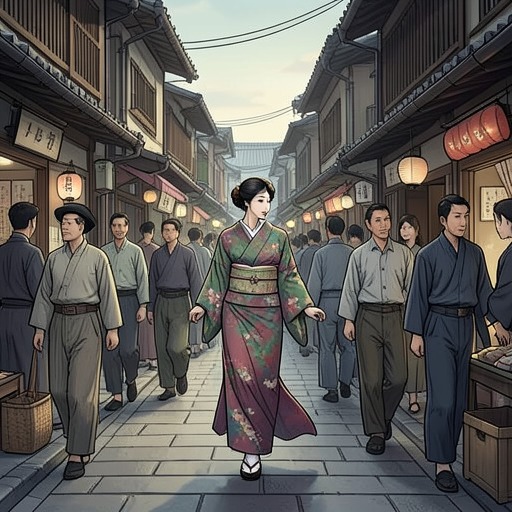
Memoirs of a GeishaThe Wartime closure of the geisha districts is the decisive rupture that ends Sayuri’s relative security in Gion and sends her into years of exile. Announced by a government representative in the snow, the order turns the geisha districts from places of work into places their inhabitants must leave, and reduces the immediate question of survival to whether any familiar man can offer shelter. Its consequences reach beyond the closure itself: the protection that had shielded Sayuri’s okiya disappears, and her return to Gion remains out of reach even after the districts reopen.
Protection Before the Order
For several years, General Tottori’s influence had made Sayuri’s okiya unusually secure amid wartime scarcity. Even after rationing began, it received regular supplies of food, tea, linens, cosmetics, and chocolate. The okiya did not keep everything behind closed doors: Mother passed goods to people who asked for help, partly because Gion’s households were linked by mutual dependence. That informal network, however, operated within a political shelter. When military police discovered a maid carrying far more ration coupons than her okiya was allowed, she was sent to Sayuri’s household to be kept safe while arrangements were made to take her to the countryside. General Tottori had instructed the police to leave the household alone. The protection that made it a refuge for others also placed it among the best-supplied households in the district.
That advantage rested on a precarious arrangement. Sayuri acknowledges that Gion’s okiya hoarded coupons and committed other wartime offenses, including hoarding cotton, withholding metal and rubber from the war effort, and misusing ration tickets. The military police’s later intervention is framed not as the discovery of exceptional wrongdoing but as the consequence of a household that had enjoyed more good fortune, and survived in better condition, than most. The closure thus follows a period in which military favor had softened the effects of state scarcity without removing the okiya from wartime rules.
The Government Announcement
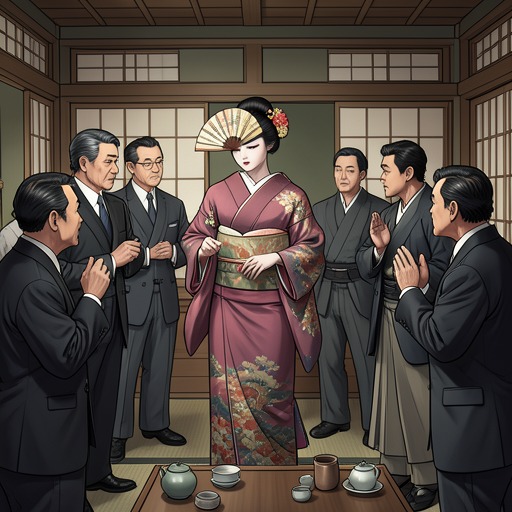
In December 1942, as Sayuri was eating her first meal of the day after helping clean the okiya for New Year, a military policeman arrived looking for Mother. The officer listed the household’s alleged misdeeds; Mother returned, spoke with him privately in the reception room, and served him tea. The scene makes the loss of protection feel gradual before it becomes absolute: a home accustomed to being left alone is now subject to an official investigation, and its safety depends on a conversation whose contents Sayuri does not fully witness.
The closure order comes later, delivered to geisha gathered in the falling snow. They are told that the government has closed the geisha districts and that they must report to a registry office the next morning. The announcement is followed not by explanation but by the sound of a radio inside a shop, a door closing, and the hiss of snow. Around Sayuri, the geisha look at one another in despair. Their first thought is practical and collective: which of the men they know might save them from being sent to work in factories? The order therefore changes not only where they can work but what kinds of dependence appear available to them.
Refuge and Displacement
Sayuri had known General Tottori as her danna until the previous year, but she understands that other geisha may also turn to him. She leaves at once for the northwest of the city, carrying ration coupons in the pocket of her peasant trousers and wearing clothing inadequate for the weather. The General is rumored to be staying at the Suruya Inn, where they had met twice a week for many years. After an hour’s journey through the snow, Sayuri reaches the inn, but its mistress looks at her and says she does not know who she is. The familiar relationship no longer guarantees immediate recognition or refuge.
Nobu, rather than the General, ultimately arranges Sayuri’s escape from the threatened life in Gion by sending her to live and work with the Arashino family. The choice is not presented as one among many easy alternatives. Sayuri emphasizes that a successful young geisha with admirers is not simply a jewel waiting for someone to pick it up; hundreds of geisha are trying to find shelter, and only a few succeed. Living with the Arashino family therefore leaves her increasingly indebted to Nobu. In the snow, as Nobu departs and Sayuri holds the paper with Mr. Arashino’s address, the prospect of losing Gion recalls the earlier experience of being torn from home as a child.
Exile and the Limits of Reopening
The districts reopen within a few months of Japan’s surrender, but that national change does not bring Sayuri home. She remains with the Arashino family until Mother summons her, while Mother and Auntie stay on a small farm west of Kyoto and make a living selling kimono, artwork, and Japanese swords to American soldiers. Sayuri works hard for the Arashinos, including gathering spiderworts for dye and extracting their juice, yet thinks of Gion every night. The contrast between reopening and return makes clear that the end of the wartime closure is not the same as restoration of the life it interrupted: her movement depends on a later summons, not simply on the district doors reopening.
Although Gion is only a few kilometers away, Sayuri visits it just once during nearly five years away. On her way back from collecting medicine for Juntaro at the Kamigyo Prefectural Hospital, she crosses into the district and sees families crowded in poverty along the river. The familiar streets seem to her like a stage after the dance has ended. The Shirakawa Stream, the bench where she and Pumpkin once shared noodles, the alley where Nobu chastened her, and the corner where she made a deliveryman drop lunch boxes remain present as remembered locations, but not as a life she can simply resume.
Historical Consequences
The closure exposes how quickly privilege can become vulnerability when its institutional basis vanishes. Military protection had allowed Sayuri’s household to receive scarce goods and shelter someone fleeing scrutiny; once the geisha districts are shut, that earlier security cannot secure Sayuri’s future. Her refuge rests instead on Nobu’s intervention and on the Arashino family’s willingness to take her in. The order also makes the geisha’s dependence newly visible: with their work prohibited and factory labor looming, their immediate prospects turn on access to private protection.
Wartime pressure continues to shape the story after Sayuri’s exile. When Nobu later gives her a fist-sized piece of concrete from an Osaka factory, he explains that two of the company’s four factories have been destroyed and that the business may not survive. Later, he tells Sayuri that the Occupation authorities had been prepared to seize Iwamura Electric, until the Minister persuaded them to reopen the case. These events are not the closure itself, but they echo its structure: political decisions narrow the lives and choices of people and institutions, while survival depends on relationships and interventions that cannot be assumed in advance. For Sayuri, the shutdown of Gion is therefore both an immediate displacement and the beginning of an exile whose end depends on someone else’s decision.