Water imagery
Memoirs of a GeishaWater imagery is a recurring structure through which Sayuri understands a life shaped by apparent chance, dangerous falls, and attachment that survives separation. Streams and falling water first give her a language for helplessness and rescue; later, a stray drop of sake becomes an emblem of how a life can seem to travel without control yet arrive somewhere that, in retrospect, feels charged with meaning. In Sayuri’s final reflections, water also figures impermanence: struggles and triumphs dissolve into a wash, while memory gives the vanished past a form that can still be told.
Streams, danger, and rescue
The image of water is bound to the moment when the Chairman recognizes Sayuri as a child at Shirakawa Stream. Years later, explaining why he acted as he did, he recalls that she had looked desperate, as if she might drown unless someone saved her. After learning that her arranged encounter with the Minister had been intended for Nobu to witness, the Chairman tells Sayuri that Nobu’s angry response convinced him Nobu could not forgive her and was not her destiny. The stream thus returns not as scenery alone but as a remembered image through which the Chairman interprets Sayuri’s peril and the choice he makes to step toward her.
Sayuri connects that rescue to an earlier childhood scene in Yoroido. A boy named Gisuke climbs too high in a tree above a pond, afraid to descend because of the rocks below; when he loses his grip, his father catches him and sets him upright. Watching the rescue, the children rejoice around the pond. Looking back on the Chairman gathering her into his arms, Sayuri recognizes the same sudden passage from falling toward danger to being caught. The remembered pond and the stream establish a pattern: water marks the edge of peril, while the arrival of another person changes the meaning of the fall.
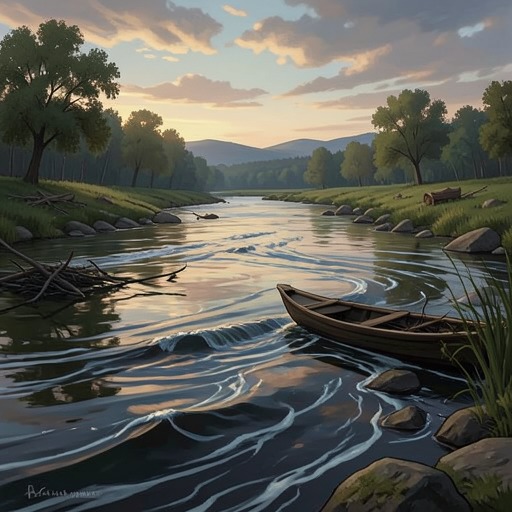
The pattern does not make Sayuri’s life feel entirely chosen. She describes her beginnings—cutting her lip, meeting Mr. Tanaka, her mother’s death, and being sold—as a stream plunging over rocky cliffs before it can reach the ocean. The water carries events forward, but the image stresses the rough descent rather than a deliberate route. In retrospect, the trajectory that once seemed a sequence of injuries becomes part of the story she can recount; the stream supplies continuity without pretending that she controlled its course.
The sake drop and the shape of destiny
At the ceremony when she and the Chairman drink sake together at Ichiriki Teahouse, a single drop spills from the smallest of the three cups. Sayuri wears a black five-crested kimono, its gold-and-red dragon winding up the hem to her thighs. She watches the drop fall through empty space, roll down the silk, and stop at the dragon’s heavy silver teeth. What could be read as a bad omen instead becomes, to her, a miniature account of her life: first exposed to a course she cannot direct, then carried along a path, and finally brought to an arresting place.
The drop’s significance lies in the tension between accident and retrospective meaning. It has no control over its fall, just as Sayuri cannot claim to have commanded the events that carried her away from Yoroido or toward the Chairman. Yet its arrival at the dragon’s teeth lets her see a shape in what had seemed mere drift. The image does not prove that every turn was destined; it shows how, at the ceremony, Sayuri reads her past as a route whose significance becomes visible only after the journey.
That reading reaches back to the petals she threw into the shallows of the Kamo River outside Mr. Arashino’s workshop, imagining that they might find their way to the Chairman. The petals and the sake drop are small things released into water, each joining distance to hope. When the drop comes to rest on the dragon, she feels that perhaps the petals had somehow reached their intended destination. The later image does not erase the childishness or uncertainty of the hope; it gives that earlier gesture a place within the life she has lived.
Water, attachment, and loss
The river imagery also helps Sayuri distinguish the life she expected from the life she received. She had imagined that becoming the Chairman’s mistress would make her life perfect, but becoming his danna’s companion brings an unforeseen cost: to keep her out of Nobu’s sight, the Chairman wants her to leave Gion. Sayuri recognizes that losing Nobu means losing not only his friendship but also her place in the district. The water images cannot make that consequence benign. Instead, their recurring movement holds together the hope of arrival and the fact that every course carries losses that cannot simply be undone.
Years later, Sayuri describes her attraction to the Chairman as a fall governed by a force she cannot resist, like a stone falling toward the earth. The image extends the water-shaped account of her life without making the two metaphors identical: the stream suggests a journey through obstacles, while the falling stone conveys the felt inevitability of her attachment. Her claim that she has him still in the richness of memory turns the image away from physical possession. The Chairman is gone, but telling the story allows his presence, and the earlier stages of her life, to remain available in recollection.
Impermanence and the work of memory
At the end of her account, Sayuri sets her New York surroundings against the imagined return to Yoroido. Yellow taxicabs sweep across Park Avenue, and women carrying briefcases look perplexed at the sight of an elderly Japanese woman in kimono. Yet she asks whether Yoroido would really seem less exotic if she went back. What once appeared to be the stable home she was torn from has itself become distant; neither place stands outside change.
The ocean wave and watery ink give this recognition its final form. The world, Sayuri concludes, is no more permanent than a wave rising on the ocean: suffering and triumph alike soon bleed into a wash, like ink spreading across paper. This does not make the events unreal or interchangeable. The water image describes their impermanence, while the act of narration preserves their distinctness long enough to be witnessed. Sayuri’s remembered streams, pond, river petals, falling drop, and final ocean wave therefore chart not a simple progress from hardship to fulfillment but a changing understanding of how chance, desire, loss, and memory move through one life.